←Back to blog
Revenue Intelligence & Data ToolingGuideAugust 29, 20268 min read
6Sense Alternatives: What B2B Revenue Teams Should Actually Compare
The best 6sense alternative depends on which job you are replacing. Demandbase and ZoomInfo compete on full-suite account-based marketing. Bombora and G2 Buyer Intent sell raw intent signal. RB2B, Warmly, and Dealfront handle visitor identification. Clay handles orchestration. Most teams buy the suite when one layer plus working routing would have done the job.
The best 6sense alternative depends on which job you are replacing. Demandbase and ZoomInfo compete on full-suite account-based marketing. Bombora and G2 Buyer Intent sell raw intent signal. RB2B, Warmly, and Dealfront handle visitor identification. Clay handles orchestration. Most teams buy the suite when one layer plus working routing would have done the job.
Key takeaways
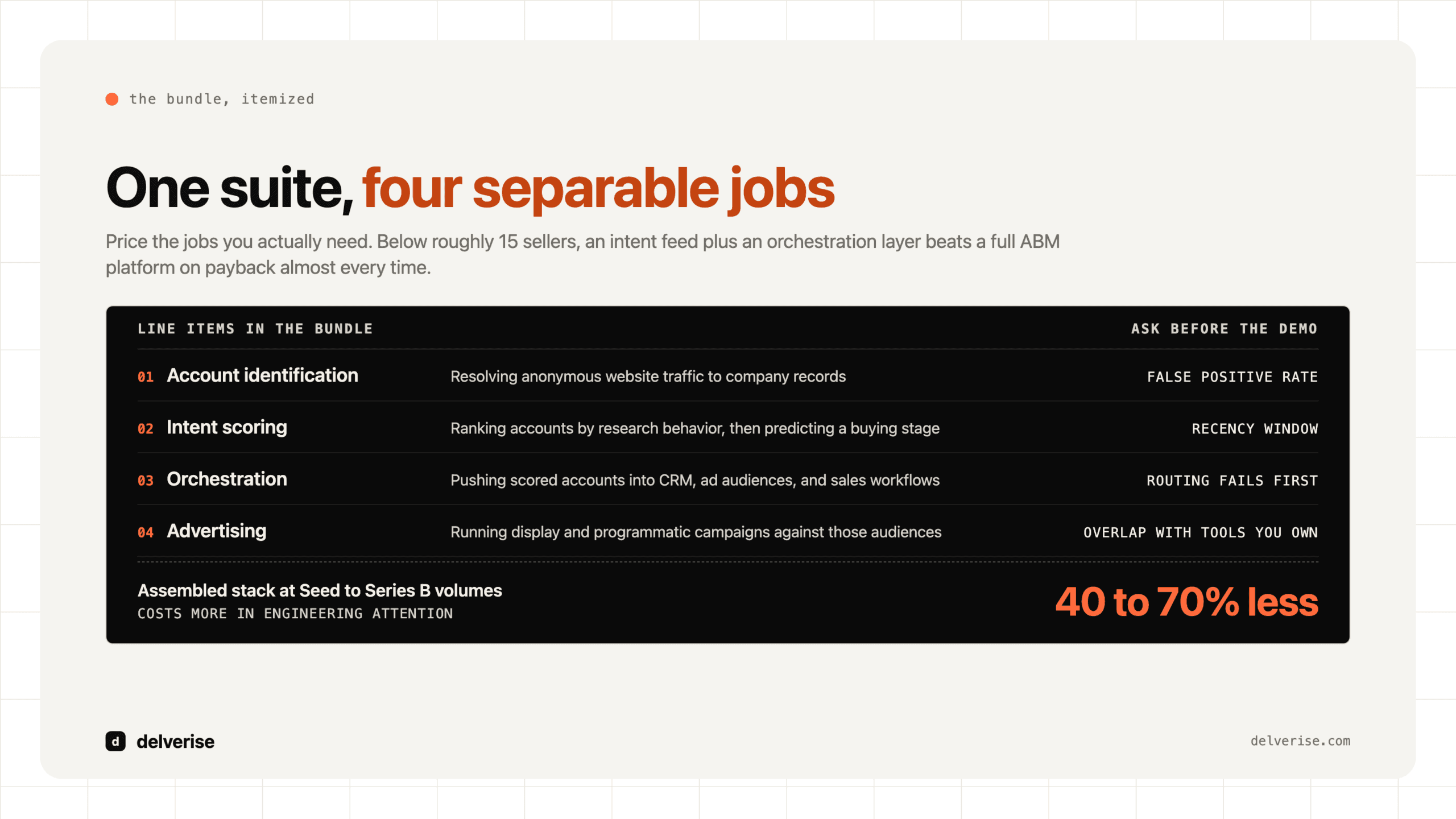
- 6sense bundles four separable jobs: account identification, intent scoring, orchestration, and advertising. Price the jobs you actually need.
- Signal quality rarely fails first. Routing fails first. A platform that surfaces 400 in-market accounts to a two-rep team produces the same pipeline as no platform at all.
- Assembled stacks usually cost 40 to 70 percent less than a suite at Seed to Series B volumes, and they cost more in engineering attention.
- Ask every vendor for the false-positive rate on account identification and the recency window on intent topics before you look at a demo.
- Below roughly 15 sellers, an intent feed plus an orchestration layer beats a full ABM platform on payback almost every time.
What does 6sense actually do that you would need to replace?
6sense is a revenue AI platform built around account-based marketing, meaning marketing and sales programs aimed at a named list of target accounts rather than at individual inbound leads. It does four distinct things that vendors tend to sell as one thing:

- Account identification. Resolving anonymous website traffic and third-party activity to company records.
- Intent scoring. Ranking accounts by research behavior across a publisher network, then predicting a buying stage.
- Orchestration. Pushing scored accounts into CRM, ad audiences, and sales workflows.
- Advertising. Running display and programmatic campaigns against those audiences.
The reason this category exists is well documented. Gartner’s B2B buying research found that a typical complex purchase involves six to ten decision makers, each arriving with four or five pieces of information they gathered on their own. Gartner also found buyers spend roughly 17 percent of their total purchase time meeting with potential suppliers. Most of the buying journey happens where your reps cannot see it, and intent platforms sell visibility into that gap.
The gap is real. The question worth asking is how much of the bundle you need to buy to close it. We covered the same tension in why batch outreach cannot see buying timing.
Why do revenue teams start looking for 6sense alternatives?
Four reasons come up repeatedly in evaluations.

Cost against team size. Enterprise ABM platforms are priced for organizations with a marketing operations function and a dozen or more sellers. A Series A team with three AEs cannot absorb an annual commitment in that band and still fund demand generation.
Signal exceeds capacity. Intent platforms are good at producing lists. If your team can work 60 accounts a month with real personalization, a platform surfacing 500 in-market accounts creates a triage problem. McKinsey’s B2B Pulse research found buyers now move across ten or more channels in a single decision journey, which means the follow-up burden per surfaced account is heavier than it was five years ago.
Overlap with tools you own. Many teams already pay for contact data, a sequencer, and a CRM with scoring. A suite replaces part of that and duplicates the rest.
Attribution opacity. Predictive stage models are hard to audit. When a model says an account moved from Awareness to Consideration, most buyers cannot trace which inputs drove it, which makes the number difficult to defend in a board meeting.
What are the strongest 6sense alternatives by job to be done?
| Alternative | Job it replaces | Best fit | Honest tradeoff | Cost posture |
|---|---|---|---|---|
| Demandbase | Full ABM suite plus advertising | Enterprise teams that want the same bundle with different data lineage | Same commitment profile and same implementation burden | Enterprise annual |
| ZoomInfo (Copilot / Marketing OS) | Contact data plus intent plus workflow | Sales-led motions that need contact coverage more than ad targeting | Intent depth is thinner than a dedicated ABM platform; contract terms are firm | Enterprise annual |
| Bombora | Third-party intent signal only | Teams with a working CRM and a scoring model that need a clean feed | Provides topics, not orchestration; you build the routing | Mid-market |
| G2 Buyer Intent | Category-level in-market signal | Products with an established G2 category and review volume | Coverage limited to G2 activity; useless if your category is nascent | Mid-market |
| RB2B / Warmly | Website visitor identification | Teams with meaningful traffic and fast follow-up capacity | Person-level resolution is US-centric and varies by traffic mix | Low entry, free tiers exist |
| Dealfront / Factors.ai | Company-level visitor ID and ad analytics | European targeting and GDPR-sensitive motions | Company level rather than person level; smaller signal surface | Low to mid |
| Common Room | Signal capture across product, community, and social | PLG and community-driven motions | Weak substitute if you have no product usage or community footprint | Mid-market |
| Clay | Enrichment, scoring, and orchestration | Teams assembling their own stack around bought signal | Requires an owner; it is a build surface, not a turnkey platform | Usage-based |
Clay deserves a specific note because it sits in a different position from the rest. It ingests intent from providers like Bombora or G2, runs waterfall enrichment across multiple data vendors, applies your own scoring logic, and writes the result into CRM or a sequencer. Teams evaluating that approach can start with Clay directly. It replaces the orchestration half of 6sense and none of the intent-network half, so it works as a component rather than a swap.
Suite or assembled stack: how should you decide?
The honest dividing line is operational ownership. A suite sells you a vendor-managed system with one contract and one support channel. An assembled stack gives you cheaper components, better vendor-switching optionality, and a maintenance job that somebody has to own. If nobody on your team owns that job, the assembled stack degrades within two quarters and you end up paying for tools nobody trusts.

Use these thresholds:
- Under 10 sellers, no marketing ops function. Buy signal and routing separately. Skip the suite.
- 10 to 25 sellers, one ops owner. Assembled stack, with the ops owner accountable for scoring accuracy and CRM hygiene.
- 25-plus sellers, multi-product, ad budget above roughly $500K. A suite starts to earn its price, largely on the advertising and audience sync side.
Whichever side you land on, the underlying data problem stays the same. We wrote about the failure modes in what revenue teams actually need from lead gen data and how the layers fit together in the GTM tech stack guide.
What does a replacement stack look like in practice?
Here is an illustrative build for a Series A B2B SaaS company at roughly $6M ARR with four AEs and two SDRs. Treat the figures as planning ranges to test against live quotes, since list pricing in this category is rarely public.
- Third-party intent: Bombora topic feed or G2 Buyer Intent, scoped to 8 to 12 topics that map to real purchase triggers. Roughly $15K to $30K a year.
- Visitor identification: RB2B or Warmly on high-intent pages only, meaning pricing, comparison, and integration pages. $3K to $15K a year.
- Enrichment and orchestration: Clay for waterfall enrichment, account scoring, and CRM writeback. $6K to $20K a year depending on credit volume.
- Activation: your existing sequencer and CRM. No new spend.
Total lands in the $25K to $65K band against a suite commitment that typically starts well above it. The savings are real, and they come with a condition: someone has to define what a qualified signal is, write the scoring rules, and maintain the routing when a field name changes in Salesforce. That work is the actual deliverable, and it is what GTM engineering covers. If Clay is the orchestration layer you pick, our Clay implementation page shows how we build it.
What should you verify before signing anything?
- Ask for the false-positive rate on account identification, tested against a sample of your own known traffic
- Confirm the recency window on intent topics: weekly refresh behaves very differently from monthly
- Get coverage numbers for your specific geography, not global averages
- Run a 30-day pilot where the only success metric is meetings booked from surfaced accounts
- Map how scored accounts reach a rep, including the exact CRM field and the alert path
- Calculate cost per worked account at your real rep capacity, not at platform capacity
- Check contract length, auto-renewal terms, and whether credits roll over
That last routing item is where most evaluations go wrong. G2 category data consistently shows implementation and ease of use scoring below feature depth across this category, which is a polite way of saying teams buy signal and then fail to act on it. Before you compare vendors, write down what happens in the 20 minutes after an account crosses your threshold. If you cannot answer that, no platform on this list will help.
Frequently Asked Questions
Is there a free 6sense alternative?
For visitor identification, yes. RB2B and Factors.ai both offer free tiers that identify a capped number of monthly visitors, which is enough to test whether your traffic converts into workable accounts. Third-party intent networks like Bombora have no meaningful free option, since the data comes from a paid publisher co-op. Free tiers are useful for validating demand and poor as permanent infrastructure.
How much does 6sense cost compared to alternatives?
6sense does not publish list pricing, and quotes vary widely by seat count, ad spend, and contract length. In practice, enterprise ABM suites sit in a materially higher band than component stacks built from an intent feed plus an orchestration layer. Get quotes from both sides and compare on cost per worked account rather than on platform sticker price.
Can I replace 6sense with ZoomInfo?
Partially. ZoomInfo covers contact data and workflow well and includes intent, but its intent depth and advertising capability differ from a dedicated ABM suite. It works as a swap for sales-led teams where contact coverage matters more than audience targeting. It works poorly as a swap if your motion depends on programmatic display against account audiences.
Does intent data actually work for small B2B SaaS companies?
It works when your category has enough search and review volume to generate signal, and when your team has the capacity to act within days. Below roughly 500 target accounts, intent tends to be noisy relative to a well-built list. Companies in emerging categories usually get more from tight account selection and account research than from a topic feed. Our guide to B2B prospecting covers that alternative path.
What is the fastest way to test an alternative before committing?
Run a single-quarter pilot on one segment. Pick 200 target accounts, layer one intent source and one visitor identification tool, route everything to two reps with a defined follow-up play, and measure meetings booked. Ninety days gives you enough volume to see whether the signal changes rep behavior. If meeting rates on surfaced accounts do not beat your baseline list, the problem sits in routing or messaging, and buying a larger platform will not fix it.
Read next