←Back to blog
Revenue Intelligence & Data ToolingGuideJuly 12, 20267 min read
AI Cold Caller: What Revenue Leaders Should Know Before Putting Voice AI on the Phones
An AI cold caller is software that uses conversational voice AI to place outbound sales calls, qualify prospects, and book meetings without a human dialing. It handles list dialing, natural speech, objection handling, and CRM logging in real time. For B2B teams it performs best on high-volume, lower-complexity work like lead qualification and speed-to-lead follow-up.
An AI cold caller is software that uses conversational voice AI to place outbound sales calls, qualify prospects, and book meetings without a human dialing. It handles list dialing, natural speech, objection handling, and CRM logging in real time. For B2B teams it performs best on high-volume, lower-complexity work like lead qualification and speed-to-lead follow-up.
Key takeaways
- An AI cold caller automates the dial, the opening pitch, basic qualification, and meeting booking, then writes the result back to your CRM.
- It earns its keep on volume tasks: inbound speed-to-lead, list re-engagement, and top-of-funnel qualification, where consistency matters more than nuance.
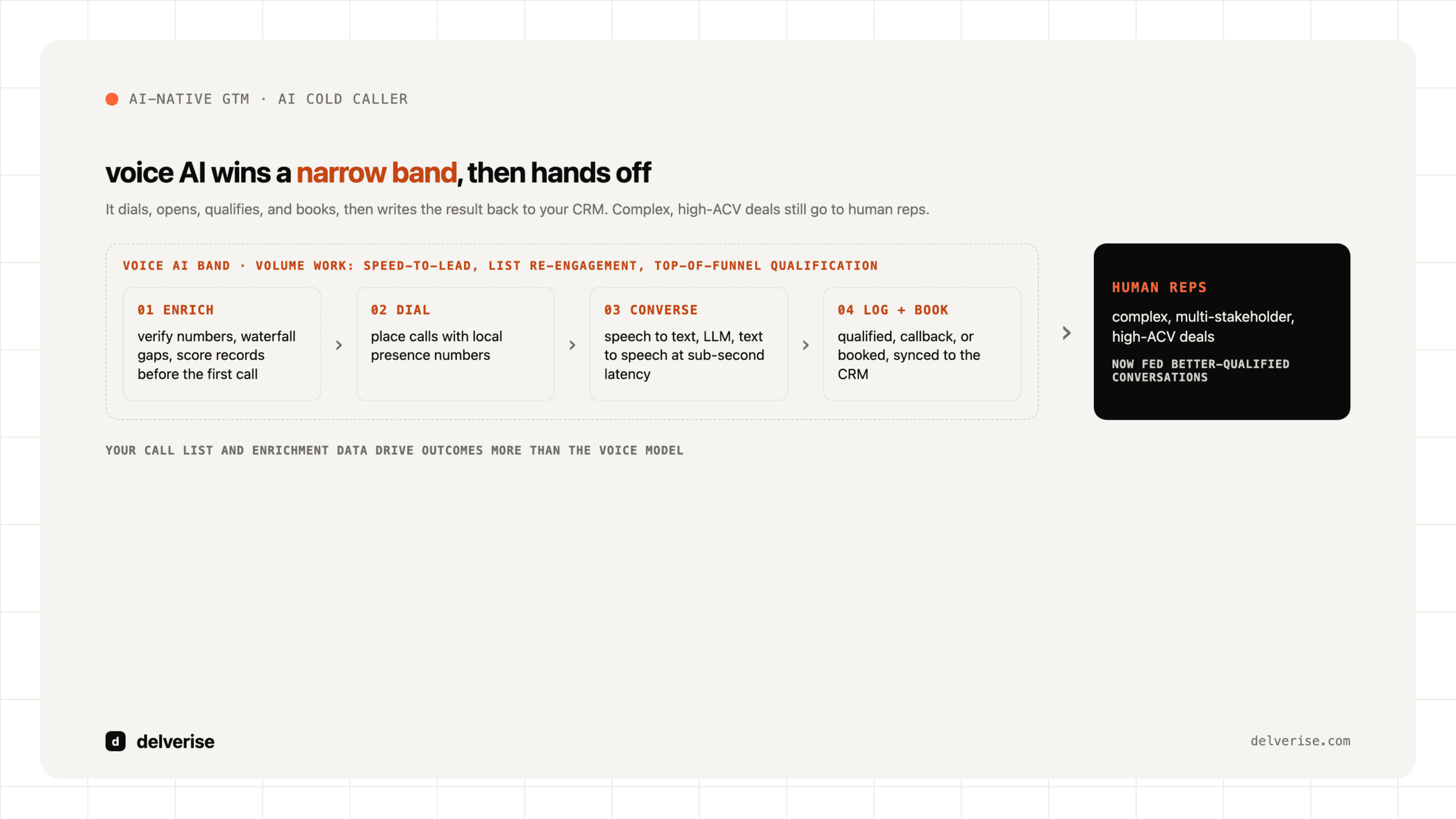
- Complex, multi-stakeholder, high-ACV deals still need human sellers. Voice AI feeds those reps better-qualified conversations.
- The quality of your call list and enrichment data drives outcomes more than the voice model itself.
- Compliance, brand voice, and data hygiene are where most deployments fail, so treat this as a system, not a plug-in.
What is an AI cold caller?
An AI cold caller (sometimes called an AI voice agent or AI SDR) is a system that combines three things: a text-to-speech and speech-to-text engine, a large language model that decides what to say next, and a dialer connected to your contact list. When it reaches a prospect, it speaks in a natural voice, listens, responds to questions and objections, and follows a goal you set, usually qualifying the person or booking a meeting on a rep’s calendar.
The distinction from an old-school robodialer is real. A robodialer plays a recording. An AI cold caller holds a two-way conversation, adapts to what the prospect says, and logs structured outcomes. Most tools also branch: if a prospect asks about pricing, it can answer from a knowledge base; if they ask for a callback, it schedules one.
How does an AI cold caller actually work?
The workflow is more plumbing than magic. A typical deployment runs like this:

- A target list is pulled from your CRM or a data source, then enriched with phone numbers, job titles, and firmographics.
- The dialer places calls, often with local presence numbers, and the voice model runs a script you have defined as a goal plus guardrails.
- Speech-to-text transcribes the prospect in real time, the LLM decides the next line, and text-to-speech responds with sub-second latency so the conversation feels live.
- Outcomes get logged: qualified, not interested, callback requested, wrong number, voicemail. Booked meetings sync to a calendar and the CRM record updates automatically.
That first step, enrichment, is where results are won or lost. A voice agent calling stale numbers with wrong titles will burn through a list and produce nothing. This is why teams pair voice AI with a data layer. Tools like Clay can verify phone numbers, waterfall through multiple providers to fill gaps, and score records before a single call goes out. If you want to see how that enrichment sequencing works in practice, our guide on Clay waterfall enrichment covers the same logic that applies to phone data.
Do AI cold callers actually work for B2B?
They work in a narrower band than the marketing suggests, and that band is genuinely useful. The strongest case is speed-to-lead. Research published in Harvard Business Review on the short life of online sales leads found that firms contacting a web lead within an hour were far more likely to qualify it than those who waited even a few hours. An AI cold caller answers in seconds, every time, at 2am on a Saturday. No human team matches that coverage.

The second strong case is reach. Gartner’s research on B2B buying has repeatedly shown that buyers spend only a small share of their time, roughly 17%, actually meeting with suppliers, and that time gets split across every vendor in the deal. Getting on the calendar at all is a numbers game at the top of the funnel, and a voice agent can work a large list without fatigue.
Where they struggle is complexity. McKinsey’s work on B2B buying behavior shows buyers now move across roughly ten channels in a single purchase and expect consistency across all of them. A voice agent handling a $120k platform deal with five stakeholders will hit its ceiling fast. For those motions, the honest use of AI is to qualify and route, then hand a warm, well-briefed conversation to a human. Our view on where automation helps and where it hurts is expanded in AI lead generation automation.
AI cold caller vs human SDR: what does the comparison look like?
Both have a place. The table below reflects typical B2B SaaS conditions rather than best-case vendor claims.

| Dimension | AI cold caller | Human SDR |
|---|---|---|
| Call volume per day | Hundreds to thousands | 40 to 80 connects |
| Cost structure | Per-minute or per-seat, no ramp | Salary plus ramp, benefits, management |
| Availability | 24/7, instant response | Business hours, one time zone |
| Complex objection handling | Limited to scripted branches | Strong, reads nuance and emotion |
| Multi-threading a deal | Weak | Strong |
| Consistency of pitch | Perfect, every call | Varies by rep and day |
| Best fit | Speed-to-lead, list re-engagement, qualification | Discovery, complex deals, relationship building |
A practical model many teams land on: the AI cold caller works the top of the list and the after-hours inbound, then books qualified conversations for SDRs who focus their energy on discovery and multi-threading. That is a reallocation of human time toward the work that needs judgment. For a broader look at the tooling around this layer, see our roundup of sales engagement platforms for startups.
A concrete worked example
Say you generate 800 inbound trial signups a month and 3,000 outbound-sourced contacts. Two SDRs can realistically call a fraction of that with real quality. You point an AI cold caller at two jobs: instant callback on every trial signup, and a first-touch qualification pass on the outbound list.
The agent reaches the signups within minutes, confirms fit against three qualifying questions, and books 6 to 9% of connected calls into demos. On the cold list, connect rates are lower, but the agent surfaces the 4 to 5% who are in-market and routes them to a human with a full transcript. Your SDRs now spend their day on pre-qualified conversations instead of dialing. The economics work when your data is clean and your qualifying logic is tight, which loops back to lead quality. If your scoring is fuzzy, read how to rank pipeline by real buying intent before you automate the calls.
How do you deploy an AI cold caller without hurting your brand?
This is the part that separates a system that compounds from one that quietly damages your reputation. A few principles hold up across deployments:
- Verify phone data and consent status before dialing, and honor DNC lists and regional calling laws (TCPA in the US, plus disclosure rules where required).
- Have the agent disclose it is an AI assistant when asked, and design for graceful human handoff on request.
- Write tight qualifying logic and guardrails so the model cannot promise pricing, terms, or claims you have not approved.
- Start on a low-stakes segment (aged leads, re-engagement) before you put voice AI on your best inbound.
- Instrument everything: connect rate, qualified rate, booked rate, and show-up rate, then review transcripts weekly.
The strategic point is that an AI cold caller sits inside a revenue system, dependent on enrichment upstream and CRM routing downstream. Getting the voice right is the easy 20%. Getting the data, compliance, routing, and measurement right is the 80% that decides whether it produces pipeline or noise. This is the kind of build we do as GTM engineering work, and if Clay is part of your data layer, our Clay implementation page shows how we wire enrichment into outbound calling. For the broader motion, our AI outbound approach frames where voice fits alongside email and LinkedIn.
Frequently Asked Questions
Is an AI cold caller legal for B2B outbound?
In most cases yes, provided you follow the same rules that govern human cold calling: honor do-not-call registries, respect TCPA and any state-level consent requirements in the US, disclose the AI nature of the call when asked, and comply with recording-consent laws in two-party states. Legal counsel should review your specific setup before you scale.
Will prospects hang up as soon as they realize it is AI?
Some will, and that is fine for a qualification motion where you are filtering for fit. Modern voice models sound natural enough that many prospects complete a short qualifying conversation, especially on inbound callbacks they were expecting. Honesty about what the tool is tends to preserve trust better than trying to disguise it.
How much does an AI cold caller cost compared to an SDR?
Pricing is usually per-minute or per-seat and runs a fraction of a loaded SDR salary at volume, with no ramp period. The real cost is upstream: clean phone data, enrichment credits, and the engineering time to wire qualification logic and CRM routing correctly. Budget for the system, not just the software seat.
Can an AI cold caller replace my SDR team?
For high-value, multi-stakeholder deals, no. Voice AI handles volume, speed, and first-pass qualification well, then hands warm conversations to reps who do discovery and build relationships. Most teams use it to reallocate SDR time toward the work that needs human judgment rather than to cut headcount outright.
What matters most for making it work?
Data quality. A great voice model calling a bad list produces nothing. Verified phone numbers, accurate titles, and tight qualifying criteria drive results more than the voice itself. Pair the caller with a strong enrichment layer and clear lead scoring, and review transcripts every week to refine the script.
Read next