←Back to blog
Revenue Intelligence & Data ToolingGuideSeptember 10, 20268 min read
AI Email Lead Generation Business: How B2B SaaS Teams Build One That Actually Produces Pipeline
An AI email lead generation business uses software to do the research, list building, and personalization that once required headcount: finding accounts that match a buying pattern, verifying contact data, drafting relevant messages, and sending on infrastructure that reaches the inbox. AI compresses research time. Humans still own targeting, offer, and follow-up.
An AI email lead generation business uses software to do the research, list building, and personalization that once required headcount: finding accounts that match a buying pattern, verifying contact data, drafting relevant messages, and sending on infrastructure that reaches the inbox. AI compresses research time. Humans still own targeting, offer, and follow-up.
Key takeaways
- AI removes the research and assembly cost of outbound email. It has no opinion about who should be on the list, and that decision drives most of the result.
- Deliverability is the silent kill switch. Domain setup, volume pacing, and list hygiene decide whether any of the messaging gets read.
- Contact data decays continuously, so an AI email system is a maintenance commitment rather than a one-time build.
- The honest unit of measurement is cost per qualified meeting and pipeline created, tracked in the CRM, not open rates.
- Most teams get more return from fixing targeting and routing than from adding another AI writing tool.
What is an AI email lead generation business, exactly?
Two things go by this name, and they behave very differently.
The first is a company that sells AI-assisted email outreach as a service to other companies. The second, and the one most revenue leaders actually care about, is an internal capability: your own team running an email-first acquisition motion where AI handles account research, contact discovery, enrichment, message drafting, and reply triage.
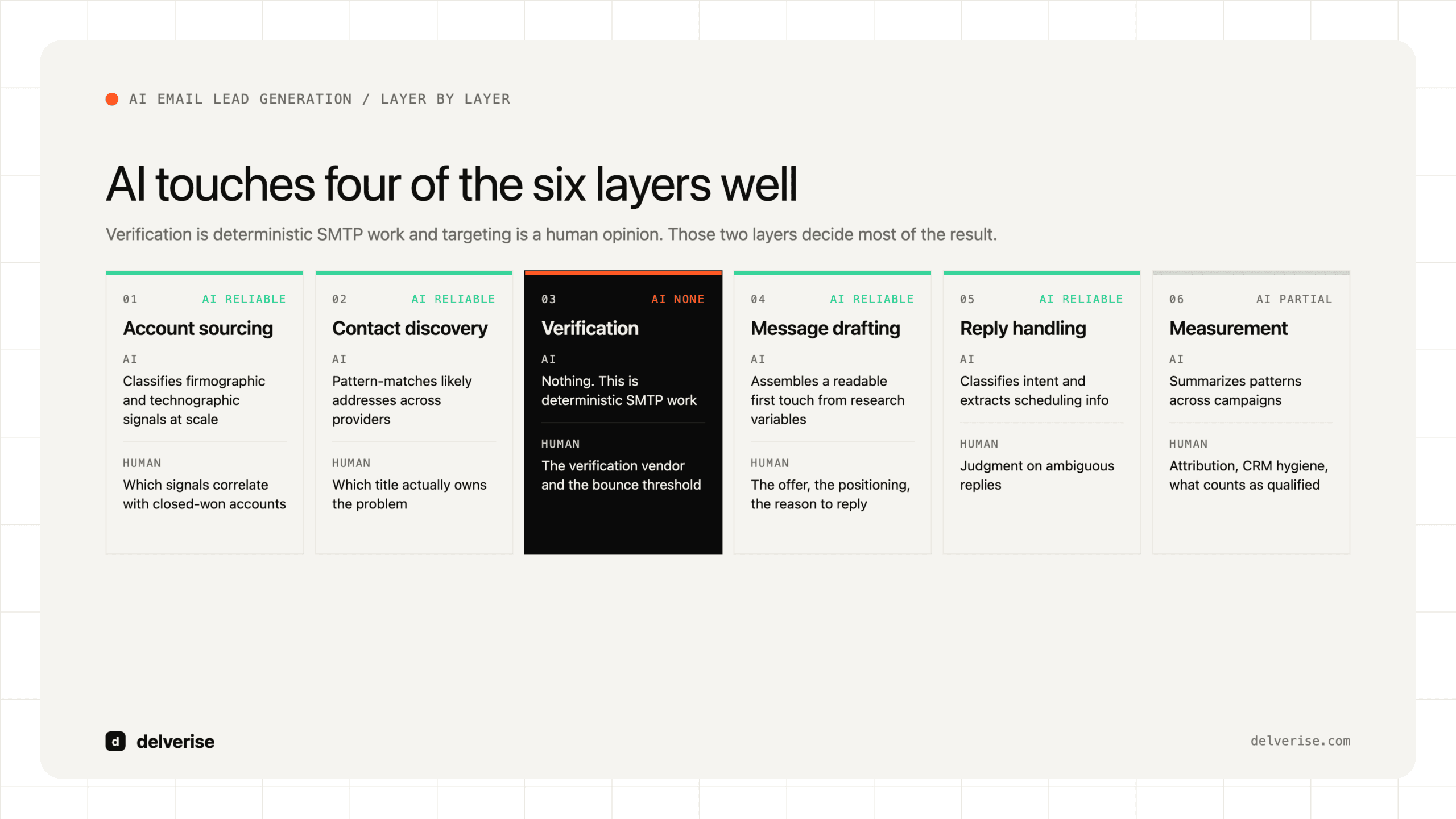
In both cases the machinery is the same. A source of accounts, a way to find and verify the humans inside them, a signal layer that explains why this account is worth an email today, a message generator, sending infrastructure, and a CRM that records what happened. AI touches four of those six components well. It touches the other two barely at all.
What does AI actually automate in an email pipeline?
AI is genuinely good at reading unstructured information and turning it into a structured field. Job postings, funding announcements, review site profiles, technology footprints, and product pages all become usable variables. That is the real unlock in this category, and it is why a two-person team can now run research work that used to take a research pod.

Here is where each layer stands today.
| Layer | What AI does reliably | What still needs a human |
|---|---|---|
| Account sourcing | Scrapes and classifies firmographic and technographic signals at scale | Defining which signals correlate with your closed-won accounts |
| Contact discovery | Finds and pattern-matches likely addresses across providers | Deciding which title actually owns the problem you solve |
| Verification | Nothing. This is deterministic SMTP work, not inference | Choosing a verification vendor and a bounce threshold |
| Message drafting | Assembles a relevant, readable first touch from research variables | The offer, the positioning, and the reason to reply |
| Reply handling | Classifies intent, extracts scheduling info, drafts responses | Judgment on ambiguous replies and anything near a deal |
| Measurement | Summarizes patterns across campaigns | Attribution model, CRM hygiene, and what counts as qualified |
If you want the deeper version of that verification distinction, we broke it down in how AI email finders actually work, and the buying side in how revenue leaders should buy contact data.
Why do most AI email programs stall?
Three failure modes account for nearly all of them.

The list is wrong. AI will happily personalize 5,000 emails to people who have no budget, no pain, and no authority. Gartner’s research on B2B buying found that buyers spend only about 17 percent of their purchase journey meeting with potential suppliers, and that time is split across every vendor in the consideration set. You are competing for a very small window, so the account selection carries more weight than the copy.
The infrastructure was treated as an afterthought. Sending domains, SPF, DKIM, DMARC, warmup, per-inbox volume caps, and list hygiene determine whether messages land in the primary inbox. Teams that skip this spend months optimizing subject lines while their mail is filtered before a human sees it.
Nothing catches the reply. The classic Lead Response Management study published in Harvard Business Review found that companies contacting a prospect within an hour were dramatically more likely to qualify that lead than those waiting even a few hours. AI can generate demand faster than a slow routing process can absorb it, and the surplus quietly expires.
There is a fourth, slower failure: data decay. B2B contact records go stale continuously as people change roles, and industry estimates commonly put the rate at a few percent per month. A list built once and reused for a year is mostly fiction by the end of it.
What does the economics look like in practice?
Concrete numbers make the decision easier. Take a B2B SaaS company with a $30,000 average contract value and a functioning email motion.

- 2,000 verified contacts reached per month across a small pool of sending domains
- 2.5 percent positive reply rate, which is a realistic target for a well-researched list: 50 positive replies
- 40 percent of those convert to a held meeting: 20 meetings
- 30 percent become qualified opportunities: 6 opportunities
- 25 percent close: 1.5 deals, or roughly $45,000 in new ARR per month
Now the cost side. Data providers, enrichment credits, sending infrastructure, and a sequencer typically run $1,500 to $3,000 per month at that volume. Add the human who owns targeting, replies, and iteration. Cost per held meeting lands somewhere between $150 and $400 fully loaded, which compares favorably to a single outbound SDR carrying salary, ramp, and management overhead.
Change one input and the model collapses. Drop the positive reply rate to 0.5 percent because the list was bought rather than built, and you get 10 positive replies, 4 meetings, and roughly one opportunity per month. Same tooling cost, same effort, a fifth of the output. That sensitivity is the whole argument for spending your energy on targeting.
How do you build the system without over-buying tools?
Build in the order that fixes constraints, starting with the one that is actually binding.
- Write down the closed-won pattern: firmographics, trigger events, and the title that felt pain first in your last 20 wins
- Stand up sending infrastructure on separate domains with authentication configured and a conservative per-inbox daily cap
- Build one list of 300 to 500 accounts that match the pattern, with verified contacts and a bounce rate under 2 percent
- Add one research variable per contact that a human would find genuinely relevant, then write a message that would still make sense without it
- Route every positive reply to a named owner with an SLA measured in minutes
- Instrument the CRM so meetings, opportunities, and pipeline trace back to campaign and segment
- Run four weeks, then compare segments on meetings booked rather than on open rate
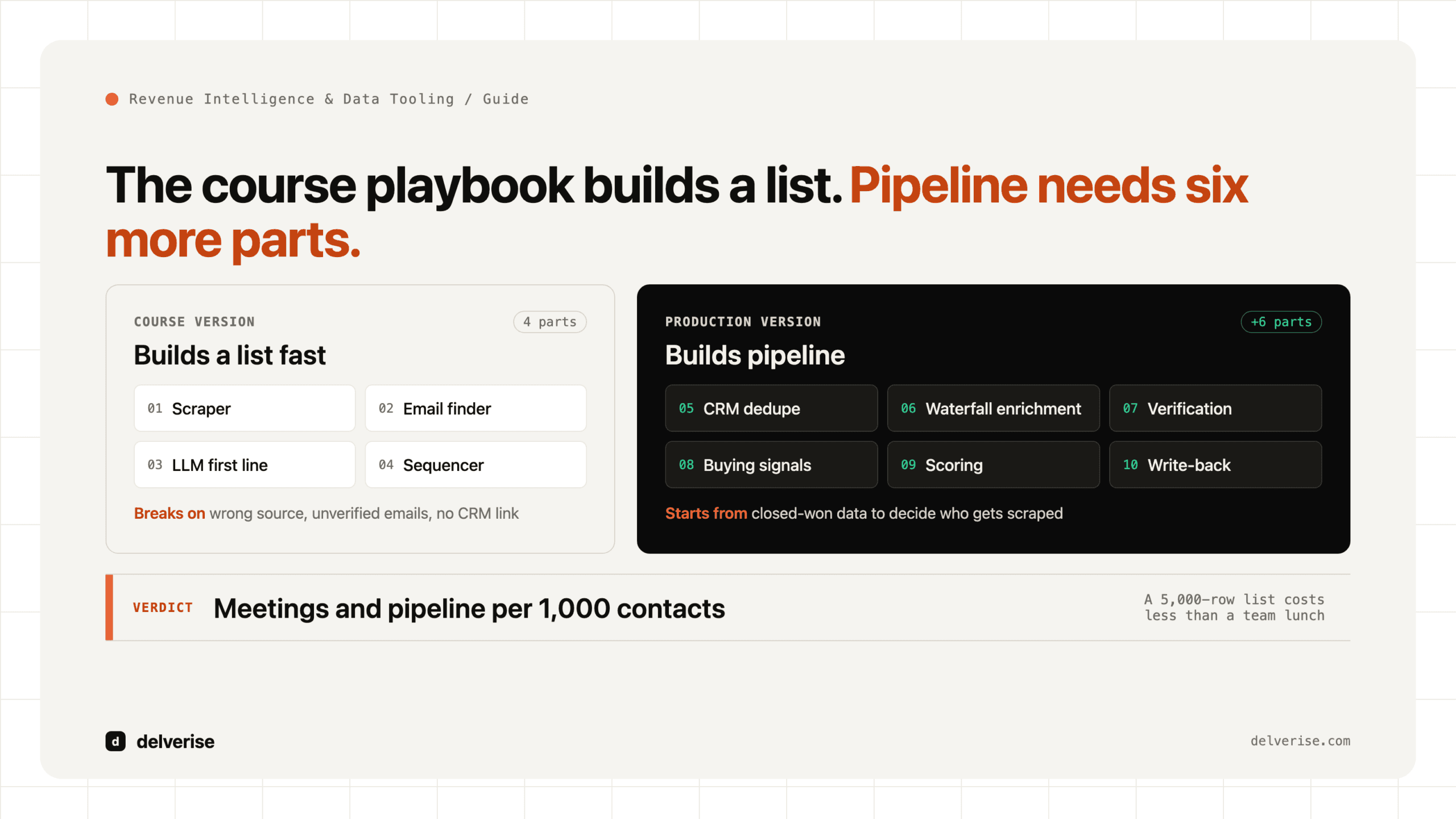
For the research and enrichment layer, Clay has become the practical default for teams that want to combine multiple data providers, run AI research agents against each account, and waterfall between vendors so you pay for the cheapest source that returns a valid answer. It rewards teams with a clear definition of a good account and punishes teams without one, since it will faithfully enrich a bad list. delverise is a Clay First 100 Solutions Partner and builds these systems on it regularly; the Clay implementation page covers what that involves.
Alternatives exist and are worth honest comparison. Apollo bundles data and sequencing in one place at lower cost with less flexibility. Native enrichment inside HubSpot or Salesforce covers basic firmographics without a separate build. Custom pipelines in n8n or Python give total control and cost engineering time forever. The right choice depends on how much of your differentiation lives in the research step.
When should you build this in-house versus have it built?
Build in-house when you have someone who owns the system as their primary job, not as a side project on top of a quota. The failure pattern is a talented rep who builds a good v1, gets pulled into a quarter-end scramble, and leaves a decaying pipeline behind.
Bring in outside help when the constraint is time to a working system rather than headcount. A well-built email engine touches data contracts, deliverability, enrichment logic, CRM schema, and reporting, and each of those has its own failure modes. Getting it standing in six weeks instead of six months is usually worth more than the build cost. The tradeoff analysis is laid out in building GTM capability in-house versus bringing it in, and the broader system context in AI-assisted outbound.
One caution regardless of path: an email engine amplifies whatever positioning you already have. Companies with a fuzzy value proposition get fuzzy replies at higher volume. Fix the message with 50 manual emails before you automate 5,000.
Frequently Asked Questions
Is AI-generated cold email still effective in 2026?
Yes, with a caveat. Generic AI copy has trained buyers to recognize and ignore a certain register of message, so the advantage has moved from writing speed to research depth. Emails that reference something specific and verifiable about the account still get replies. Emails that reference a scraped LinkedIn headline do not.
How many emails per day can I safely send from one inbox?
Most teams settle between 20 and 50 per inbox per day on properly warmed domains, and scale volume by adding inboxes rather than raising per-inbox limits. Higher volumes are possible with strong engagement rates and clean lists, though the risk profile changes quickly and domain reputation takes weeks to repair.
What reply rate should I expect?
A tightly targeted list with real research typically produces 2 to 5 percent positive reply rates. Broad list purchases with light personalization usually land under 1 percent. Judge campaigns on meetings booked and pipeline created, since reply rate alone can be inflated by messages that generate curiosity without intent.
Do I need a dedicated tool, or can my CRM handle this?
CRM-native sequencing works fine at low volume and simple targeting. Once you need waterfall enrichment, per-account research, and deliverability controls across multiple domains, a dedicated stack pays for itself. Our comparison of AI lead generation tools walks through where each category fits.
How long before this produces pipeline?
Plan on two weeks for infrastructure and warmup, two to three weeks for list build and first sends, and another four to six weeks before opportunity data is meaningful. Teams that judge the system at week three almost always kill it during the normal warmup period.
Read next