←Back to blog
Growth & Demand GenerationGuideNovember 28, 20269 min read
B2B SaaS Lead Gen: How Revenue Leaders Build a System That Produces Pipeline
B2B SaaS lead gen is the repeatable system a software company uses to find, attract, and qualify buyers who fit its ideal customer profile, then convert them into sales pipeline. It combines outbound, inbound, and product signals with clean data, routing, and measurement, so a revenue leader can predict how many qualified opportunities each dollar and hour will produce.
B2B SaaS lead gen is the repeatable system a software company uses to find, attract, and qualify buyers who fit its ideal customer profile, then convert them into sales pipeline. It combines outbound, inbound, and product signals with clean data, routing, and measurement, so a revenue leader can predict how many qualified opportunities each dollar and hour will produce.
Key takeaways
- Lead gen works as a connected system: targeting, data, channels, qualification, routing, and measurement. A weakness in any one piece caps the output of all the others.
- Start from your revenue number and work backward to the pipeline you need. That math tells you which channels you can afford and how much volume each one must carry.
- Seed and Series A companies usually get the fastest signal from targeted outbound. Inbound and SEO compound later and need patience to pay off.
- Most pipeline leaks happen after the lead arrives: slow follow-up, bad routing, and no agreed definition of a qualified lead.
- Measure pipeline created and win rate by source. Lead volume on its own is a vanity metric.
What does B2B SaaS lead gen actually include?
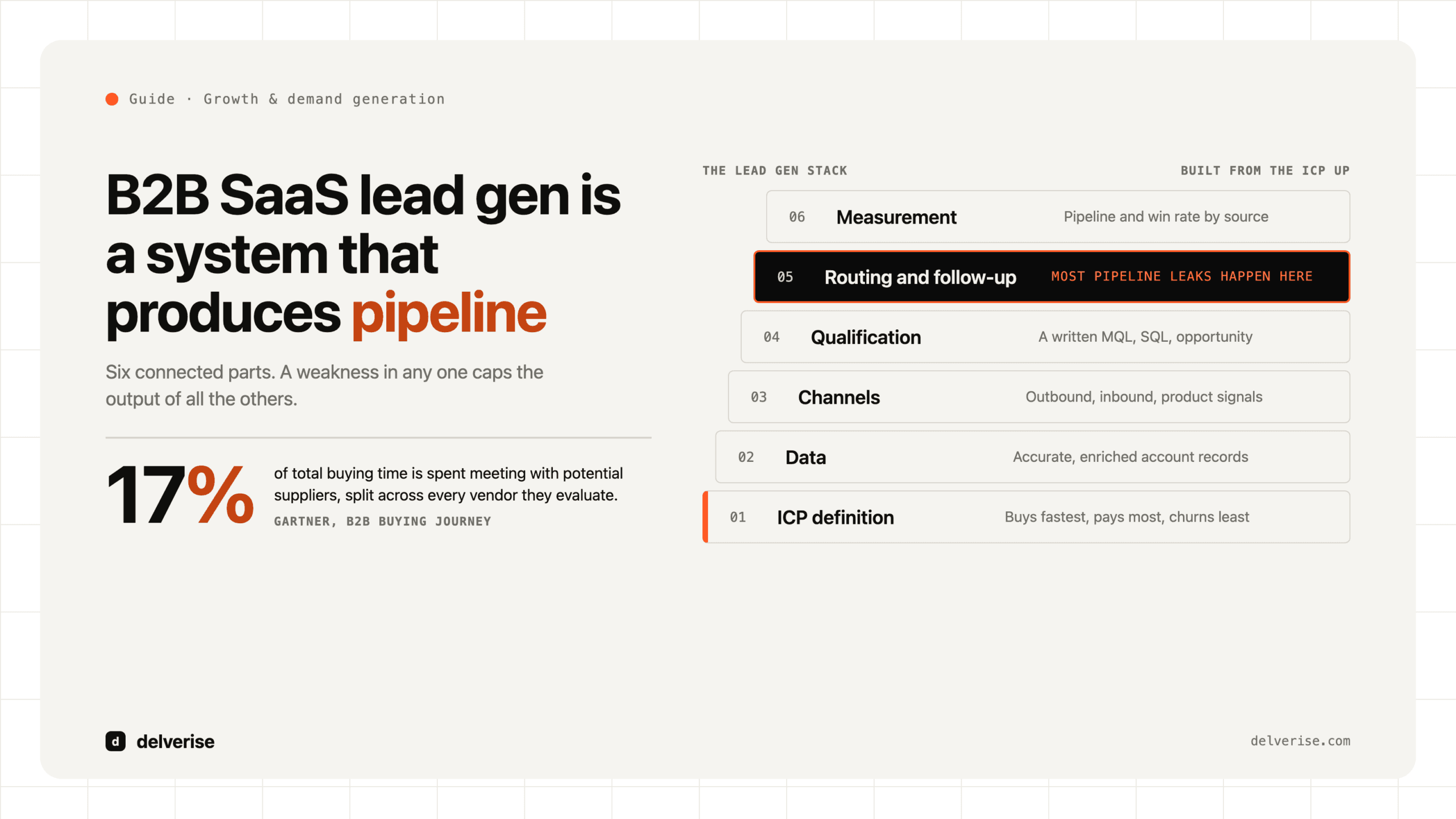
Lead gen is often treated as a marketing activity: run some ads, publish some content, buy a list. In a B2B SaaS company that owns a revenue number, it is broader than that. A working lead gen system has six parts:

- ICP definition. Your ideal customer profile (ICP) is the set of firmographic, technographic, and situational traits shared by the accounts that buy fastest, pay the most, and churn the least.
- Data. Accurate account and contact records, enriched with the fields your targeting and routing depend on. This is where CRM enrichment earns its keep.
- Channels. The ways buyers reach you or you reach them: outbound email and calling, content and SEO, paid, partnerships, events, and product-led signups.
- Qualification. A shared, written definition of a marketing qualified lead (MQL), a sales qualified lead (SQL), and an opportunity.
- Routing and follow-up. Rules that get every qualified lead to the right owner quickly, with a defined next step.
- Measurement. Attribution of pipeline and revenue back to source, so budget follows results.
If you want the broader view of each channel, our guide on how to get B2B leads covers the full set. This post focuses on how a SaaS revenue leader should design and prioritize the system.
Why does lead gen feel harder in B2B SaaS than it used to?
Buyers have changed how they purchase, and most lead gen playbooks have not caught up. Gartner’s research on the B2B buying journey found that buyers spend only about 17% of their total buying time meeting with potential suppliers, and that time is split across every vendor they evaluate. Most of the decision happens before a rep is ever involved.
McKinsey’s B2B Pulse research points in the same direction: buyers now move across many channels during a single purchase, and they expect roughly equal access to in-person, remote, and self-serve options. Forrester’s work on buying groups adds another layer. Purchases increasingly involve many stakeholders across multiple departments, so the single contact who filled out a form rarely makes the decision alone.
For a revenue leader, the practical implications are clear. Your lead gen has to reach the buying group, show up in the channels buyers research on their own, and respond fast when real intent appears. Volume alone does not get you there.
Which lead gen channels work best at each stage?
No channel wins everywhere. The right mix depends on your average contract value (ACV), sales cycle, and how much runway you have to wait for results. Here is how the main channels compare for a Seed to Series B SaaS company.

| Channel | Time to first pipeline | Cost profile | Best fit | Common failure mode |
|---|---|---|---|---|
| Targeted outbound | 2 to 6 weeks | Tools, data, and SDR or automation cost | Seed to Series B, ACV above roughly $10k | Generic messaging to a loose list, burned domains |
| Content and SEO | 4 to 12 months | Mostly fixed content investment, compounding | Series A onward, categories with search demand | Traffic that never converts, topics chosen for volume over buyer fit |
| Paid search and social | Days | Variable, scales with spend | Proven offer and conversion path | Buying leads that sales rejects, rising cost per opportunity |
| Product-led signups | Immediate once live | Engineering and onboarding investment | Low-friction products with a free tier or trial | No handoff from product usage to sales |
| Partners and referrals | 3 to 9 months | Relationship time, revenue share | Ecosystem products that integrate with larger platforms | Partner programs with no enablement or tracking |
At Seed and early Series A, outbound usually gives you the fastest feedback on ICP and messaging, and that feedback also improves every later channel. Our breakdown of the outbound funnel shows how to structure it so conversion holds up at each stage. As you approach Series B, inbound and product signals should carry a growing share of pipeline, because they get cheaper per opportunity over time while outbound costs scale roughly with headcount and volume.
How much pipeline do you actually need?
Every lead gen plan should start from the revenue target and work backward. Here is a worked example using round, illustrative numbers.

Say your plan calls for $1.2M in new ARR next year, and your average ACV is $24k. That means you need 50 closed-won deals.
- Win rate from opportunity: 20%, so you need 250 qualified opportunities.
- SQL to opportunity conversion: 50%, so you need 500 SQLs.
- MQL or positive reply to SQL conversion: 30%, so you need roughly 1,670 MQLs or positive replies.
- Spread across the year: about 140 per month, or roughly 21 new opportunities per month.
Now the channel question becomes concrete. If outbound can reliably produce 12 opportunities a month and inbound currently produces 4, you have a gap of about 5 per month. You can close it with more outbound capacity, a better inbound conversion path, or a higher win rate. A two-point improvement in win rate removes about 23 required opportunities for the year, which is often cheaper than generating them.
This same math is the foundation of a credible forecast. If you want to connect pipeline coverage to the number you commit to the board, our guide on revenue forecasting for B2B SaaS walks through it.
Where does B2B SaaS lead gen usually break?
When pipeline falls short, the instinct is to add more leads. In practice, the leaks are usually downstream, and more volume just pours through the same holes. The most common failure points we see:
No shared definition of a qualified lead
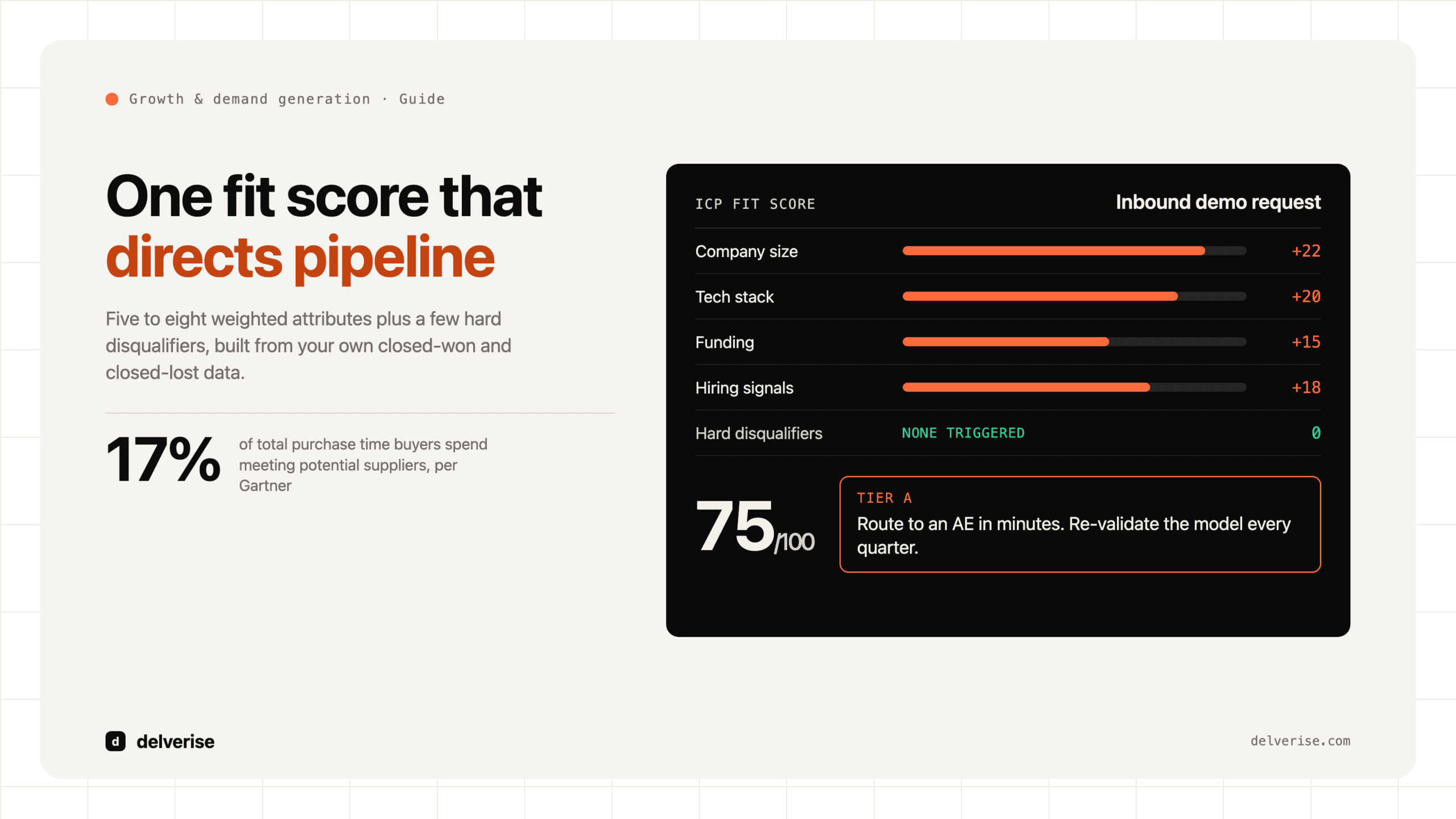
If marketing counts an ebook download as an MQL and sales wants a confirmed budget and timeline, both teams will report success while pipeline stays flat. Write the definitions down, agree on them, and encode them in your CRM as fields and stages. A scoring model helps here; our post on AI lead qualification explains what a modern scoring layer should actually weigh.
Slow or broken routing
A demo request that sits in a shared inbox for a day has lost much of its value. Routing rules in HubSpot or Salesforce, backed by round-robin assignment and alerts, should get high-intent leads to an owner within minutes.
Dirty or thin data
Outbound built on stale contacts damages sender reputation, and inbound leads missing company size or industry cannot be scored or routed. Enrichment through tools like Clay or Apollo at the point of entry fixes both problems.
Leads with no path back
Most leads are not ready to buy when they first appear. Without a nurture track, they disappear. A focused lead nurturing tool keeps them warm until timing changes, and it recovers pipeline you already paid to generate.
How should you build the system?
For a founder or revenue leader, the sequence matters more than the tool choices. Build in this order:
- Define your ICP from closed-won and churned accounts, including the triggers that preceded a purchase.
- Write MQL, SQL, and opportunity definitions and get sales and marketing to sign off.
- Clean and enrich your CRM so every account carries the fields your targeting and routing need.
- Launch one primary channel matched to your stage, usually targeted outbound for Seed and Series A.
- Set up routing with a speed-to-lead target and alerts when it slips.
- Build a nurture track for leads that are qualified on fit but early on timing.
- Report pipeline, win rate, and cycle length by source every month, and move budget accordingly.
- Add a second channel only once the first one produces predictable output.
The tools themselves are interchangeable to a large degree. HubSpot or Salesforce as the system of record, Clay or Apollo for data and enrichment, Outreach or Salesloft for sequencing, and n8n or native workflows for automation can all work well. What makes the difference is how they connect: whether a signal in one place triggers the right action in another without someone copying data between tabs. That integration work is the core of GTM engineering, and it is where delverise spends most of its time with Seed to Series B teams.
How should you measure lead gen performance?
Lead count is the easiest number to report and the least useful. Track these instead:
- Pipeline created by source: dollar value of qualified opportunities each channel produced.
- Cost per opportunity: fully loaded channel cost divided by opportunities, including tools and people.
- Win rate by source: some channels produce fewer opportunities that close at twice the rate.
- Sales cycle length by source: faster cycles free up rep capacity and cash.
- Speed to lead: median time from inbound request to first human touch.
Review these monthly with sales and marketing in the same room. When the numbers disagree with anyone’s intuition, trust the numbers and investigate the gap.
Frequently Asked Questions
What is the best lead gen channel for an early-stage B2B SaaS company?
For most Seed and early Series A companies with an ACV above roughly $10k, targeted outbound produces the fastest pipeline and the quickest feedback on ICP and messaging. Content, SEO, and partnerships compound over time, so start them early, but expect outbound to carry pipeline in the first year.
How many leads does a B2B SaaS company need?
It depends on your revenue target, ACV, and conversion rates. Divide new ARR by ACV to get required deals, then divide by win rate and each funnel conversion rate to get required opportunities, SQLs, and leads. Most teams find they need fewer leads than they assumed once they fix conversion.
Should we build lead gen in-house or bring in outside help?
Keep ownership of ICP, messaging, and the revenue number in-house. Outside help makes sense for the systems work: data architecture, enrichment, routing, automation, and attribution. That work is technical, easy to get wrong, and expensive to rebuild once your team has scaled on top of it.
How long does it take to see results from B2B SaaS lead gen?
Outbound typically produces first opportunities within two to six weeks of launch, provided domains are warmed and data is clean. SEO and content usually take four to twelve months to produce meaningful pipeline. Paid can generate leads within days, though quality depends heavily on your offer and conversion path.
What is the difference between an MQL and an SQL?
An MQL is a lead that fits your ICP and has shown some interest, such as downloading content or attending a webinar. An SQL is a lead sales has reviewed and accepted as worth pursuing, usually because of confirmed need, authority, or timing. The handoff criteria between them should be written down and agreed on by both teams.