←Back to blog
Growth & Demand GenerationGuideNovember 28, 20268 min read
ABM Companies: The Four Types and How to Choose the Right One
ABM companies are vendors that help B2B teams run account-based marketing (ABM), a strategy that focuses sales and marketing on a defined list of high-value accounts. There are four main types: ABM platforms, data and intent providers, advertising and orchestration tools, and execution partners who build and run the program. Most Seed to Series B teams need only two of the four.
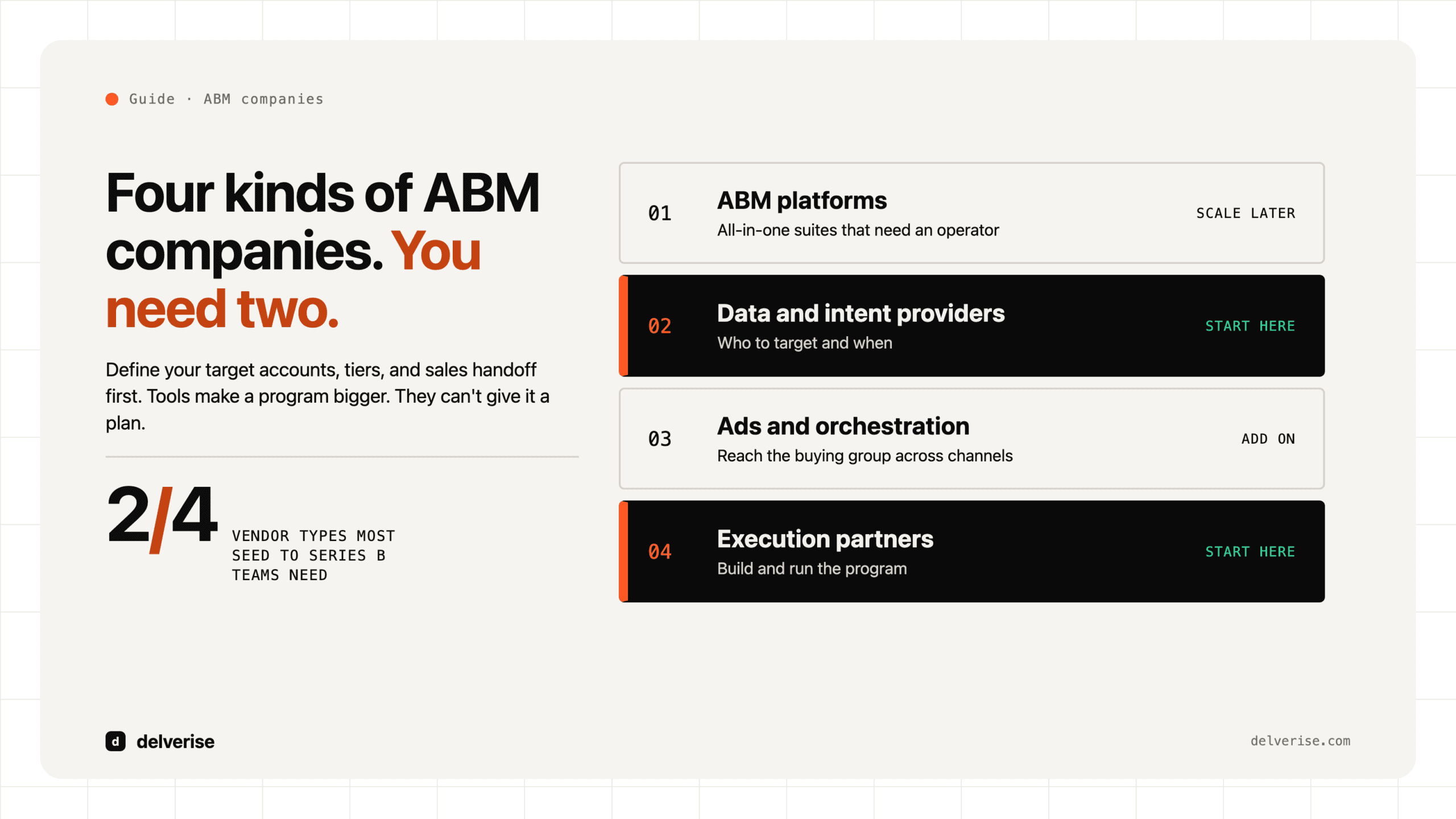
ABM companies are vendors that help B2B teams run account-based marketing (ABM), a strategy that focuses sales and marketing on a defined list of high-value accounts. There are four main types: ABM platforms, data and intent providers, advertising and orchestration tools, and execution partners who build and run the program. Most Seed to Series B teams need only two of the four.
Key takeaways
- “ABM companies” covers four different kinds of vendor. Comparing a platform against an execution partner is like comparing a CRM against a sales hire.
- Enterprise ABM platforms suit teams with enough traffic, budget, and ops capacity to use them. Most Seed and Series A companies get more from clean account data, tight targeting, and good outbound.
- Buying groups of several stakeholders now make most B2B decisions, and that is the main reason ABM works: you reach the whole committee instead of one lead.
- Before you pick any vendor, define your target account list, your tiers, and your sales handoff. Tools make a program bigger. They can’t give it a plan.
- Measure ABM by pipeline and win rate in target accounts. MQL volume is the wrong metric.
What does “ABM companies” actually mean?
Account-based marketing treats a named company as the unit of marketing instead of an individual lead. You pick the accounts first using your ideal customer profile (ICP), the firmographic and technographic traits of the customers you win and keep. Then you run coordinated sales and marketing at the people inside those accounts.
Two more terms come up in every vendor conversation. Intent data is a signal that an account is researching a topic related to what you sell, collected from content consumption, review sites, or your own website visits. A buying group is the set of stakeholders who together make a purchase decision: an economic buyer, a champion, technical evaluators, and often procurement or security.
When someone searches “ABM companies,” they could mean software vendors, data vendors, or firms that run ABM programs. Those are different purchases with different budgets. Knowing which one you need saves months of demos.
What are the main types of ABM companies?
1. ABM platforms
These are the all-in-one suites: 6sense, Demandbase, and similar products. They combine account identification, intent data, predictive scoring, advertising, and dashboards in one place. They’re powerful, but they need someone to operate them. They also expect a CRM with clean account data, and they show their value slowly unless you have meaningful web traffic to de-anonymize.
2. Data and intent providers
This group includes contact and firmographic databases like ZoomInfo, Apollo, and SalesIntel, intent sources such as Bombora and G2 Buyer Intent, and enrichment layers like Clay that pull from many providers at once. They tell you who to target and when. Nothing gets executed. For many early-stage teams, this layer plus a well-run CRM covers most of what ABM actually requires.
3. Advertising and orchestration tools
RollWorks, Terminus, and LinkedIn’s Matched Audiences let you serve ads only to people at target accounts. Sequencing tools like Outreach and Salesloft handle coordinated email and call touches. This layer puts your message in front of the buying group across channels.
4. Execution partners and systems builders
These firms design and run the program: account selection, tiering, data pipelines, CRM plumbing, outbound, and reporting. Quality varies widely. Some produce campaigns and creative. Others build the underlying revenue system, the data flows and automations that keep the program running after the partner leaves. The second kind leaves you with an asset. The first leaves you with a monthly invoice.

| Type | What it does | Example tools | Best fit | Main tradeoff |
|---|---|---|---|---|
| ABM platform | Identification, intent, scoring, ads, reporting in one suite | 6sense, Demandbase | Series B+ with ops headcount and inbound traffic | High cost, long ramp, needs a dedicated operator |
| Data and intent | Account lists, contacts, buying signals, enrichment | ZoomInfo, Apollo, Bombora, Clay | Every stage | Data decays, and coverage varies by segment |
| Ads and orchestration | Reach buying groups across channels | RollWorks, LinkedIn, Outreach, Salesloft | Seed to Series B with a defined account list | Wasted spend if targeting is loose |
| Execution partner | Designs, builds, and runs the program | Varies | Teams without in-house GTM engineering | Value depends on whether they build durable systems |
Why do B2B SaaS teams invest in ABM at all?
Because buying has changed. Gartner’s research on B2B buying found that buyers spend only about 17% of their total buying time meeting with potential suppliers, and that time is split across every vendor they evaluate. Most of the decision happens before your rep is ever in the room.

Gartner has also reported that a typical complex B2B purchase involves six to ten decision makers. A single lead captured from a form fill represents one of those people. ABM is built to reach the others.
McKinsey’s B2B Pulse research found that buyers regularly use ten or more channels during a purchase, spread across in-person, remote, and self-serve. And Forrester has spent years pushing B2B marketers to organize around buying groups and opportunities instead of individual leads. The logic is the same across all three: if the decision is made by a committee across many channels, you need a coordinated way to reach that committee.
Which type of ABM company fits your stage?
Seed to early Series A
Skip the enterprise platform. Your target list is probably under a few hundred accounts, your traffic is too thin for de-anonymization to matter, and you likely have nobody to run the tool. Put your money into a clean account list, enriched contacts, and a disciplined outbound funnel aimed at those accounts. Founder-led and SDR outreach, backed by good data, is the ABM motion at this stage.

Series A
Add orchestration. With a defined ICP and a few reps, account-targeted LinkedIn ads plus coordinated sequences start to pay off. This is also when CRM enrichment becomes urgent, because account-level reporting falls apart once duplicates and stale records pile up.
Series B
Now an ABM platform can earn its cost, as long as you have a RevOps or MarOps owner to run it, enough inbound traffic for intent and identification to matter, and a sales team that will act on the signals. Without an owner, the platform turns into an expensive dashboard nobody opens.
What does a lean ABM system look like in practice?
Here’s an illustrative setup for a Series A SaaS company selling to mid-market finance teams, with 180 target accounts and three account executives.
- Tier 1 (20 accounts): One-to-one treatment. Account research, a mapped buying group of five to eight people, personalized outreach from the AE and an executive, and custom content where it earns a meeting.
- Tier 2 (60 accounts): One-to-few. Grouped by industry or tech stack, with messaging tailored to the segment’s pain and LinkedIn ads targeted to the account list.
- Tier 3 (100 accounts): One-to-many. Programmatic sequences triggered by intent or website visits, with email templates built around the segment’s trigger events.
The stack under it is modest: HubSpot or Salesforce as the system of record, Clay for enrichment and buying-group mapping, one intent source, LinkedIn for ads, and a sequencing tool. An automation layer (n8n or native CRM workflows) sends intent spikes to the owning rep with context attached. Reporting tracks engaged accounts, meetings per tier, pipeline created, and win rate against non-target accounts.
That setup costs a small fraction of an enterprise platform contract. Its limits are also clear: no predictive scoring and limited anonymous-visitor identification. Once you outgrow it, the clean data and defined tiers make moving to a platform far easier.
What should you check before signing with an ABM vendor?
- We have a written ICP and a target account list with tiers.
- Our CRM account records are deduplicated and owned by a named rep.
- We know who will operate the tool weekly, by name.
- Sales has agreed on what happens when an account shows intent, and how fast.
- The vendor has shown intent or data coverage for our specific segment, using sample accounts we picked.
- We’ve defined success as pipeline and win rate in target accounts, with a baseline.
- We know the contract term, renewal terms, and what happens to our data if we leave.
If several of these are unchecked, fix the foundation pieces before buying software. Every vendor on the list above performs better on a clean base.
Where do ABM programs usually break?
Account data. The account list drifts, contacts change jobs, and duplicates split activity across records. Account-level reporting then undercounts engagement, and the program looks weaker than it is.
Sales follow-through. Intent alerts reach reps who have no playbook for them. Signals pile up, nobody acts, and marketing concludes the data doesn’t work.
Measurement. Teams judge ABM by lead volume, which it’s designed to reduce. Tie it to pipeline and bookings in target accounts, and feed those numbers into your revenue forecast so leadership sees ABM as a revenue line.
Ownership. ABM touches marketing, sales, and ops, so it often belongs to no one. Assign one owner for the account list, the data flows, and the reporting.
All four failures come from the system, and buying a different vendor won’t fix any of them. That’s why delverise approaches ABM as a GTM engineering problem: the account data, routing, automation, and reporting have to work before any tool on top can deliver.
Frequently Asked Questions
What is the difference between an ABM platform and an ABM service provider?
An ABM platform is software you license and operate, such as 6sense or Demandbase. A service provider designs and runs the program for you, and the good ones leave behind a documented system your team can keep running. Many companies use one of each, while early-stage teams often need only data, orchestration, and a partner.
Do Seed-stage startups need ABM?
They need its core discipline: a defined account list, researched buying groups, and coordinated outreach. They rarely need an ABM platform. At Seed, founder-led outbound aimed at a tight, well-researched list gives you most of the benefit for very little spend.
How much do ABM companies cost?
It varies a lot by category. Enterprise ABM platforms usually sell annual contracts priced for mid-market and enterprise budgets. Data, enrichment, and ad tools can start much smaller and scale with usage. Execution partners price by scope. Ask for total first-year cost including setup, seats, and data credits.
How long does ABM take to show results?
Early signals like account engagement and meetings in target accounts usually show up within the first quarter. Pipeline and closed revenue follow your sales cycle, so a team with a six-month cycle should judge ABM on win rates over two or three quarters.
Can ABM and outbound run as one motion?
Yes, and at most B2B SaaS companies they should. Outbound is often the main execution channel for ABM. Target accounts get sequenced by reps, supported by ads and content, with intent signals deciding timing. Running them as separate programs usually means duplicated effort and mixed messages to the same buyers.