←Back to blog
Revenue Intelligence & Data ToolingGuideSeptember 1, 20268 min read
Lead Nurturing Tool: How B2B Revenue Teams Should Actually Choose One
A lead nurturing tool is software that automates follow-up with leads who are not ready to buy, moving them toward a sales conversation through timed, behavior-triggered messaging. In B2B SaaS, the right choice depends less on feature lists and more on your data model: nurture quality is capped by how well your systems know who each lead is and what they did.
A lead nurturing tool is software that automates follow-up with leads who are not ready to buy, moving them toward a sales conversation through timed, behavior-triggered messaging. In B2B SaaS, the right choice depends less on feature lists and more on your data model: nurture quality is capped by how well your systems know who each lead is and what they did.
Key takeaways
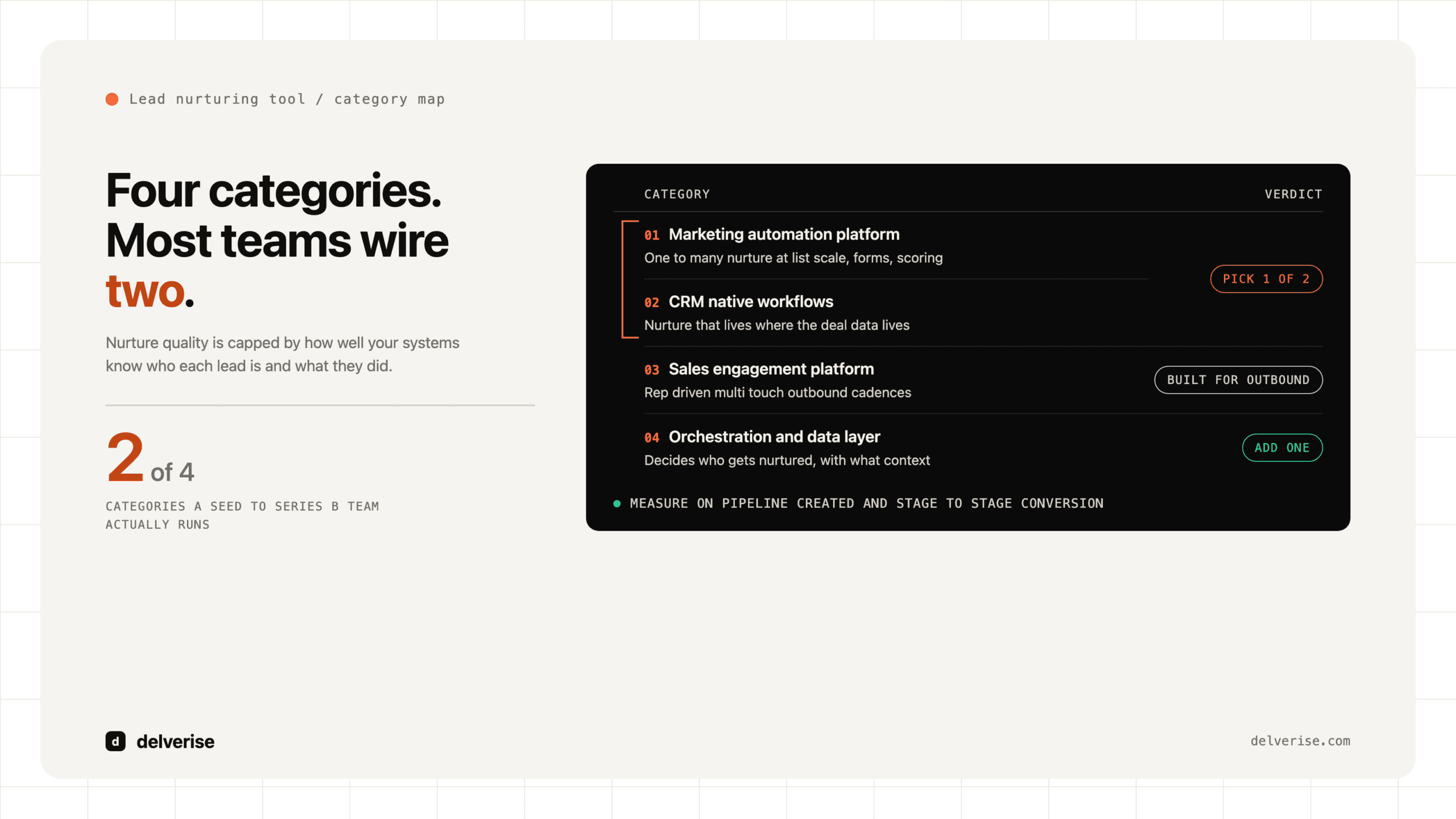
- Nurture tools fall into four categories: marketing automation platforms, CRM-native sequencing, sales engagement platforms, and orchestration layers. Most teams need two, not four.
- The bottleneck is almost never the sending tool. It is lead scoring quality, data hygiene, and the handoff rules between marketing and sales.
- Buy for your team size and data maturity. A Seed-stage team running HubSpot workflows well beats a Series B team running an enterprise platform badly.
- Define “nurture-ready” and “sales-ready” explicitly before you buy anything. Tools enforce definitions, they do not create them.
- Measure nurture on pipeline created and stage-to-stage conversion, not open rates.
What does a lead nurturing tool actually do?
Strip away the category marketing and a nurture tool performs four jobs. It stores lead records with attributes and behavior history. It evaluates rules against those records (form fill, page visit, score threshold, time delay). It sends messages across channels when rules fire. And it writes the outcome back so sales and reporting can see it.

Every serious platform does all four. The differences show up in how well each handles the boring parts: what happens when a lead exists in two systems with different data, whether a sales rep’s manual email pauses the automated sequence, whether your reporting can attribute a closed deal to a nurture touch that happened five months earlier.
Gartner’s research on B2B buying has consistently found that buyers spend only a small fraction of their purchase journey with any individual vendor’s sales team, with most time going to independent research and internal group discussion. That is the actual case for nurture: you are trying to stay useful during the long stretch where nobody is talking to you.
What are the main categories, and which one fits?
Vendors blur these lines in their own marketing, so it helps to separate them by the job they were built for.

| Category | Built for | Examples | Where it breaks |
|---|---|---|---|
| Marketing automation platform | One-to-many nurture at list scale, form handling, scoring, landing pages | HubSpot Marketing Hub, Marketo, Customer.io | Weak at individualized, rep-owned follow-up. Costs scale with contact database size, so bad data gets expensive. |
| CRM-native workflows | Nurture that lives where the deal data lives, minimal integration overhead | HubSpot workflows, Salesforce Flow plus Account Engagement | Limited channel range and content management. Fine for simple logic, painful for complex branching. |
| Sales engagement platform | Rep-driven multi-touch sequences across email, call, LinkedIn | Outreach, Salesloft, Apollo | Built for active outbound cadences, not for the six-month drip on a lead who said “not now.” |
| Orchestration and data layer | Deciding who gets nurtured, with what context, based on enriched signals | Clay, n8n, reverse-ETL tooling | Does not send at scale on its own. It feeds the sending tools, so you still need one. |
Most B2B SaaS companies between Seed and Series B end up with one platform in the first two rows plus one in the last row. If you are weighing sequencing platforms specifically, we compared two of the common finalists in Outreach vs Salesloft. For the broader stack picture, see what a GTM tech stack actually contains.
Why do most nurture programs underperform?
Three failure modes account for most of it, and none of them are solved by switching vendors.
 nurture programs: arbitrary scoring, thin data, and an u” class=”wp-image-3225″/>
The scoring model is arbitrary. Someone assigned 10 points to a pricing page visit and 5 to an ebook download in 2023, and nobody has looked since. Whether those weights predict anything is untested. Forrester and others who study lead management have long pointed out that scoring models decay when they are never validated against closed-won outcomes.
The data is too thin to personalize on. If your lead record holds an email, a company name, and a form source, your nurture can only send generic content. Enrichment changes what is possible: firmographics, tech stack, funding stage, headcount trend, and job change signals give the automation something real to branch on. This is where CRM enrichment pays for itself, and where thin lead gen data quietly caps every downstream metric.
The handoff is undefined. Marketing thinks it passed a qualified lead. Sales sees an ebook download and ignores it. No shared definition exists, so both sides are right. HBR’s widely cited work on lead response time found that companies contacting a new inbound lead within the first hour were dramatically more likely to qualify it than those waiting even a few hours. Speed is a routing and ownership problem before it is a tooling problem.
How should we evaluate a lead nurturing tool?
Run the evaluation against your actual workflows, not a demo dataset. The questions that separate tools:
- Can it branch on enriched account attributes, or only on form and email behavior?
- Does it deduplicate leads against existing CRM contacts and accounts before enrolling them?
- Can a sales rep’s manual activity automatically pause or exit a lead from a nurture track?
- Does it support account-level nurture (multiple contacts at one company treated as a buying group)?
- Can you attribute influenced pipeline, not just last-touch conversions?
- What is the real cost at 3x your current contact count, including inactive records?
- How hard is it to export everything if you leave in 18 months?
That last question matters more than teams expect. Nurture platforms accumulate years of behavioral history, and the ones that make export painful are counting on switching costs.
What does a working nurture system look like in practice?
Here is a concrete build for a Series A B2B SaaS company with roughly 12,000 contacts and two SDRs.
Segment. Three tracks, not fifteen. Track one: ICP-fit leads who engaged but did not book (highest value). Track two: closed-lost opportunities from the last 18 months. Track three: everyone else, on a low-frequency content cadence.
Enrich. Every new lead gets enriched on entry: company size, funding stage, tech stack, and current role. Leads that fail ICP criteria go straight to track three and never consume rep attention. Teams often run this layer in Clay, which is useful here because it can chain multiple data providers and fall back when one fails, then push the enriched record into the CRM. It is a data and decisioning layer, so you still need a sending platform behind it.
Trigger. Track one leads get a five-touch sequence over three weeks. Pricing page visits or repeat product page views trigger an immediate task for the assigned rep instead of the next automated email.
Route. When a lead crosses the sales-ready threshold, it creates an owned task with an SLA, not a queue entry someone might see. Ownership is assigned at creation.
Measure. One number governs the program: pipeline created from nurtured leads, split by track. Email open rate is a diagnostic, never a goal.
This is roughly the shape of what we build as GTM engineering work, and it typically takes four to six weeks to stand up properly. The tooling decision is maybe 20 percent of that effort. The rest is definitions, data plumbing, and routing logic.
Should we buy a dedicated tool or extend what we already have?
Extend what you have if: your CRM already holds clean contact data, your nurture logic fits in under a dozen branches, and no one on the team has run a marketing automation platform before. HubSpot workflows or Salesforce Flow will carry a Seed-to-Series-A team further than most vendors admit.
Buy a dedicated platform when: you need behavioral scoring across a large contact base, you are running multi-channel nurture with real content operations, or your list has grown past the point where CRM-native tooling handles segmentation without manual work.
Add an orchestration layer when: the limitation is knowing who to nurture and with what context, rather than sending capacity. That is a data problem, and adding a second sending tool will not fix it. Related reading on where automation genuinely helps: AI powered lead generation and the buying guide for AI lead generation tools.
G2 review data across marketing automation categories reflects a consistent pattern: satisfaction scores track implementation quality and support far more than feature breadth. Teams rarely regret the platform. They regret the setup.
Frequently Asked Questions
How much should a B2B SaaS company spend on a lead nurturing tool?
For Seed to Series B, most teams land between $500 and $4,000 per month depending on contact volume. Watch the pricing model closely: platforms that charge on total database size punish you for keeping inactive records, and cleaning that list becomes a recurring cost-control exercise rather than a one-time project. Budget implementation separately, because it usually costs more than the first year of license fees.
How long should a nurture sequence be?
It depends on your sales cycle. A useful heuristic: nurture length should roughly match your average time from first touch to closed-won. If deals take five months, a three-week sequence ending in silence wastes the leads that were always going to take longer. Long-horizon tracks should drop to monthly cadence rather than stopping entirely.
Can AI replace rule-based nurture logic?
Partly. AI is genuinely useful for content variation, send-time optimization, and summarizing account context for reps. It is much weaker at deciding qualification thresholds, which still require human judgment about what your business considers a real opportunity. The teams getting value treat AI as a layer on top of clear rules. Our take on where this holds up is in how to use AI in sales.
What is the difference between lead nurturing and sales sequencing?
Nurturing is marketing-owned, long-horizon, and one-to-many, aimed at leads who are not in an active buying cycle. Sequencing is rep-owned, short-horizon, and one-to-one, aimed at leads who are. They use different tools for good reason, and the handoff rules between them are where most revenue leaks.
Do we need a full platform if we only have 2,000 contacts?
Usually no. At that volume, CRM-native workflows plus solid enrichment will outperform an underused enterprise platform. Spend the difference on data quality and on defining your qualification criteria. If you want help sizing what to build versus buy, delverise’s Clay implementation work and broader revenue systems builds start from exactly that question.
Read next