←Back to blog
Growth & Demand GenerationGuideNovember 27, 20268 min read
GTM Motions: What They Are and How to Pick the Right Mix for B2B SaaS
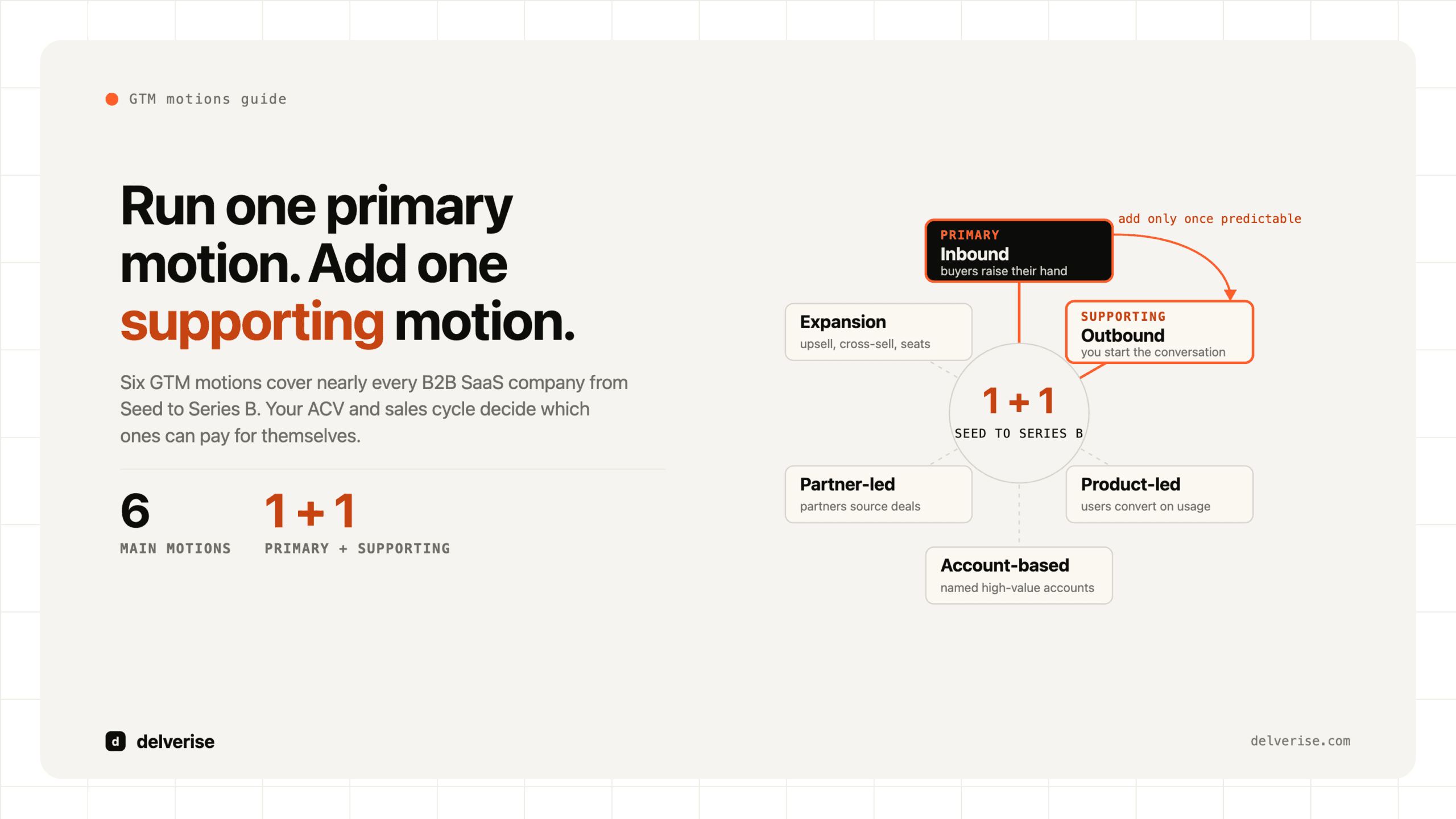
GTM motions are the repeatable ways a company finds, converts, and grows customers. The main ones in B2B SaaS are inbound, outbound, product-led, account-based, partner-led, and expansion. Each motion needs its own economics, systems, and metrics. Most companies from Seed to Series B should run one primary motion and one supporting motion. Running more than that usually spreads the team too thin.
GTM motions are the repeatable ways a company finds, converts, and grows customers. The main ones in B2B SaaS are inbound, outbound, product-led, account-based, partner-led, and expansion. Each motion needs its own economics, systems, and metrics. Most companies from Seed to Series B should run one primary motion and one supporting motion. Running more than that usually spreads the team too thin.
Key takeaways
- A GTM motion is a full operating loop: who you target, how they first engage, how they convert, and what data and tooling keep that loop running.
- Your average contract value (ACV) and sales cycle length decide which motions can pay for themselves. Founder preference should not decide it.
- Seed to Series B companies should commit to one primary motion, add a supporting motion only after the first one is predictable, and instrument both separately.
- Most motion failures come from shared infrastructure: a messy CRM, unclear lifecycle stages, and attribution that cannot tell motions apart.
- Adding a motion is a systems project with its own data model, routing, and reporting. Hiring headcount alone will not create one.
What exactly is a GTM motion?
A go-to-market (GTM) motion is the specific path a buyer takes from first contact to closed revenue, plus the people, processes, and systems your company runs to move them along it. “Outbound” is a motion. “Cold email” is a channel inside that motion. The difference matters because a motion comes with its own unit economics. It has a cost to acquire a customer, a cycle length, a conversion profile, and a set of leading indicators you manage every week.

Two companies can both say they “do outbound” and run very different motions. One sends high-volume sequences to a broad list. The other runs a tightly researched program against 300 named accounts with multi-threaded outreach. Those programs need different data, different reps, and different forecasts. Naming your motions precisely is the first step toward managing them.
What are the main GTM motions in B2B SaaS?
Six motions cover nearly every B2B SaaS company from Seed to Series B:
- Inbound: buyers find you through content, search, referrals, or paid media, then raise their hand. Marketing creates demand and sales converts it.
- Outbound: your team starts the conversation with accounts that fit your ideal customer profile (ICP), using email, phone, and social. Our breakdown of the outbound funnel covers each conversion stage in detail.
- Product-led growth (PLG): users sign up, get value from a free or trial product, and convert through self-serve purchase or a sales assist triggered by usage signals.
- Account-based (ABM): marketing and sales coordinate on a defined list of high-value accounts, with messaging tailored to each buying committee.
- Partner-led: resellers, agencies, marketplaces, or technology partners source or influence deals for you.
- Expansion: revenue grows inside existing accounts through upsell, cross-sell, and seat growth. Many teams treat this as “post-sale,” but at Series B it is often the most efficient motion you run.
Sales-led and product-led are sometimes described as motions of their own. In practice they describe who owns the conversion step, so they sit on top of the six motions above. A PLG company can still run outbound into its highest-usage accounts.
How do the GTM motions compare?
The table below is the fastest way to see which motions fit your economics. The ACV ranges are working heuristics. Treat them as starting points, not laws.

| Motion | Typical ACV fit | Cycle length | Core systems | Leading metric | Common failure mode |
|---|---|---|---|---|---|
| Inbound | $5k to $50k | Short to medium | Website, forms, marketing automation, lead scoring | Qualified inbound pipeline per month | High volume, low fit leads that clog SDR time |
| Outbound | $15k and up | Medium | Data sourcing, enrichment, sequencing, deliverability infrastructure | Positive reply rate and meetings held | Burned domains and generic messaging |
| Product-led | Under $10k self-serve, higher with sales assist | Short | Product analytics, usage-to-CRM sync, in-app messaging | Activation rate and product-qualified accounts | Usage data never reaches sales |
| Account-based | $50k and up | Long | Account lists, intent data, multi-channel orchestration | Engaged accounts and buying-committee coverage | Target list with no coordinated plays |
| Partner-led | Varies by partner type | Medium to long | Partner portal, deal registration, attribution | Partner-sourced pipeline | Partners sign up and never sell |
| Expansion | Any, strongest with seat or usage pricing | Short | Health scoring, usage alerts, renewal workflows | Net revenue retention | No owner and no trigger-based plays |
How do you choose the right motion for your stage?
Start with three inputs: ACV, buyer behavior, and the size of your addressable account list.

ACV sets the ceiling on acquisition cost. A $6k ACV product cannot support a fully loaded account executive running a 90-day cycle. A $120k ACV product can easily support ABM and executive outreach. Work backward from a payback period you can defend to the board, then eliminate motions that cannot hit it.
Buyer behavior determines where demand already exists. Gartner’s research on the B2B buying journey found that buyers spend only about 17% of their purchase time meeting with potential suppliers, and that time is split across every vendor they are considering. Most of the evaluation happens without you. If your category is well understood and actively searched, inbound can carry real weight. If the category is new and buyers do not know to look for you, outbound or ABM has to create the conversation.
List size shapes the play. If your ICP contains 800 companies worldwide, you are running account-based whether you call it that or not. If it contains 80,000, you need volume-capable outbound or a product that lets users qualify themselves.
A rough sequencing rule works for most teams. At Seed, founder-led sales plus one scalable motion you can test cheaply. At Series A, make that primary motion predictable enough to forecast, then add one supporting motion. At Series B, formalize expansion and consider a third motion only if the first two are instrumented cleanly. That predictability is what makes a revenue forecast that holds possible.
What does running two motions look like in practice?
Consider a hypothetical Series A company selling workflow software to mid-market operations teams at a $30k ACV. Its ICP contains roughly 6,000 companies. Inbound produces about 40 demo requests a month, but only a third match the ICP.
A sensible design makes outbound the primary motion and inbound the supporting one:
- Outbound: build a tiered account list from the 6,000 ICP companies, enrich contacts for two or three roles per account, and run sequences based on triggers like hiring for ops roles or a recent funding round. Target a set number of meetings held per rep per week.
- Inbound: keep content and search running, but route every form fill through enrichment and scoring before it reaches a rep. Low-fit leads go into nurture. High-fit leads get a same-day response. An AI lead qualification layer can handle this triage without adding SDR headcount.
- Shared layer: one account object in the CRM, a field that records which motion sourced each opportunity, and one set of lifecycle stage definitions both teams agree on.
The shared layer is where this plan succeeds or fails. When an outbound target downloads a whitepaper, somebody has to decide which motion owns that account. If the CRM cannot answer that question, reps collide, attribution breaks, and leadership loses the ability to compare motion economics.
Why do GTM motions fail?
Motions rarely fail because the strategy was wrong. They fail because the operating system underneath them was never built. The patterns repeat:
- No motion tagging. Opportunities are not marked by source motion, so nobody can say what outbound pipeline costs compared with inbound.
- Undefined handoffs. Lead-to-rep routing, SDR-to-AE handoff, and AE-to-CS transition live in people’s heads.
- Dirty data. Duplicate accounts, missing firmographics, and stale contacts make targeting and scoring unreliable. This is usually a CRM enrichment problem first.
- Launching too many motions at once. A team of four sellers running inbound, outbound, partners, and ABM at the same time does none of them well.
- No nurture path. Leads that are not ready yet get dropped. They need a nurture system that brings them back when timing changes.
McKinsey’s B2B Pulse research has repeatedly found that buyers now use around ten channels across a purchase and expect a consistent experience across all of them. That raises the bar for coordination. Once you run two motions, the same buyer will often touch both, and the systems have to recognize them as one person at one account.
What systems does each motion need?
Every motion sits on the same foundation: a clean CRM, agreed lifecycle definitions, reliable data enrichment, routing logic, and reporting that separates motions. If those pieces are shaky, fix them first. Our checklist on the six foundation pieces under every revenue stack walks through each one.
On top of that foundation, each motion adds its own layer. Outbound needs sending infrastructure, list building in tools like Clay or Apollo, and a sequencer such as Outreach or Salesloft. PLG needs product usage flowing into HubSpot or Salesforce so reps see which accounts are activating. Expansion needs health scores and usage alerts that trigger plays automatically. Designing how these layers connect is the core work of GTM engineering, and it is where delverise spends most of its time with Seed to Series B teams.
Before adding a new motion, run this check:
- The current primary motion hits its pipeline target at least three quarters in a row
- Every opportunity in the CRM carries a source motion field
- Lifecycle stages are defined in writing and enforced by automation
- Routing rules handle accounts that engage through more than one motion
- You can report CAC and payback by motion
- A named owner is accountable for the new motion’s number
Frequently Asked Questions
What is the difference between a GTM motion and a GTM strategy?
A GTM strategy defines your market, ICP, positioning, and pricing. GTM motions are the operating loops that carry out that strategy, such as outbound, inbound, or product-led. One strategy can be delivered through several motions, and each motion needs its own metrics and systems.
How many GTM motions should a Series A company run?
Usually two: one primary motion that produces most of the pipeline and one supporting motion. Add a third only after both are predictable and your CRM can attribute pipeline and cost to each motion separately.
Can a product-led company also run outbound?
Yes, and many do. The strongest version uses product usage signals to prioritize outbound, so reps contact accounts where several users are already active. This requires syncing product data into the CRM so sellers can see it.
Which GTM motion is cheapest to start?
Outbound usually has the lowest startup cost and the fastest feedback loop, because you control volume and targeting and see reply data within weeks. Inbound and partner-led motions tend to compound over time but take longer to show results.
How do you measure whether a GTM motion is working?
Track a leading indicator and an economic indicator for each motion. Leading indicators include meetings held, activation rate, or engaged accounts. Economic indicators include CAC, payback period, and win rate by motion. If you cannot split these numbers by motion today, fix the attribution first.