←Back to blog
Revenue Intelligence & Data ToolingGuideAugust 30, 20268 min read
Free AI Email Finder: What You Actually Get and Where It Breaks
A free AI email finder is a tool that predicts and verifies a prospect’s work email from a name and company domain, usually offering 25 to 50 lookups a month at no cost. Free tiers work well for spot checks and small tests. They break once you need consistent coverage across hundreds of accounts.
A free AI email finder is a tool that predicts and verifies a prospect’s work email from a name and company domain, usually offering 25 to 50 lookups a month at no cost. Free tiers work well for spot checks and small tests. They break once you need consistent coverage across hundreds of accounts.
Key takeaways
- Free email finders solve a research problem. Sustained pipeline coverage is a different job with different economics.
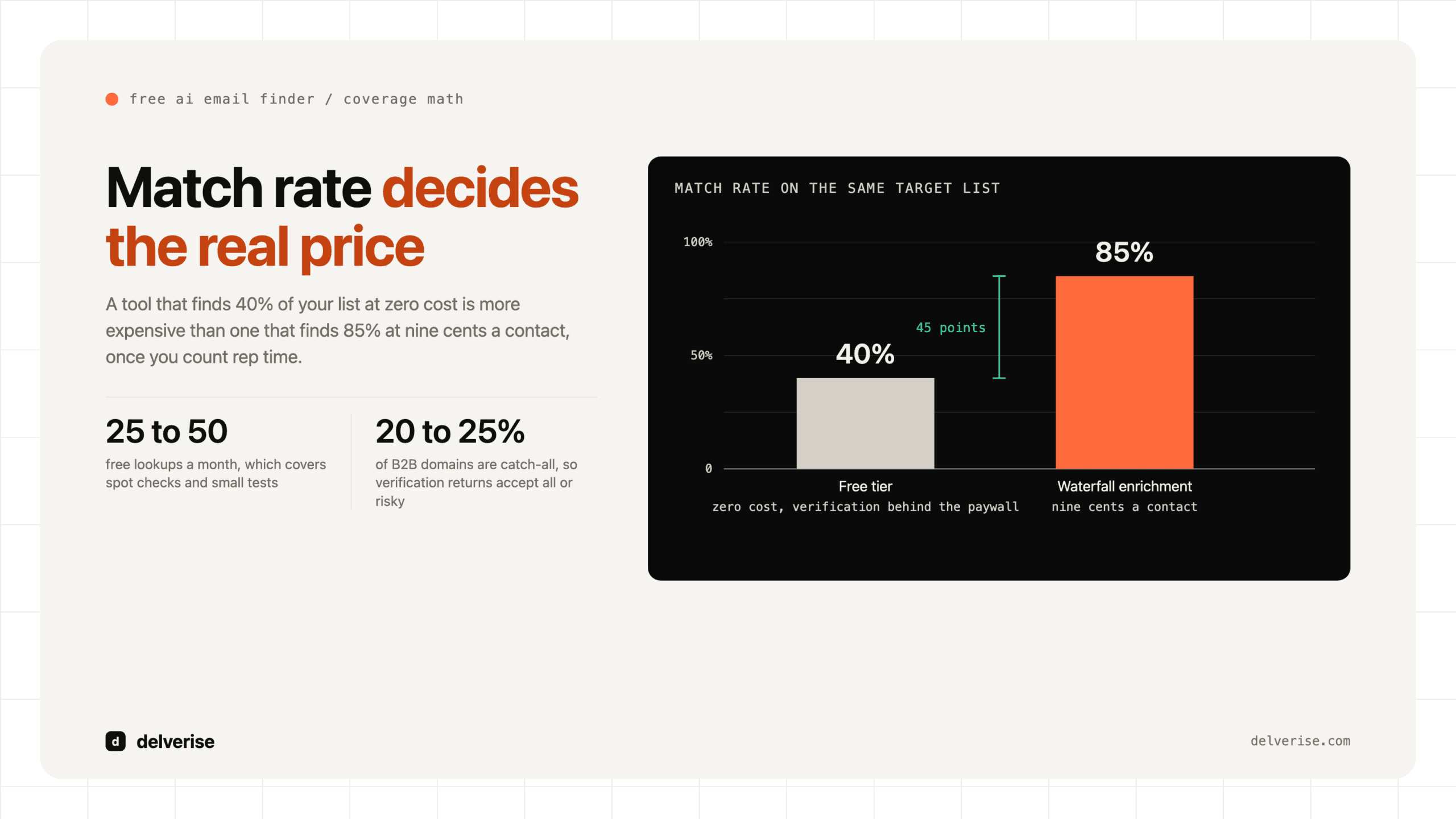
- Match rate matters more than price. A tool that finds 40% of your list at zero cost is more expensive than one that finds 85% at nine cents a contact, once you count rep time.
- Finding an address and verifying it are two separate steps. Most free tiers do the first well and the second poorly.
- Deliverability rules from Google and Yahoo made unverified sending genuinely risky for your domain, so bounce discipline is now an infrastructure concern.
- The buying decision is about your target list shape: geography, company size, and seniority determine which providers actually have your people.
What is a free AI email finder, and how does it work?
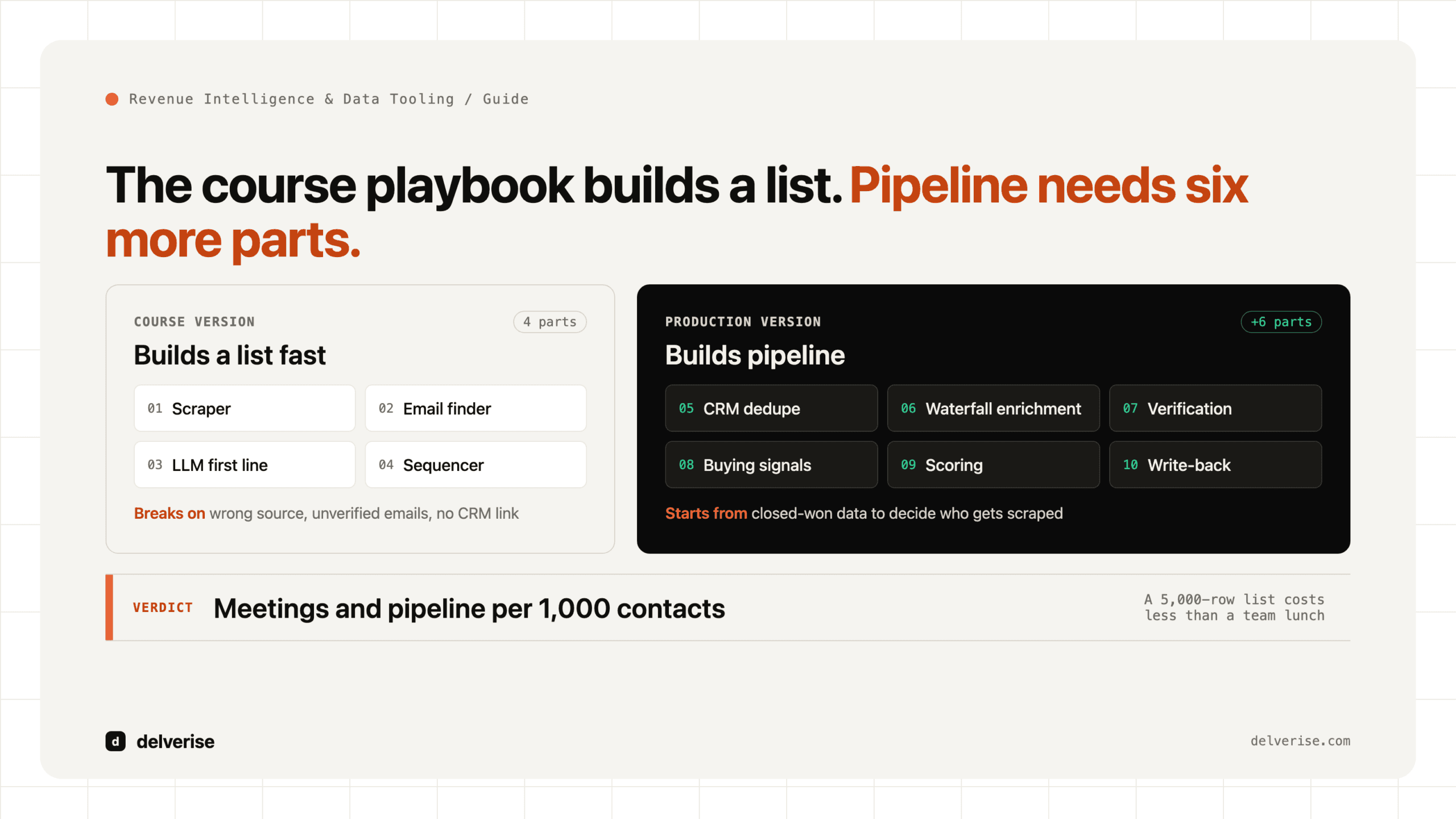
Most of these tools run three steps in sequence. First, pattern inference: the tool looks at known addresses on a company domain, learns the format (first.last@, flast@, first@), and applies it to your target’s name. Second, database lookup: it checks the name against a contributed or scraped contact index. Third, verification: it opens an SMTP conversation with the receiving mail server to ask whether the mailbox exists, without sending anything.

The “AI” label mostly describes the pattern inference and the confidence scoring layered on top. Some newer tools add a language model that reads a LinkedIn profile or company site to resolve the right person before the lookup runs. That step is useful. It also introduces a failure mode worth knowing about: a chat-based tool asked for someone’s email will sometimes produce a plausible, well-formatted address that was never verified against anything. Treat any address that arrives without a verification status as a guess.
One term to define now, because it decides a lot of your bounce math: a catch-all domain accepts mail to any address at that domain, valid or not. Verification tools cannot confirm individual mailboxes there, so they return “accept all” or “risky.” Roughly a fifth to a quarter of B2B domains behave this way, and how a provider handles them is one of the clearest signals of quality.
What do free tiers actually give you?
Free offerings cluster into a few archetypes. Allowances change often, so treat the numbers as the shape of the market rather than a price list.
| Approach | Typical free allowance | Best for | Where it breaks |
|---|---|---|---|
| Browser extension finders | 25 to 50 lookups per month | Researching a named target while you are already on their profile | No bulk processing, no API, coverage skews heavily toward US tech |
| Free tier of a data platform (Apollo, Hunter, and similar) | A small monthly credit pool | Measuring real match rates on your ICP before you sign anything | Export caps, monthly credit resets, verification often sits behind the paywall |
| Chat or agent-based finders | Usage-limited sessions | One-off answers where you can eyeball the result | No audit trail, no confidence score, occasional fabricated addresses |
| Free bulk verifiers | A few hundred verifications | Cleaning a list you already have | They verify only. They find nothing. |
| Waterfall enrichment (paid) | None | Production coverage across thousands of contacts | Cost, orchestration overhead, needs someone to own it |
The honest read: free tiers are genuinely good at evaluation. Running your actual target list through three or four free tiers before you buy tells you more about match rate than any vendor deck will. We covered the broader category in free AI tools for lead generation, and the same pattern holds here.
How accurate are free AI email finders?
Accuracy splits into two numbers that vendors tend to blur together. Match rate is the share of your input list the tool returns an address for. Accuracy is the share of returned addresses that are real and deliverable. A tool can post a 95% accuracy claim while matching only 35% of your list, and both statements are technically true.

Coverage quality also varies by segment in predictable ways. US and Western European contacts at companies above 50 employees are well covered almost everywhere. Coverage thins fast for companies under 20 employees, for APAC and LATAM, and for non-quota roles like operations and finance. If your ICP sits in a thin segment, free tools will feel broken when the real issue is index depth. That is a buying decision, and we broke down how to make it in how revenue leaders should actually buy contact data.
Decay compounds the problem. Contact data degrades continuously as people change jobs, and HubSpot has published that marketing databases lose roughly a fifth of their accuracy each year. A record you found for free in March is measurably worse in September.
Where does the free approach break at scale? A worked example
Take a Series A team with 500 target accounts and three contacts each: 1,500 addresses per quarter.

- A free extension at 50 lookups a month covers 150 per quarter, about 10% of the need.
- Stacking six free tiers gets you closer to 900, at the cost of six logins, six exports, and a manual dedupe.
- At 90 seconds per lookup and reconciliation, 1,500 contacts is roughly 37 hours of rep time. At a $45 loaded hourly rate, that is about $1,700 of selling time spent avoiding maybe $600 of data cost.
- Unverified output typically carries 8% to 15% invalid addresses. At 10%, that is 150 hard bounces landing on your sending domains.
That last line is the one that actually hurts. Since Google and Yahoo tightened bulk sender requirements in 2024, senders must authenticate with SPF, DKIM, and DMARC, offer one-click unsubscribe, and hold spam complaint rates below 0.3%. High bounce volume signals a scraped list to mailbox providers, and reputation damage takes weeks to repair. The savings from free tooling disappear the first time a domain gets throttled. Getting the sending side right is a separate discipline, which is why we treat email prospecting as a system rather than a list activity.
Gartner’s research on B2B buying found that buyers spend only about 17% of their purchase journey meeting with potential suppliers, split across every vendor they consider. When your share of buyer attention is that thin, a 10% bounce rate is not a data hygiene footnote. It is a meaningful cut of your total access to the account.
When should you stop using free tools and build a system?
Three signals, in the order they usually appear.
Volume crosses roughly 500 contacts a month. Below that, free tiers plus a cheap verifier are a reasonable answer. Above it, manual assembly costs more in rep hours than the data would cost outright.
Your ICP stops matching the free indexes. If you sell to European mid-market manufacturers or to operations leaders at sub-50-person companies, one provider will never carry your list. That is where waterfall enrichment earns its keep: you query provider A, and only when it returns nothing do you pay provider B, then C. Match rates in the 80s become reachable, and you pay per successful find rather than per seat. Clay is the tool most teams use to orchestrate this, since it chains multiple data vendors and a verifier into one table. delverise is a Clay First 100 Solutions Partner, and our Clay implementation work is mostly about designing those waterfalls so credits go to the sources that actually cover your segment.
Nothing writes back to the CRM. The moment found contacts live in spreadsheets, you lose attribution, dedupe, and any read on which data source produces meetings. Enrichment belongs in the flow of record creation, a topic we go deeper on in CRM enrichment.
McKinsey’s work on B2B buying behavior has consistently found that buyers now move across a wide mix of channels before they ever talk to a seller. Email is one input into that mix. Its value comes from being consistently correct at the account level, which is an infrastructure property rather than a tool property. That framing is why we treat contact data as one layer inside a wider GTM tech stack.
How should you evaluate an email finder?
Run this before you sign anything. Use free tiers as the test harness.
- Build a 100-row test list drawn from your real ICP, including the segments you find hardest
- Run it through three providers and record match rate separately from accuracy
- Verify every returned address with an independent verifier, not the finder’s own scoring
- Check how each tool labels catch-all domains and whether it charges for those results
- Confirm the data source and GDPR basis in writing if you sell into the EU or UK
- Test the API or native integration, since manual CSV work erases the savings
- Price the winner per successfully verified contact, not per seat or per credit
The per-verified-contact number is the one that makes vendors comparable. A $99 plan with a 40% match rate costs more per usable record than a $299 plan at 85%, and only this calculation shows it. The same evaluation logic applies to the wider category of AI lead finders.
Frequently Asked Questions
Are free AI email finders legal to use for B2B outreach?
In the US, CAN-SPAM permits unsolicited commercial email to business addresses provided you identify yourself, include a valid postal address, and honor opt-outs. In the EU and UK, GDPR requires a lawful basis, typically legitimate interest, plus a documented source for the data and a way to handle deletion requests. Ask any provider where its data comes from and get the answer in writing.
What is the difference between an email finder and an email verifier?
A finder produces a candidate address from a name and domain. A verifier checks whether that mailbox actually accepts mail. Many free tiers include light verification, though quality varies widely on catch-all domains. For anything you plan to send at volume, run a dedicated verification pass before the send.
How much should we budget for contact data at Seed to Series B?
Most teams sending 2,000 to 5,000 emails a month land somewhere between $300 and $1,500 monthly across finding, enrichment, and verification. The variable that moves the number most is ICP difficulty. Thin segments need waterfall coverage across several sources, which costs more per record and returns far better match rates.
Can ChatGPT or another LLM find email addresses reliably?
General-purpose models can infer a likely format, and they have no way to confirm the mailbox exists. Any address produced that way should be treated as unverified until a verifier checks it. We wrote about where language models genuinely help sellers in ChatGPT for sales.
What match rate should we expect from a good setup?
For US and Western European contacts at companies above 50 employees, a well-configured waterfall reaches 75% to 90% verified coverage. Thinner segments run lower. Any vendor quoting a single global match rate without asking about your ICP is quoting a marketing number.
Read next