←Back to blog
Revenue Intelligence & Data ToolingGuideAugust 22, 20269 min read
What Is a GTM Tech Stack? The Layers, the Tradeoffs, and How to Build One
A GTM tech stack is the connected set of systems a B2B company uses to find, win, and keep customers: CRM, data and enrichment, engagement, marketing automation, analytics, and the orchestration layer that ties them together. Its value depends on how cleanly data moves between those layers rather than on how many tools you own.
A GTM tech stack is the connected set of systems a B2B company uses to find, win, and keep customers: CRM, data and enrichment, engagement, marketing automation, analytics, and the orchestration layer that ties them together. Its value depends on how cleanly data moves between those layers rather than on how many tools you own.
Key takeaways
- Six layers matter: system of record, data and enrichment, engagement, marketing automation, orchestration, and analytics. Every layer owes you one specific job.
- Most stack problems are data model problems. Duplicate accounts, unmapped fields, and silent sync failures cost more than any license.
- Suites win on governance and total cost. Best-of-breed wins on capability. Pick per layer, not for the whole stack.
- Buy the system of record first, the data layer second, and orchestration third. Analytics gets real once the first three are trustworthy.
- Judge the stack on operating metrics: field coverage, sync error rate, lead-to-first-touch time, and cost per sourced opportunity.
What counts as a GTM tech stack, and what does not?
Go-to-market technology covers every system that touches a buyer or the data about a buyer, from first anonymous visit through renewal. That includes your CRM, your data providers, your sequencer, your marketing automation platform, your billing and product usage feeds, and the automation that moves records between them.
Plenty of teams describe their CRM as their stack. A CRM is a system of record: it stores what happened. A stack is a system of action: it decides who gets contacted, with what context, by whom, and when. The difference shows up the moment you try to answer a question like “which accounts showed buying behavior last week and what did we do about it.” If that answer requires a person exporting spreadsheets, you own tools rather than a system. Our breakdown of what GTM tech actually is goes deeper on the category boundaries.
What are the layers, and what does each one owe you?
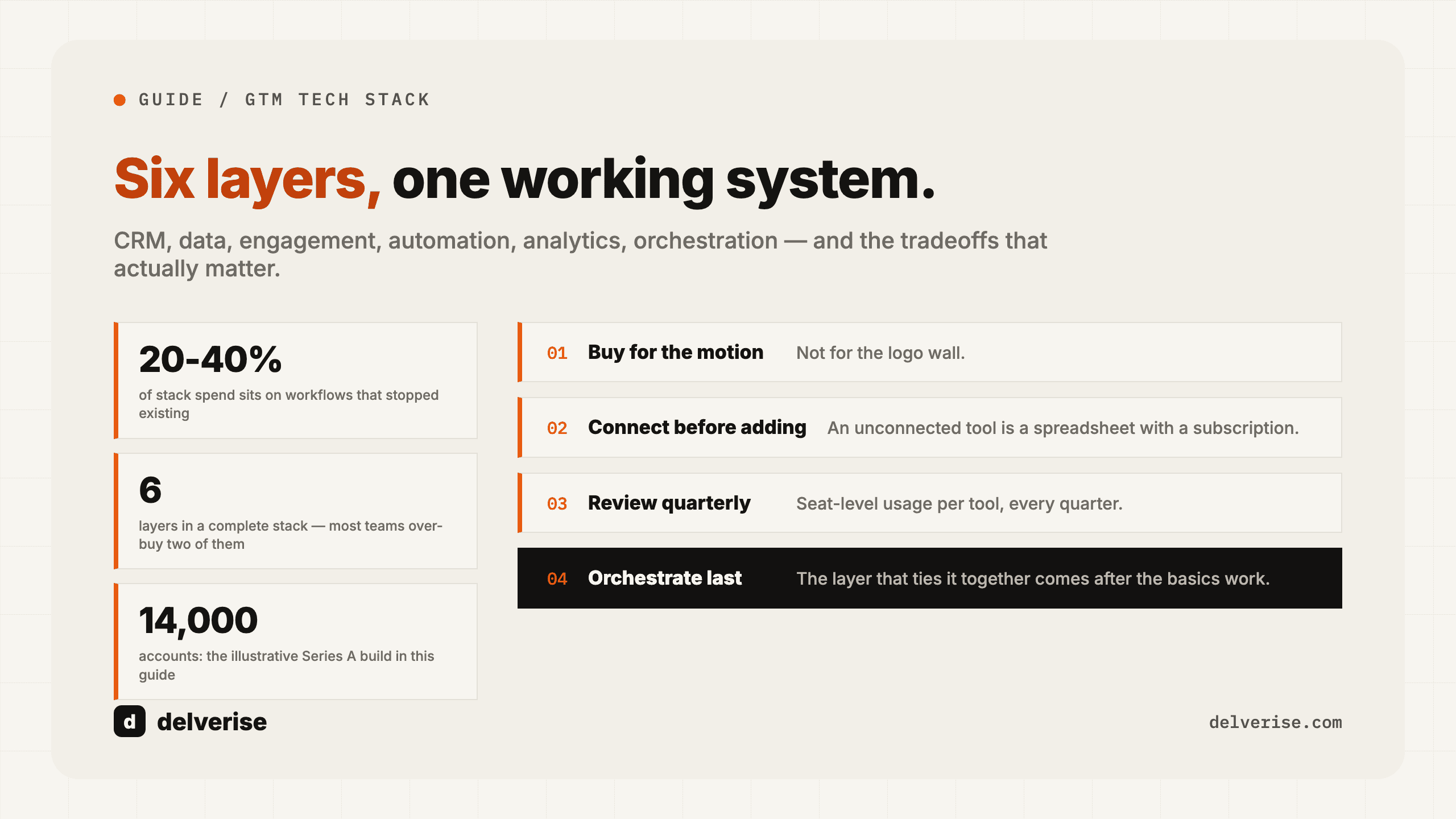
Treat the stack as six layers with distinct jobs. When a layer has no clear owner or no clear output, that is usually where pipeline goes missing.

| Layer | Job to be done | Common tools | Where it breaks |
|---|---|---|---|
| System of record | One trusted definition of account, contact, opportunity, and stage | Salesforce, HubSpot, Pipedrive | Duplicate accounts, free-text fields, stages nobody enforces |
| Data and enrichment | Accurate firmographics, contacts, technographics, and intent signals | Apollo, ZoomInfo, Ocean.io, Bombora | Single-vendor dependency, stale records, no coverage measurement |
| Engagement | Sequenced outbound and inbound follow-up with logged activity | Outreach, Salesloft, Instantly, Smartlead | Volume without targeting, activity that never syncs back |
| Marketing automation | Nurture, scoring, forms, lifecycle transitions | HubSpot, Marketo, Customer.io | Scoring models nobody has recalibrated in a year |
| Orchestration | Rules and workflows that move data and trigger action across layers | Clay, n8n, Zapier, Workato, custom jobs | Undocumented automations, no error alerting, one person holds the map |
| Analytics | Funnel conversion, attribution, forecast, cohort retention | Warehouse plus BI, native CRM reporting | Numbers that disagree with the CRM, so nobody trusts either |
Why do most stacks underperform their price tag?
Three reasons show up repeatedly, and none of them are solved by buying another tool.

Buyers barely interact with sellers. Gartner’s research on B2B buying found that buyers spend roughly 17% of the purchase journey meeting with potential suppliers, split across every vendor in consideration. McKinsey’s B2B Pulse work found buyers now move across around ten channels during a decision, up from about five a decade ago. A stack that only captures what a rep logged is blind to most of the journey. That blind spot is the real argument for signal capture, which we cover in why batch outreach cannot see buying timing.
Integrations are treated as configuration instead of architecture. Two systems can be “connected” and still disagree about which record is the truth. Field-level ownership, sync direction, and conflict resolution are design decisions. When they go undocumented, you get the classic failure where an opportunity closes in one system and never updates in another. We walked through a concrete version of this in what actually syncs between Salesloft and Salesforce.
Nobody measures adoption. Gartner has repeatedly reported that sellers use only a fraction of the technology bought for them. Licenses renew on autopilot while usage quietly drops. A quarterly review of seat-level usage per tool usually finds 20 to 40% of spend attached to workflows that stopped existing.
Should you consolidate on a suite or buy best of breed?
Both approaches are defensible, and the right answer changes by layer.

A suite gives you one data model, one support relationship, one security review, and predictable total cost. For a Seed to Series A team with no dedicated operations hire, that governance benefit usually beats a marginally better point solution. G2 review data consistently shows implementation effort and admin burden ranking near the top of buyer complaints, and suites reduce both.
Best-of-breed makes sense where the capability gap is large and the workflow is core to how you win. Data enrichment and orchestration are the usual candidates, because native CRM enrichment tends to lag specialized providers by a wide margin on coverage and freshness.
A practical rule: consolidate the layers where being average is fine, and buy specialists for the one or two layers that produce your differentiated motion. Then hold the specialist to a coverage or conversion number, and cut it if it misses for two quarters.
What does a working stack look like at Series A?
Here is an illustrative build for a hypothetical 8-person revenue team at roughly $3M ARR selling a $25K ACV product to operations leaders. The numbers are a modeling example, not a client account.
The team runs HubSpot as system of record with enforced picklists on industry, employee band, and lifecycle stage. Their addressable market is about 14,000 accounts. Rather than buying one data vendor and accepting whatever coverage it returns, they run a waterfall in Clay: a primary provider first, then a secondary for misses, then a scrape for the remainder. Coverage on verified work email moves from around 55% on a single source to the high 80s, and cost per enriched contact drops because the expensive provider only runs on records the cheap one missed.
Orchestration handles three triggers: a new hire in a target job function, a pricing page visit from a known account domain, and a closed-lost opportunity crossing 90 days. Each trigger writes a task with context into HubSpot and drops the contact into a small, specific sequence. Sequencer volume stays under 400 sends a week, which keeps deliverability healthy and makes reply data readable.
Analytics is one warehouse table joining CRM opportunities to source, first-touch signal, and enrichment vintage. That single table answers the question nobody could answer before: which signals produce meetings that convert. Building a defensible view of the market first, as described in turning scattered data into a buyable market, is what makes those triggers worth running at all. Teams that want the orchestration layer designed and shipped rather than assembled part-time can see how delverise approaches it on the Clay implementation page.
Total tooling cost in this example lands near $4,500 a month. The gain comes from targeting precision and follow-up speed, not send volume.
How should you sequence the build from Seed to Series B?
Sequence by trust. Each layer depends on the one before it being reliable.
Seed: one CRM, enforced fields, one enrichment source, one sequencer. Skip attribution modeling entirely. Your job is a clean record of who you talked to and what happened.
Series A: add the orchestration layer and a second data source. Define account ownership and routing rules in writing. Start measuring field coverage and sync failures as operating metrics with an owner.
Series B: add a warehouse, product usage feeds, and forecast tooling. This is also when the operations function needs a real owner. Our guide to GTM operations covers what that role owns and when to hire it.
Run this audit before any new purchase:
- Every field a rep is required to fill has a downstream consumer you can name
- Sync failures between core systems generate an alert to a human within 24 hours
- Enrichment coverage is measured as a percentage, per field, and reviewed monthly
- Every automation has a documented owner and a description of what breaks if it stops
- Seat-level usage per tool is reviewed at renewal against the workflow it was bought for
- One person can explain, without opening a spreadsheet, how a lead becomes an opportunity
How do you know the stack is working?
Tool count and spend tell you very little. These five operating metrics tell you a lot:
- Field coverage: percentage of target accounts with complete, current enrichment on the fields your routing and scoring depend on.
- Sync error rate: failed record writes per week between core systems. Anything above zero that nobody sees is a future forecast problem.
- Lead-to-first-touch time: median minutes from inbound submission to a real human response. Speed to first touch remains one of the most reliable conversion levers in inbound sales.
- Cost per sourced opportunity: total tooling plus headcount divided by opportunities created, tracked by channel.
- Manual intervention count: how many times per week someone exports, dedupes, or re-uploads a file by hand. Each instance is a process the system should own.
Every one of these is fixable with design work rather than procurement. That is the core of how delverise builds revenue systems: architecture first, then the smallest set of tools that supports it. The GTM engineering overview explains how that work gets scoped and delivered.
Frequently Asked Questions
How much should a B2B SaaS company spend on its GTM tech stack?
Most Seed to Series B teams land in the low single-digit percentage of ARR for revenue tooling, and the ratio should fall as you scale. A more useful test than the percentage: for each tool over $500 a month, name the workflow it powers and the metric it moves. Anything you cannot answer in one sentence is a renewal to cancel.
What is the difference between a GTM tech stack and a sales tech stack?
A sales tech stack covers the tools reps touch: CRM, sequencer, dialer, call recording. A GTM tech stack includes those plus marketing automation, data infrastructure, orchestration, customer success tooling, and analytics. The wider definition matters because most revenue leaks happen at the handoffs between functions rather than inside any single team’s tools.
Do we need a data warehouse before Series B?
Usually no. A warehouse earns its keep when you have more than two systems producing conflicting numbers, or when product usage data needs to influence sales action. Before that, native CRM reporting plus a disciplined data model is faster and cheaper. Buying a warehouse to compensate for a messy CRM just relocates the mess.
Who should own the GTM tech stack?
One person, with budget authority and a mandate across sales and marketing. At Seed that is often the founder or a sales leader with operations instincts. By Series A it should be a dedicated operations hire or an outside partner. Split ownership between sales ops and marketing ops without a shared data model is how most integration debt accumulates. Our piece on GTM team structure covers where the role sits.
Can AI tools replace parts of the stack?
AI reliably compresses research, list building, personalization drafting, and call summarization. It performs poorly as a replacement for your data model or routing logic, because those need deterministic, auditable rules. Add AI on top of clean data and it multiplies throughput. Add it on top of messy data and it produces wrong answers faster. See our buying guide to AI prospecting tools for how to evaluate specific vendors.
Read next