←Back to blog
Revenue Intelligence & Data ToolingGuideAugust 19, 20268 min read
ChatGPT for Sales: What It Actually Does for B2B Revenue Teams
ChatGPT for sales means using a general-purpose large language model to research accounts, draft outreach, summarize calls, and reason over CRM data. It reliably compresses writing and research time for reps. Pipeline gains appear only when the model sits inside a workflow with real data inputs, clear guardrails, and measurement attached to it.
ChatGPT for sales means using a general-purpose large language model to research accounts, draft outreach, summarize calls, and reason over CRM data. It reliably compresses writing and research time for reps. Pipeline gains appear only when the model sits inside a workflow with real data inputs, clear guardrails, and measurement attached to it.
Key takeaways
- ChatGPT is a reasoning and writing layer. Its output quality is capped by the quality of the data you feed it.
- The highest-return uses are research synthesis, call summarization, and CRM hygiene, ahead of writing cold emails.
- Copy generated from generic prompts degrades reply rates because every competitor is generating the same copy from the same public inputs.
- Chat-interface usage stays trapped in individual reps’ browsers. API-driven workflows are what compound across a team.
- Measure it on cycle time, coverage, and data completeness before you try to measure it on closed revenue.
What does ChatGPT actually do well for a sales team?
Three things, consistently.

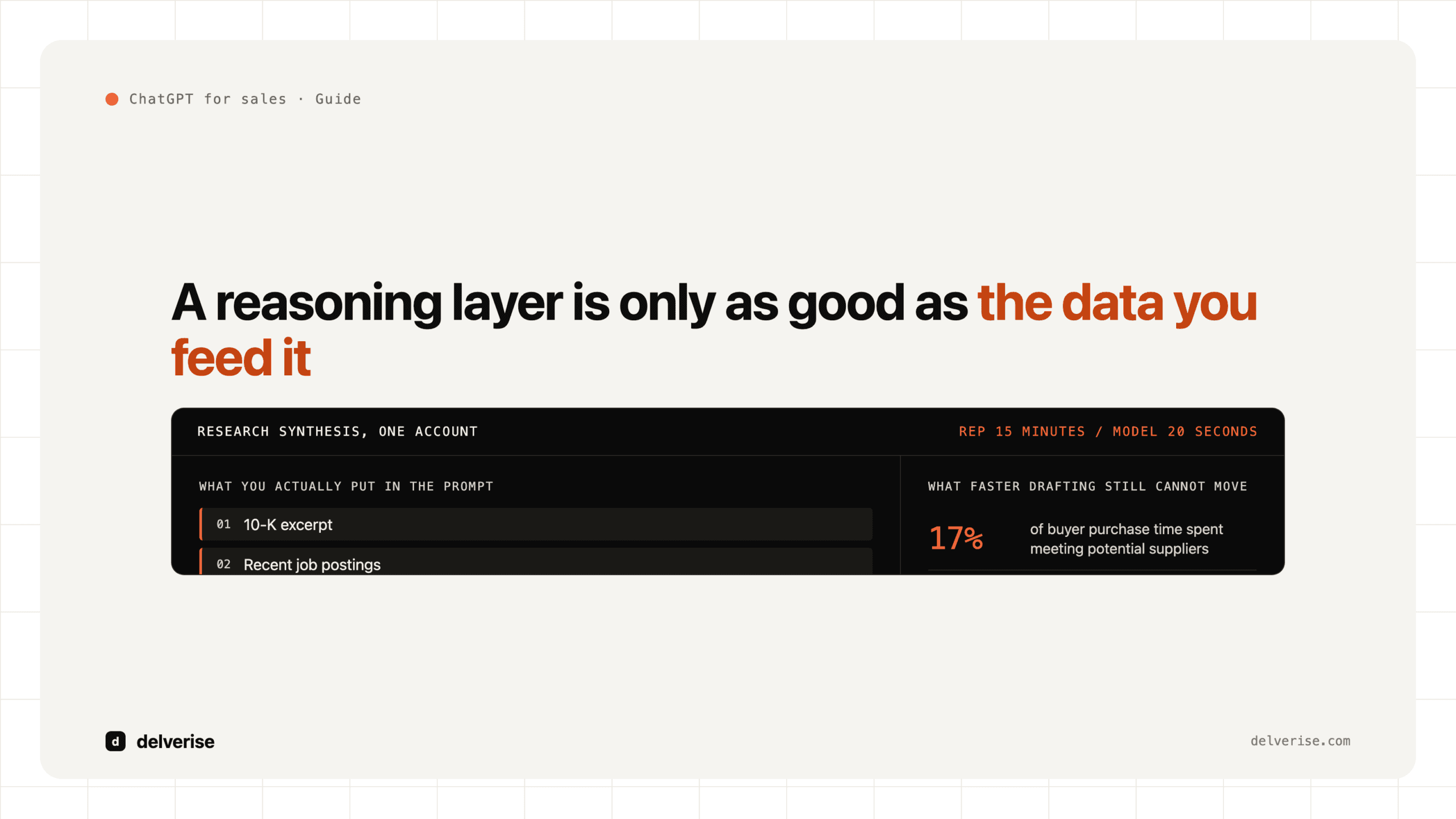
Research synthesis. Give it a company’s 10-K excerpt, recent job postings, pricing page, and a G2 review sample, and ask which of your three known pain hypotheses fits. That task takes a rep 15 minutes and an LLM 20 seconds. Salesforce’s State of Sales research has repeatedly found reps spend under a third of their week actually selling, with the remainder going to research, admin, and internal process. Research synthesis attacks the largest slice of that.
Call and thread summarization. Turning a 45-minute discovery transcript into structured fields (pain, current stack, decision process, next step, risk) is a mechanical task that models handle well. This is where CRM data quality quietly improves, which matters more than most leaders expect because every downstream forecast and scoring model reads from those fields.
Rewriting and compression. Tightening a long email, adapting a case narrative to a different persona, or turning a technical spec into buyer language. The model is a strong editor and a mediocre originator.
What it does poorly is invent an insight it was never given. If the prompt contains only a company name and a job title, the output is a plausible paragraph assembled from public generalities. Prospects have learned to recognize that shape.
Where does ChatGPT break in a real sales motion?
The first break is data. A model with no access to your product usage data, your CRM history, or the account’s actual hiring and tech signals has nothing specific to say. Fixing that means building an enrichment layer first, usually chained across multiple providers so coverage holds up. We wrote about how that chaining works in the data enrichment waterfall.

The second break is scale. Copy that a rep hand-edits in a chat window is good. Copy that the same rep pastes across 200 prospects without editing is worse than the templated sequence it replaced, because it carries the same generic structure plus occasional hallucinated details. Volume amplifies whatever quality level you started at.
The third break is buyer reality. Gartner’s B2B buying journey research found that buyers spend roughly 17% of their total purchase time meeting with potential suppliers, and when they are comparing several vendors, any single rep may get around 5% of that time. McKinsey’s B2B Pulse research found buyers now move across ten or more channels during a decision. Faster email drafting does very little against that structure. What helps is showing up with something the buyer could not have found themselves, which loops back to the data problem.
The fourth break is governance. Reps pasting customer transcripts, pricing, and pipeline data into a consumer chat account creates a real exposure. Enterprise plans with data controls, or API access under your own agreement, resolve this. Someone has to own the decision, which is typically a GTM operations responsibility rather than an individual rep’s.
ChatGPT, purpose-built sales AI, or your own workflow?
These are three different purchases with different cost structures and different failure modes.

| Dimension | ChatGPT (chat interface) | Purpose-built sales AI tool | LLM inside your own workflow |
|---|---|---|---|
| Setup effort | Minutes | Days to weeks | Weeks |
| Data access | Whatever the rep pastes | Native CRM and email integrations | Anything you connect: CRM, product usage, enrichment, web |
| Consistency across reps | Low, prompt quality varies per person | High within the vendor’s model | High, logic lives in one place |
| Cost model | Per seat, low | Per seat, moderate to high | Usage-based, plus build and maintenance |
| Best fit | Individual productivity, ad hoc research | Teams wanting a defined motion fast | Motions specific enough that no vendor covers them |
| Main risk | Invisible, unmeasurable usage | Paying per seat for a thin wrapper | Building something nobody maintains |
Most Seed to Series B teams end up with a combination: chat access for everyone, one purpose-built tool for the highest-volume motion, and a small number of custom workflows where the advantage is genuinely proprietary. Our AI sales tools buying guide goes deeper on evaluating the middle column, and AI sales assistants covers the specific category of always-on rep support.
What does a working ChatGPT sales workflow look like?
Here is a concrete example on a 300-account target list.
Step 1: assemble the inputs. For each account, gather firmographics, current headcount in the relevant function, open job postings, technologies detected on the site, and any product usage if the account has a free tier. A spreadsheet-style enrichment tool such as Clay handles this well because each column is a separate provider call and you can see exactly which accounts have coverage gaps.
Step 2: classify before you write. Run an LLM column that reads those inputs and assigns each account to one of three pain hypotheses, or to “insufficient signal.” Classification is where models are strongest and where errors are cheapest to catch, since a human can audit 300 labels in ten minutes.
Step 3: route, then generate. Accounts with a confident label and a strong signal go to a human-written sequence with one model-generated opening line grounded in the specific evidence. Accounts labeled “insufficient signal” go back to research or drop out. On a typical list, expect 30% to 50% to fall into that bucket, which is useful information about list quality.
Step 4: close the loop. Write the label, the evidence, and the outcome back to the CRM so you can later ask which hypothesis actually converted. Most teams skip this step and then have no way to improve the classifier.
The interesting part of that workflow is step 2, not step 3. Teams that jump straight to generation get volume with no learning. Teams building this pattern with Clay specifically can see how we implement it on our Clay partner page. For the fully automated version of the same motion, including where it tends to fail, see AI BDR.
How do you measure whether ChatGPT is doing anything for revenue?
Closed-won revenue is too far downstream and too noisy at Seed to Series B volumes. Use leading measures for the first two quarters:
- Research time per account. Baseline it before rollout. A 60% to 80% reduction is achievable and easy to verify.
- Account coverage. How many target accounts have a documented pain hypothesis and a named contact, as a percentage of the list.
- CRM field completeness on the fields your forecast depends on. Summarization should move this within a month.
- Reply quality, not reply rate. Track positive replies and meetings booked per 100 sends. Raw reply rate rewards volume and hides deterioration.
- Rep-level variance. If one rep gets three times the output of another from the same tool, the difference is a workflow problem worth extracting and standardizing.
If none of these move within 60 days, the constraint is somewhere other than writing speed. Common real constraints: an undifferentiated target list, slow follow-up, or an unclear ICP. Follow-up speed and context is the one that most often outranks copy quality.
What should a revenue leader do first?
- Choose one motion to instrument, usually outbound research or call summarization
- Baseline the metric you expect to move, before anyone touches a prompt
- Set the data policy: which account type, what may be pasted, where transcripts live
- Build the enrichment layer that feeds the model, ahead of any copy generation
- Assign one owner for prompts and workflows so improvements accumulate in one place
- Review output quality weekly for the first month, with humans reading actual sends
That sequence puts the data work first, which is the part most teams postpone and then blame the model for. If you want the wider view of how these pieces fit together across roles and systems, start with GTM engineering.
Frequently Asked Questions
Is ChatGPT good enough to replace an SDR?
No. It replaces specific tasks an SDR performs: research synthesis, first-draft writing, list triage, CRM logging. Judgment about which accounts deserve effort, how to handle an objection in a live conversation, and when to escalate stays human. Teams that removed the human layer entirely usually saw reply quality fall within a quarter.
Should we use ChatGPT or a dedicated sales AI platform?
Start with ChatGPT to learn what your team actually does with it, then buy a dedicated platform for whichever motion shows the highest volume and clearest repeatability. Buying the platform first means paying per seat for workflows nobody has validated yet. Our AI prospecting tools guide breaks down the categories.
How do we stop AI-generated outreach from sounding generic?
Feed the model evidence it could only get from your data: product usage patterns, hiring signals, technology changes, specific language from the account’s own materials. Generic input produces generic output regardless of prompt sophistication. Constrain the model to one or two sentences grounded in that evidence, and write the rest yourself.
What are the data privacy risks?
Consumer chat accounts have different data handling terms than enterprise or API access. Before any team-wide rollout, decide what customer data may enter the tool, choose a plan with the retention controls you need, and document it. Recorded call transcripts and pricing data are the two categories that most often need explicit rules.
How long before this shows up in pipeline?
Research and summarization gains appear within weeks. Pipeline effects take one full sales cycle plus a quarter of iteration, because you need enough labeled outcomes to know which hypotheses convert. Plan for two quarters before judging revenue impact, and use the leading indicators above in the meantime.
Read next