←Back to blog
Growth & Demand GenerationGuideNovember 24, 20268 min read
GTM Solutions: What They Are and How B2B SaaS Teams Build a Stack That Produces Pipeline
GTM solutions are the tools, data sources, and automated workflows a B2B company uses to find buyers, engage them, close deals, and expand accounts. For a Seed to Series B SaaS team, the value comes from how those pieces connect into one revenue system with shared data, clear ownership, and measurable handoffs between stages.
GTM solutions are the tools, data sources, and automated workflows a B2B company uses to find buyers, engage them, close deals, and expand accounts. For a Seed to Series B SaaS team, the value comes from how those pieces connect into one revenue system with shared data, clear ownership, and measurable handoffs between stages.
Key takeaways
- A GTM solution is a working system that includes data, engagement, a system of record, automation, and reporting. Buying one tool gives you one of those parts.
- Most pipeline problems at early-stage SaaS companies come from the gaps between tools: unsynced fields, unclear routing, and handoffs nobody owns.
- Sequence your investments by stage. Seed teams need a clean CRM and a repeatable outbound motion before they need intent data or multi-touch attribution.
- Judge any GTM solution by the pipeline it produces and the hours it removes from your team, rather than by feature count.
- The build, buy, or partner decision depends on whether you have someone who can own the integration layer full time.
What are GTM solutions, exactly?
GTM stands for go-to-market: the full set of activities a company uses to bring a product to buyers and generate revenue. A GTM solution is any tool, dataset, or workflow that supports one of those activities. In practice, the term covers everything from a CRM like HubSpot or Salesforce to an enrichment platform like Clay, a sequencing tool like Outreach or Apollo, and the automation glue (often n8n or Zapier) that moves data between them.
The phrase gets used loosely. Vendors call a single product a “GTM solution.” Revenue leaders usually mean something bigger: the combined system that takes an account from “never heard of us” to “renewed and expanded.” That second meaning is the useful one, because the revenue number depends on the whole chain holding together. The discipline of designing and maintaining that chain is increasingly called GTM engineering.
What categories make up a GTM solution stack?
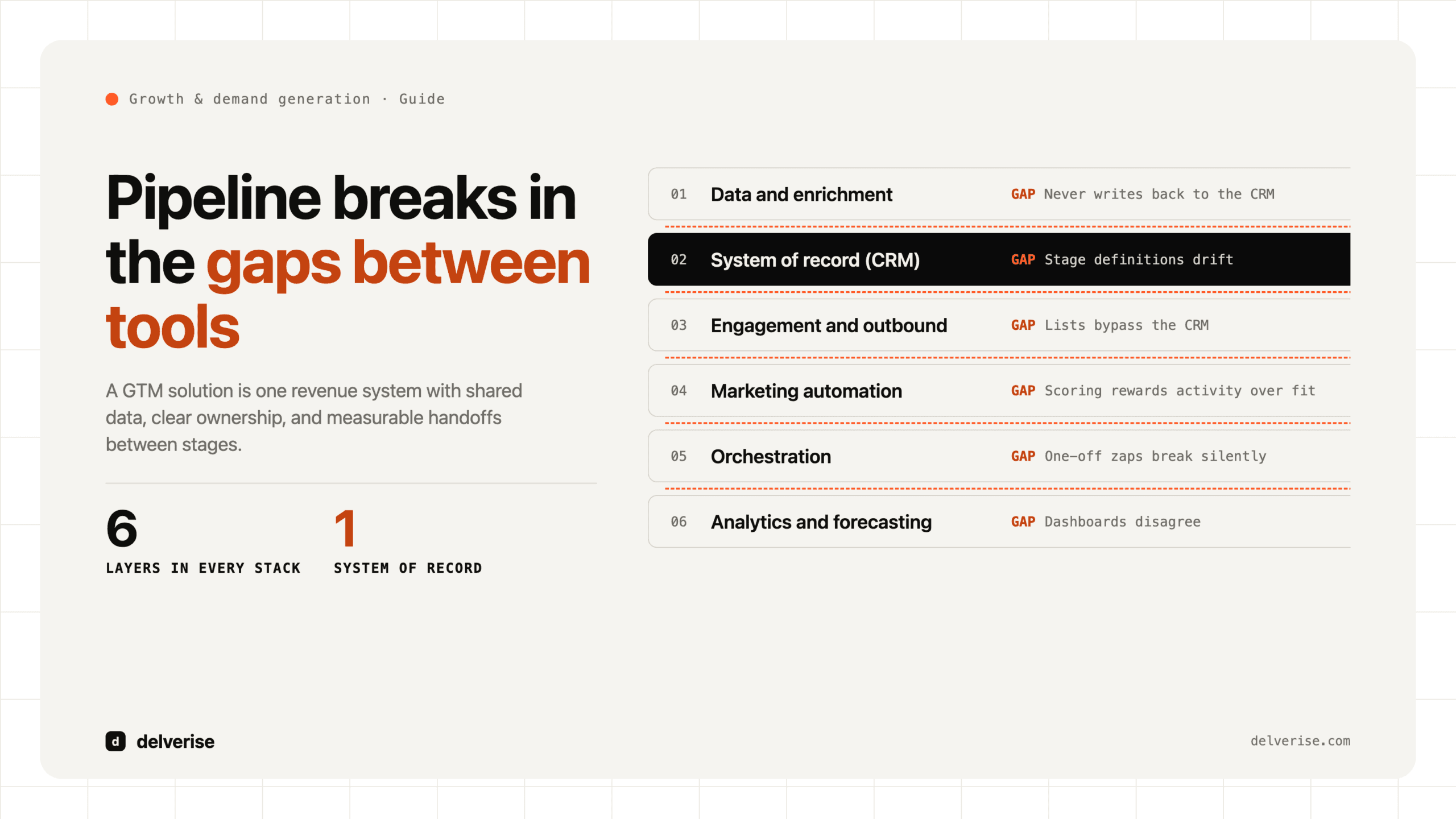
Almost every B2B SaaS revenue system, regardless of vendor choice, has the same six layers. The table below maps each one to the job it does, common tools, and the failure mode we see most often.

| Layer | Job it does | Example tools | Common failure |
|---|---|---|---|
| Data and enrichment | Builds and maintains accurate account and contact records | Clay, Apollo, ZoomInfo, SalesIntel | Enriched data never writes back to the CRM, so reps work stale records |
| System of record (CRM) | Holds the single source of truth for accounts, contacts, and deals | HubSpot, Salesforce, Close, Attio | Custom fields multiply with no owner; stage definitions drift |
| Engagement and outbound | Runs sequences across email, phone, and LinkedIn | Outreach, Salesloft, Apollo, Instantly | Sequences run off lists that bypass the CRM, creating duplicate touches |
| Marketing automation | Captures inbound, scores leads, nurtures until sales-ready | HubSpot, Marketo, Customer.io | Scoring rewards activity over fit, so sales ignores the MQLs |
| Orchestration and automation | Moves data and triggers actions between tools | n8n, Zapier, Make, native integrations | Brittle one-off zaps that break silently when a field changes |
| Analytics and forecasting | Reports pipeline, conversion, and forecast accuracy | CRM reporting, Looker, Clari, spreadsheets | Dashboards disagree because each pulls from a different source |
If you want a deeper look at what has to be in place underneath these layers, our breakdown of the six foundation pieces under every revenue stack covers the prerequisites in detail.
Why do GTM solutions so often fail to produce pipeline?
The typical Series A stack has between eight and fifteen paid tools, each bought to solve a real problem at a specific moment. Individually, most of them work. Collectively, they tend to produce three predictable problems.

Data fragmentation. Contact records live in Apollo, enrichment results sit in a Clay table, and the CRM holds a third version. Reps waste time reconciling, and reporting becomes guesswork.
Undefined handoffs. An inbound lead fills a form, gets scored, and then waits. Nobody decided who owns routing, how fast follow-up should happen, or what “qualified” means. This is where a structured qualification model earns its keep.
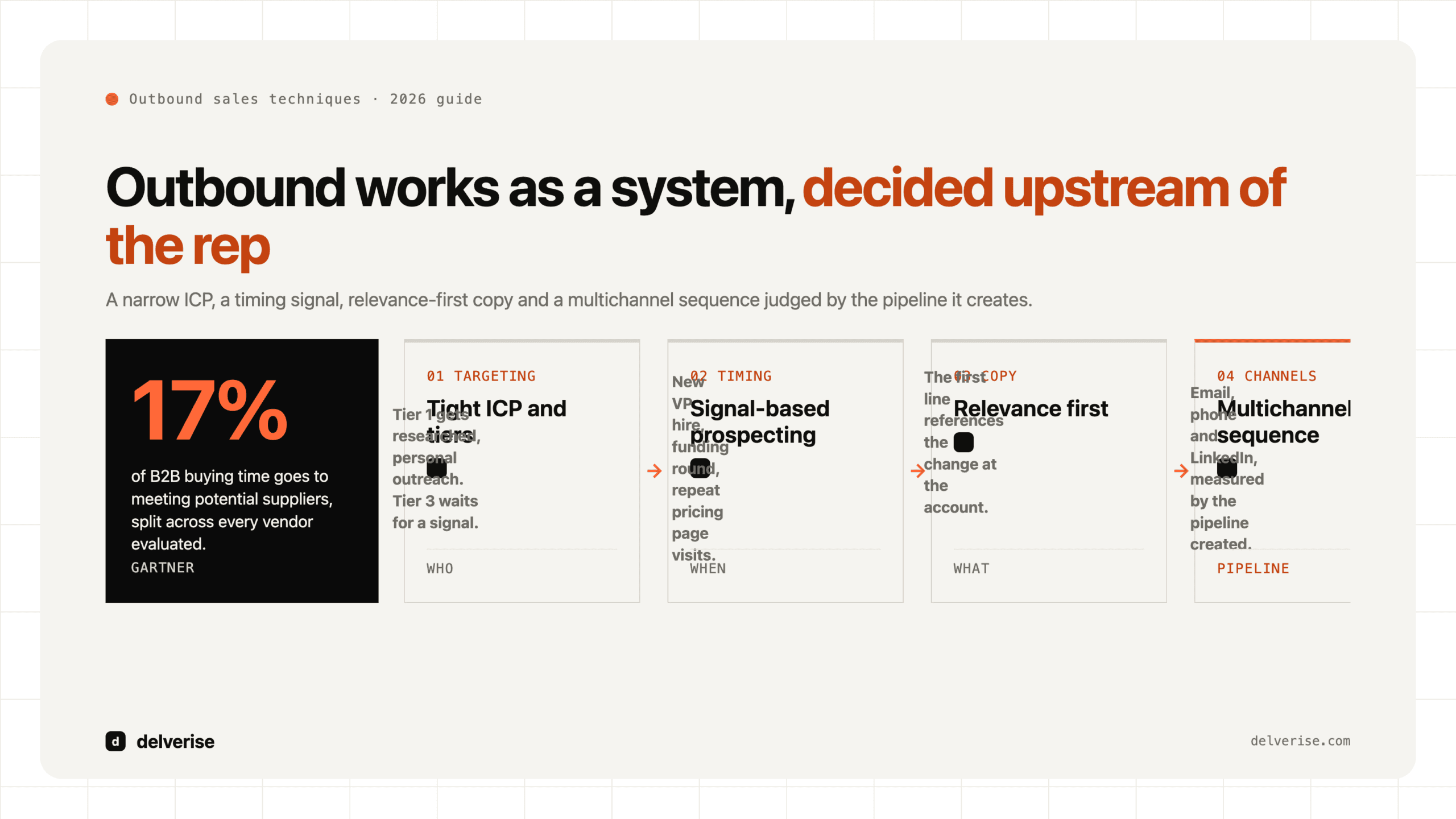
Buyer behavior outpacing the stack. Gartner’s research on the B2B buying journey found that buyers spend only about 17% of their total buying time meeting with potential suppliers, and that time gets split across every vendor they are evaluating. McKinsey’s B2B Pulse research has similarly found that buyers now move across many channels (in-person, remote, and digital self-serve) during a single purchase. A stack built around one channel, usually email sequences, misses most of the journey. Gartner has also documented that B2B purchases typically involve a buying group of several stakeholders, so a system that tracks only one contact per deal is working with partial information.
The fix in all three cases is architectural. You define how data flows, who owns each stage, and what signal triggers each action, and then you choose tools that fit that design.
How should a Seed to Series B company sequence its GTM solutions?
Buying ahead of your stage is one of the most expensive mistakes in early SaaS. Intent data, account-based advertising platforms, and conversation intelligence all have real value, but only once the basics generate consistent volume to act on. Here is a practical sequence.

Seed: prove a repeatable motion
Get one CRM configured with clean stage definitions, a small number of required fields, and a single pipeline. Add a data source and a sequencing tool to run founder-led or first-hire outbound. The goal is learning which ICP segments and messages convert. Our guide on how to get B2B leads covers the channel choices at this stage.
Series A: systematize what works
Now the motion exists and needs to scale beyond one or two people. This is when enrichment waterfalls, automated lead routing, lead scoring, and structured outbound workflows pay off. It is also when you should decide what to automate and what to keep human. Our piece on outbound sales automation walks through that line in detail. Invest in CRM enrichment that writes back to the system of record, so every downstream tool works from the same data.
Series B: instrument and forecast
With multiple reps, segments, and channels, the priority shifts to visibility. Attribution, conversion analytics by segment, and forecasting you can defend to a board become the highest-value investments. A reliable revenue forecast depends entirely on the data discipline you built in the earlier stages, which is why skipping steps shows up here as a forecast nobody trusts.
What does a connected GTM system look like in practice?
Here is an illustrative worked example of an outbound-plus-inbound flow for a Series A SaaS company selling to mid-market finance teams. The tools are examples; the structure is what matters.
- Signal capture: A job-change or funding signal lands in Clay, which pulls the account, finds the finance leader, and runs a waterfall of email and phone providers.
- ICP scoring: Clay scores the account against firmographic fit (headcount, industry, tech stack) and writes the score, plus enriched fields, to HubSpot.
- Routing: An n8n workflow checks HubSpot for existing ownership. Known accounts go to the assigned rep; net-new accounts above the fit threshold are round-robined to an SDR.
- Engagement: The rep’s sequence in Outreach starts from the CRM record, so every touch logs back to one timeline.
- Inbound convergence: If the same contact later fills a demo form, the system recognizes the account, skips the generic nurture, and alerts the owning rep within minutes.
- Reporting: Because every step writes to one system of record, pipeline by source, stage conversion, and cycle length come from a single dataset.
Nothing in that flow requires exotic software. What it requires is a deliberate design for field mapping, deduplication rules, ownership logic, and failure alerts, plus someone accountable for maintaining it when a vendor changes an API or a new segment gets added.
Should you build, buy, or bring in a partner?
There are three realistic paths, each with honest tradeoffs.
Build in-house. Hire a RevOps or GTM engineering lead to own the stack. This gives you maximum control and institutional knowledge. The cost is time: a strong hire takes months to recruit and ramp, and a single owner becomes a bottleneck and a key-person risk.
Buy an all-in-one platform. Consolidate onto a suite (HubSpot’s full platform, for example) that covers most layers natively. This reduces integration work and suits many Seed teams well. The tradeoff is depth: suites handle standard workflows cleanly but can struggle with complex enrichment, custom routing, or multi-signal outbound.
Partner with a systems builder. Bring in a specialist firm to design and build the architecture, then hand it to your team to run. This compresses timelines and brings pattern recognition from many stacks. The risk is dependency, so insist on documentation, clear ownership transfer, and outcome-based scope.
Many companies blend these: a partner builds the foundation, an internal operator runs it, and the suite handles the standard pieces. That is the model delverise works within, building revenue systems for B2B SaaS teams and handing over something the team can own.
How do you evaluate a GTM solution before buying?
Use this checklist before adding any tool to the stack:
- It solves a problem you can name with a metric (reply rate, speed-to-lead, data coverage, forecast accuracy)
- It writes data back to your CRM rather than creating a parallel database
- You know who will own it after the implementation is done
- It fits your current stage, with enough volume to justify the cost
- You checked G2 reviews from companies at your size and motion, beyond the vendor’s case studies
- You can remove it in a quarter without breaking critical workflows
Frequently Asked Questions
What is the difference between GTM solutions and a GTM strategy?
A GTM strategy defines who you sell to, what you say, which channels you use, and how you price. GTM solutions are the tools, data, and workflows that execute that strategy. Strategy comes first; the solutions should be chosen to fit it.
How many GTM tools does an early-stage SaaS company need?
A Seed company can run effectively on a CRM, one data source, a sequencing tool, and basic automation. Tool count should grow only when a clear bottleneck appears that the current stack cannot solve.
Is Clay a GTM solution?
Clay is a data enrichment and workflow platform that sits in the data layer of a GTM system. It is powerful for building targeted lists and signal-based outbound, but it delivers the most value when its output feeds a clean CRM and a defined routing process.
Who should own GTM solutions inside a company?
Ownership usually sits with RevOps or a GTM engineering function that reports to the CRO or CEO. Whoever owns it needs authority over field definitions, stage criteria, and tool purchases, or the stack fragments again within a few quarters.
How long does it take to build a working GTM system?
A focused build covering CRM cleanup, enrichment, routing, and outbound workflows typically takes several weeks to a few months, depending on data quality and how many tools need to be integrated. Maintenance is ongoing, since vendors, segments, and team structure keep changing.