←Back to blog
Revenue Intelligence & Data ToolingGuideJuly 28, 202610 min read
Artificial Intelligence for Sales and Marketing: A Revenue Leader’s Guide
Artificial intelligence for sales and marketing means using machine learning and large language models to research accounts, score intent, personalize messaging, and automate the manual work between systems. In B2B SaaS, it pays back fastest on research and data enrichment, not on message generation. The returns depend on your data quality, not on your model choice.
Artificial intelligence for sales and marketing means using machine learning and large language models to research accounts, score intent, personalize messaging, and automate the manual work between systems. In B2B SaaS, it pays back fastest on research and data enrichment, not on message generation. The returns depend on your data quality, not on your model choice.
Key takeaways
- AI compounds on top of clean data and a working revenue system. Bolted onto a broken funnel, it produces more bad output faster.
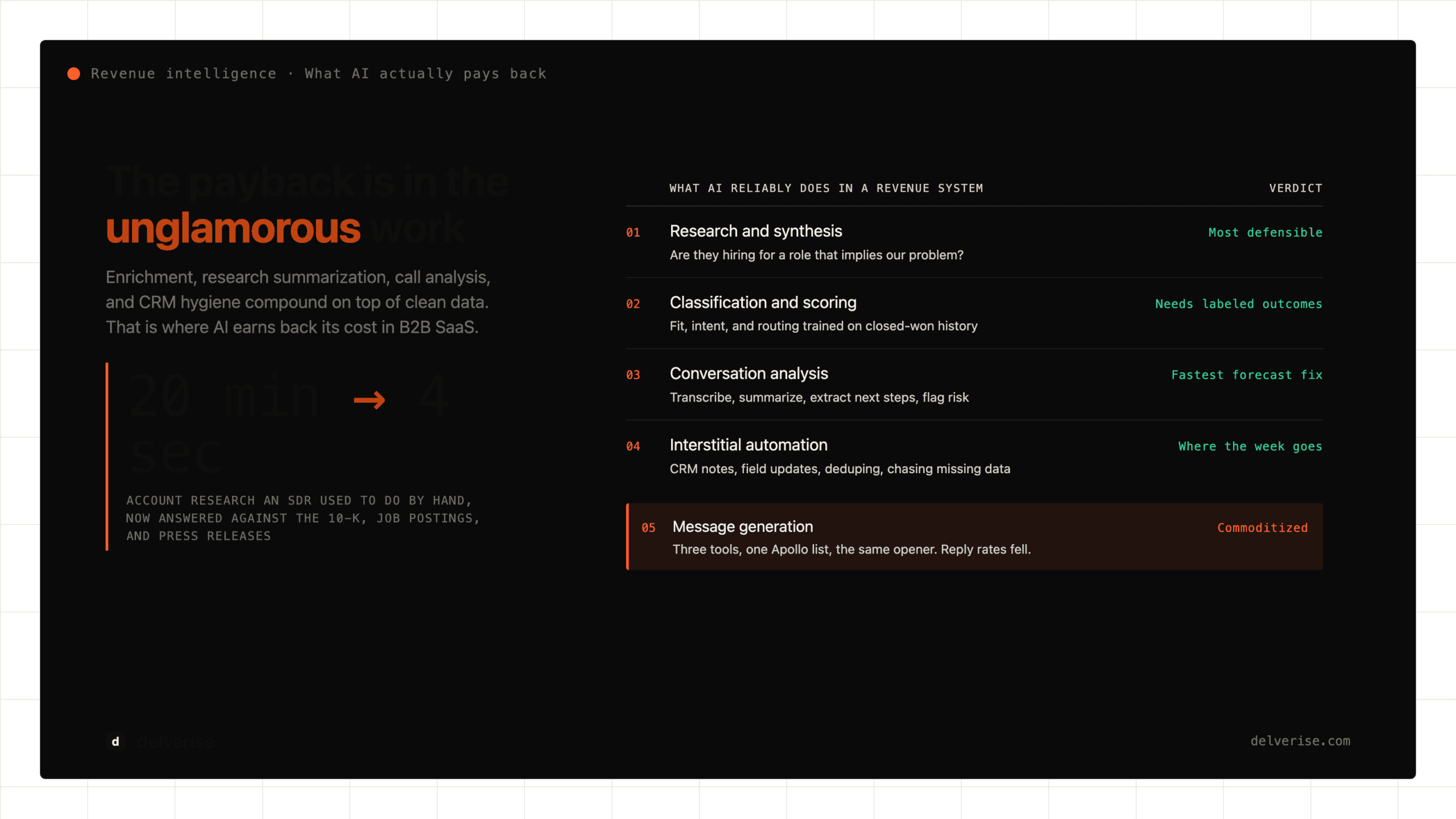
- The highest-ROI use cases are unglamorous: enrichment, research summarization, list building, call analysis, and CRM hygiene.
- AI-generated cold email volume has commoditized itself. Deliverability and reply rates have fallen as everyone adopted the same tools.
- Gartner has projected a steep decline in traditional search volume as buyers shift to AI assistants, which changes how demand reaches you.
- Budget for the plumbing, not the models. Integration, data quality, and workflow design consume most of the effort in any real deployment.
What does artificial intelligence for sales and marketing actually do today?
Strip away the category noise and there are four things AI reliably does well in a B2B revenue system.
Research and synthesis. An LLM can read a company’s 10-K, job postings, press releases, and product pages, then answer a specific question: are they hiring for a role that implies our problem? This is genuine work that a human SDR would need twenty minutes to do and now takes four seconds. It is the single most defensible AI use case in go-to-market.
Classification and scoring. Fit scoring, intent scoring, and lead routing are pattern-matching problems, and models are good at pattern matching when you have enough labeled outcomes. If you have closed-won and closed-lost history, you have training data. Most teams do this badly because they score on firmographics alone. We wrote about how to do it properly in our guide to lead scoring for B2B SaaS.
Conversation analysis. Call recording tools now transcribe, summarize, extract next steps, and flag risk signals across every deal in your pipeline. This is the fastest path from “our forecast is a spreadsheet of vibes” to “our forecast reflects what buyers actually said.”
Interstitial automation. The work between your systems: writing CRM notes, updating fields, routing leads, deduping records, chasing missing data. It is boring and it is where a real percentage of your team’s week disappears.
Notice what is missing from that list. Message generation is on it only implicitly, and deliberately so.
Why has AI-generated outbound stopped working?
Two years ago, an AI-personalized cold email was a differentiator. Today every competitor in your category is running the same three tools against the same Apollo list with the same “I noticed you’re hiring for a Head of Demand Gen” opener. Buyers have learned to spot it instantly.
The mechanics of this are simple. When a tactic’s cost drops to near zero, volume rises until the response rate collapses back to the point where marginal effort equals marginal return. AI dropped the cost of a personalized email to near zero. Volume rose accordingly. Reply rates fell.
The second-order effect is worse. Mailbox providers respond to volume spikes by tightening spam filtering, which means your legitimate, well-researched emails now land in fewer inboxes because of what everyone else did. You are paying a deliverability tax on someone else’s automation.
This does not mean stop doing outbound. It means the edge moved. It moved from writing to targeting: who you contact, on what trigger, with what evidence that now is the moment. That is a data problem, and AI is genuinely good at data problems. We go deeper on where the automation holds and where it snaps in AI BDR: what it actually automates and where it breaks.
Where should AI actually sit in your revenue system?
Here is the honest allocation of effort we see work, expressed as a comparison of the common approaches:
| Use case | Payback | Failure mode | Human still required for |
|---|---|---|---|
| Account research and enrichment | High, fast | Hallucinated facts entering the CRM as truth | Defining what signal actually predicts a deal |
| Lead and intent scoring | High, slow (needs history) | Scoring on firmographics, ignoring behavior | Labeling outcomes honestly, including bad-fit wins |
| Call and deal analysis | High, fast | Insights nobody reads or acts on | Changing the coaching and forecast process |
| Cold email copy generation | Low and falling | Generic output, deliverability damage | Positioning, offer, and the actual reason to reply |
| Content production at volume | Medium, conditional | Thin pages that rank for nothing | Point of view, proprietary data, real expertise |
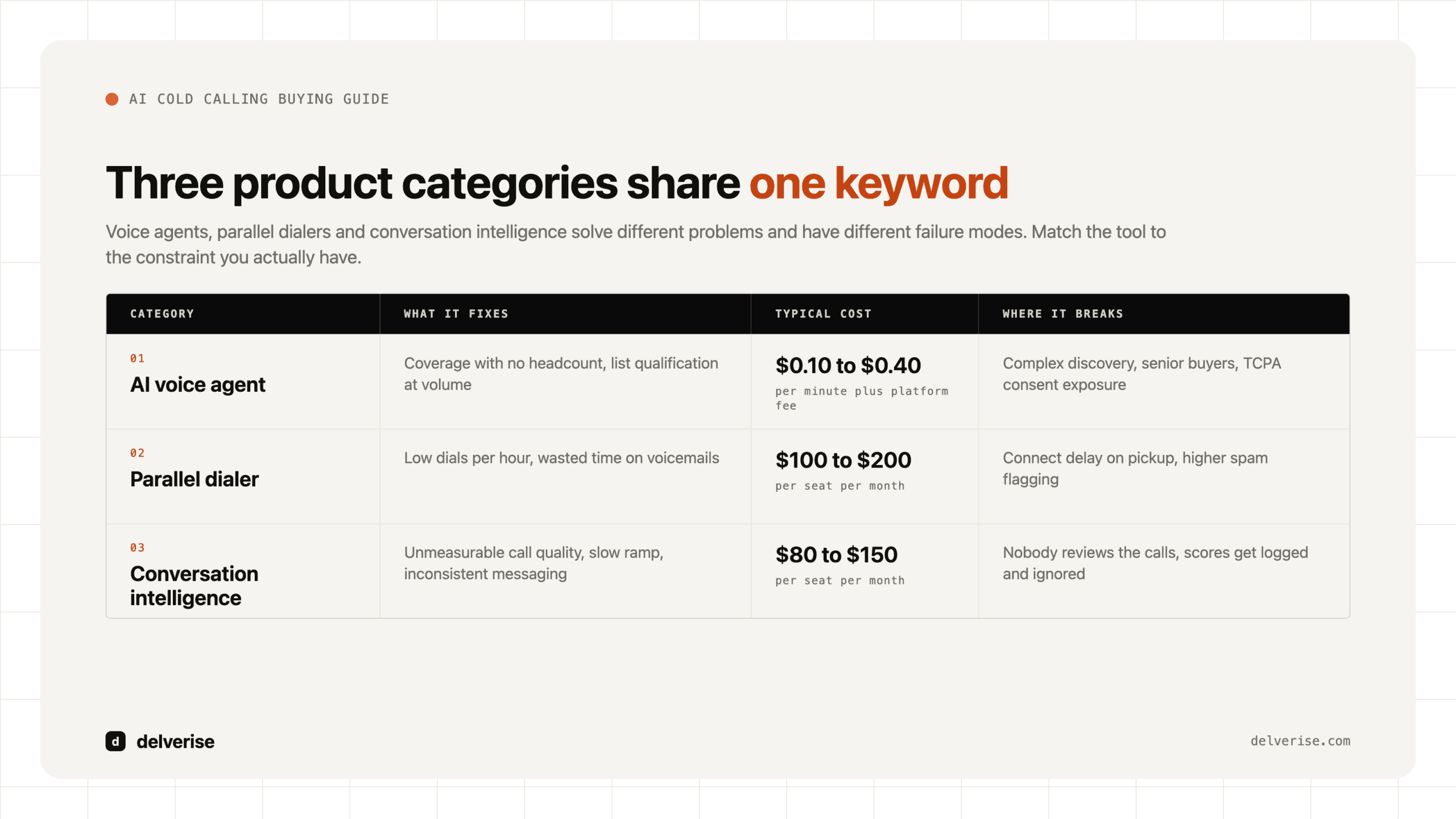
| Voice AI / AI cold calling | Low to medium, situational | Brand damage, compliance exposure | Deciding whether your buyer tolerates it at all |
The pattern: AI wins where the task is reading and structuring information, and it struggles where the task is earning attention. Attention is scarce because it is expensive to earn. Anything that makes it cheap to attempt makes it harder to win.
What does a working AI sales and marketing workflow look like?
Concrete example. A Series A SaaS company selling compliance software to fintechs wants to reach companies at the moment they are exposed to a new obligation.
The naive approach: buy a list of fintechs, run it through an AI writer, send 5,000 emails. Predictable result, and you can guess it.
The engineered approach:
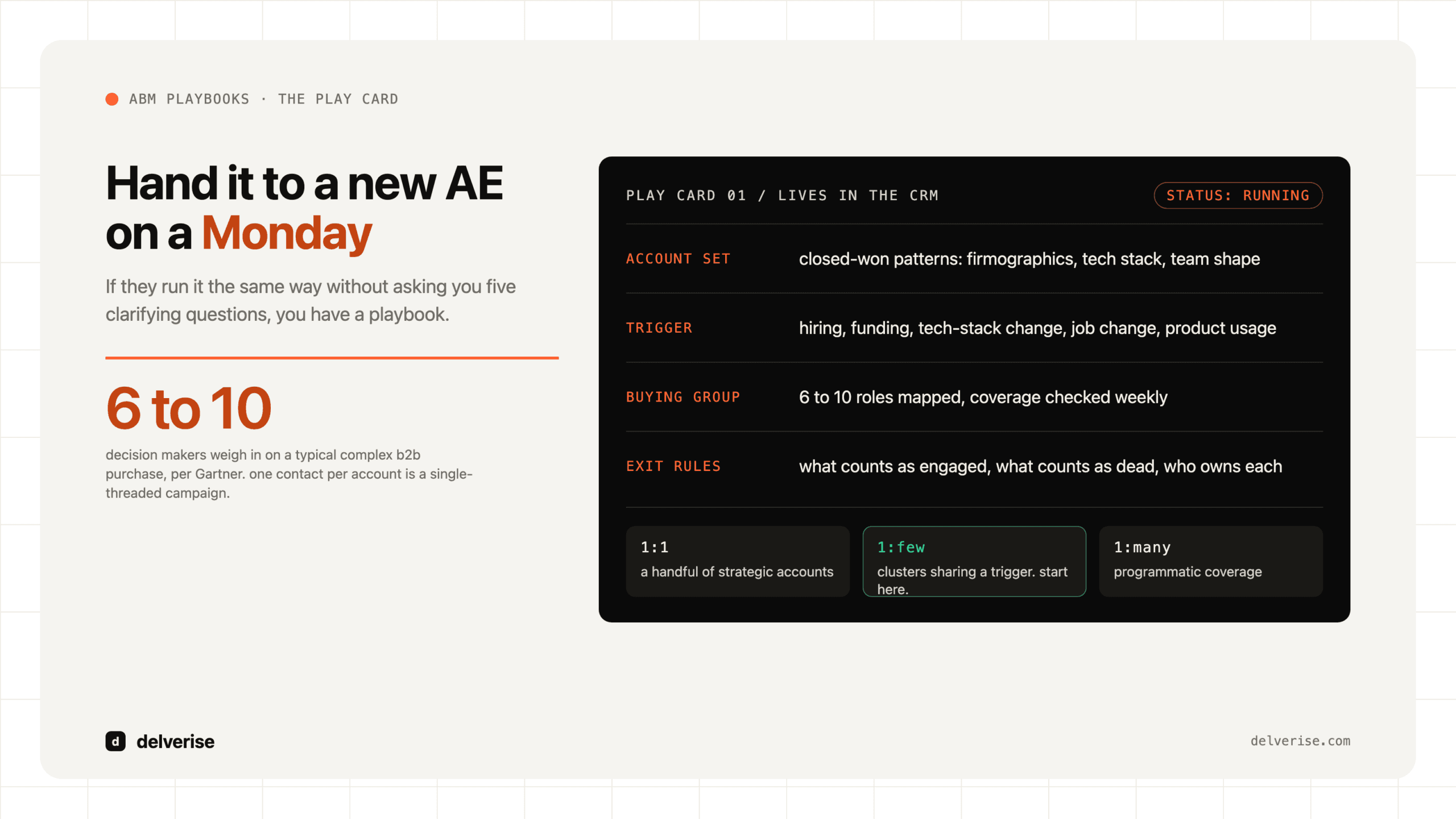
- Trigger definition. The team defines three buying triggers from closed-won history: a new compliance or risk hire, a funding round above $10M, and a public product launch into a regulated vertical.
- Signal capture. A workflow monitors job boards, funding databases, and company newsrooms daily. Each hit becomes a row.
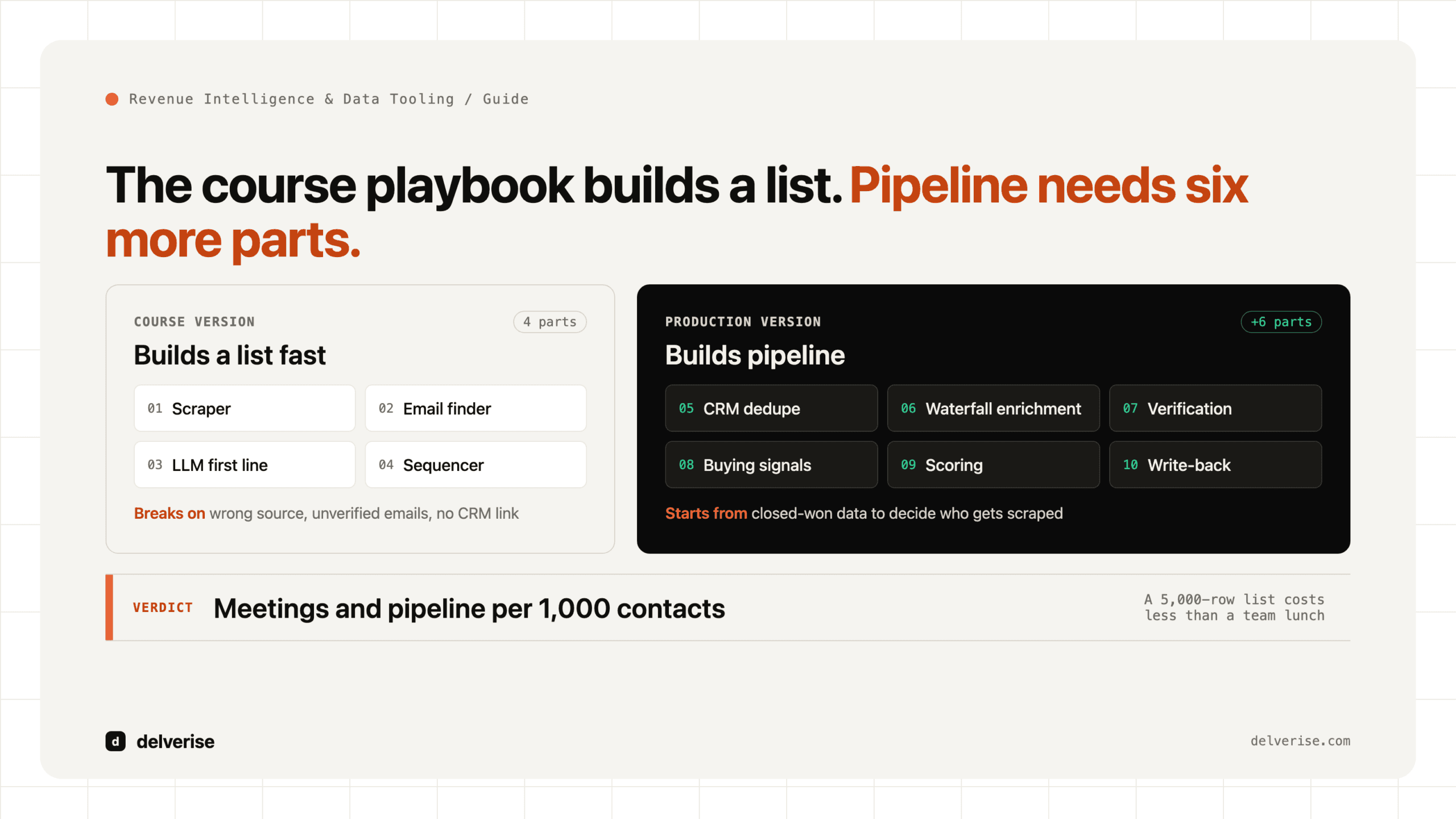
- Enrichment and waterfall. Each account is enriched through chained data providers so that when one provider misses an email or a phone number, the next one is tried. Match rates improve materially versus a single vendor. We break the mechanics down in our waterfall enrichment guide.
- LLM qualification. A model reads the job description and the company’s product pages and answers one question: does this company handle customer funds in a way that triggers the obligation we solve for? Yes, no, or unclear. Unclear goes to a human.
- Evidence-based outreach. The email references the specific trigger, not a generic compliment. One human reviews before send.
The AI is doing the reading. The human is doing the judgment and the writing. Volume drops by 90 percent, meeting rate rises, and domain reputation stays intact.
Most teams build this kind of workflow in Clay, which sits between your data providers, your enrichment logic, and your CRM, with LLM steps available at any point in the chain. It is genuinely good at this, and it is also easy to burn credits on if you sequence the enrichment badly or run expensive steps before you have filtered the list. Honest tradeoff: it rewards teams who think in systems and punishes teams who treat it as a magic list builder. If you want the system designed and built rather than assembled by trial and error, that is what our Clay implementation work covers.
How is AI changing how buyers find you?
The demand-generation side of this question matters more than most revenue leaders have priced in.
Gartner has projected a substantial decline in traditional search engine volume as buyers move queries into AI assistants and chat interfaces. Whether the exact figure lands or not, the direction is not in dispute: a growing share of your buyers will form their shortlist inside an AI answer they never click through from.
McKinsey’s research on B2B buying has consistently found that buyers now move through most of their decision process before they contact a vendor, and they expect a consistent experience across digital and human channels. Combine those two facts and the implication is uncomfortable. If the AI assistant does not surface you when a buyer asks “who solves X for fintechs,” you were never in the consideration set, and no amount of SDR activity recovers that.
This is why content strategy is now a revenue system problem. The pages that get cited by AI assistants tend to be the ones that answer specific questions directly, define terms cleanly, and contain information that is not available everywhere else. Thin AI-generated content fails this test by construction. Proprietary benchmarks, honest comparisons, and real operating detail pass it.
Practically: audit what an AI assistant says about your category today. Ask it the five questions your buyers ask. See whether you appear, and see what it says about you. That fifteen-minute exercise reprioritizes most content roadmaps.
What should we build first?
The sequence matters more than the tool selection. Data quality gates everything downstream, so it goes first.
- Fix the CRM data model before adding AI. If your account, contact, and opportunity objects do not reflect how you actually sell, every model you build on top inherits the confusion.
- Define your ICP from closed-won and closed-lost data, not from a workshop. Include the deals you won and regret.
- Instrument the funnel end to end so you can attribute changes. If you cannot measure your current conversion rates, you cannot tell whether AI helped.
- Pick one workflow with a clear owner and a clear metric. Enrichment and research is usually the right first bet because payback is fast and the failure mode is cheap.
- Set a human review gate on anything customer-facing. Every AI failure that reaches a buyer costs more than it saved.
- Measure at the pipeline level, not the activity level. More emails sent is not a result.
The teams that get value from artificial intelligence for sales and marketing tend to have one thing in common: they treated it as an engineering problem with a revenue metric attached, and they owned the system rather than renting it from six disconnected vendors. If your GTM roles and ownership are unclear, AI will not fix that. It will make the confusion faster.
What does this cost, honestly?
Tooling is the small number. A capable stack of enrichment credits, an AI workflow platform, a call intelligence tool, and model API access runs a Seed to Series B company somewhere in the low thousands per month. That is not the constraint.
The constraint is engineering time and clarity. Someone has to define the triggers, design the data flow, write the prompts, test the outputs, handle the edge cases, and maintain the thing when a provider changes its API. Teams that budget for the software and not the system end up with a stack of expensive subscriptions and no measurable pipeline change. That gap is the single most common pattern we see when we come in to fix an AI go-to-market build. For a broader survey of what to buy and what to skip, our guide to AI sales tools that actually move revenue covers the buying decisions in detail, and AI in marketing and sales covers what is working right now in B2B SaaS specifically.
Frequently Asked Questions
Will AI replace SDRs and marketers in B2B SaaS?
It replaces tasks, not roles, and the tasks it replaces are the ones nobody wanted: manual research, list building, data entry, and note-taking. What it does not replace is judgment about who to sell to, why they should care, and what to say when a deal stalls. Teams that cut headcount before the system is proven usually rehire within two quarters. The realistic outcome is smaller teams doing higher-value work with a much larger surface area of accounts covered.
How much data do we need before AI scoring works?
You need enough closed-won and closed-lost history for patterns to be real rather than noise, which in practice means at least a few hundred closed opportunities. Below that, rules-based scoring built from your own observed buying triggers will beat a model, and it is far easier to explain to your sales team. Start with rules, then move to a model when the volume justifies it.
Should we build AI workflows in-house or buy a platform?
Buy the platform, build the workflow. Building your own enrichment orchestration, provider fallbacks, and LLM chaining from scratch is months of engineering that produces no differentiation. The differentiation is in your triggers, your ICP definition, and your data model. Platforms like Clay, n8n, and the native automation inside your CRM handle the plumbing so your team can spend its time on the logic that is actually specific to your business.
Is AI cold calling worth testing?
It depends entirely on your buyer. In some markets it produces conversations at a cost per meeting that is hard to argue with. In others, an obviously synthetic voice on the phone does lasting brand damage with exactly the senior buyers you most need. Test it in a segment you can afford to burn, measure the downstream conversion rate rather than the connect rate, and be honest about what happens when the buyer realizes. We cover the tradeoffs in detail in our piece on AI cold callers.
What is the single biggest mistake revenue leaders make with AI here?
Buying tools before defining the system. AI amplifies whatever process it is dropped into, so a well-defined revenue motion gets faster and a confused one gets confused faster and at greater expense. Spend the first month on data, ICP definition, and trigger design. Spend the second month building one workflow well. The teams that do this outperform the teams that bought six AI products in a quarter, every time.
Read next