←Back to blog
Revenue Intelligence & Data ToolingGuideJuly 28, 20268 min read
Lead Nurture Software: What B2B Revenue Leaders Should Evaluate Before Buying
Lead nurture software automates the sequenced follow-up between a lead’s first touch and a real sales conversation, triggering email, SMS, ads, and in-product messages based on behavior and firmographic fit. In B2B SaaS, its job is routing attention: pushing ready buyers to sales fast and keeping the other 90% warm at near-zero marginal cost.
Lead nurture software automates the sequenced follow-up between a lead’s first touch and a real sales conversation, triggering email, SMS, ads, and in-product messages based on behavior and firmographic fit. In B2B SaaS, its job is routing attention: pushing ready buyers to sales fast and keeping the other 90% warm at near-zero marginal cost.
Key takeaways
- Nurture software is an execution layer. It amplifies whatever routing logic, data quality, and messaging you feed it, including the bad parts.
- Four distinct categories get sold as “lead nurture”: marketing automation suites, sales engagement platforms, lifecycle messaging tools, and data orchestration layers. Most teams need two of them, wired together.
- The buying decision that matters is not the tool. It is who owns the trigger logic and whether your CRM data can support it.
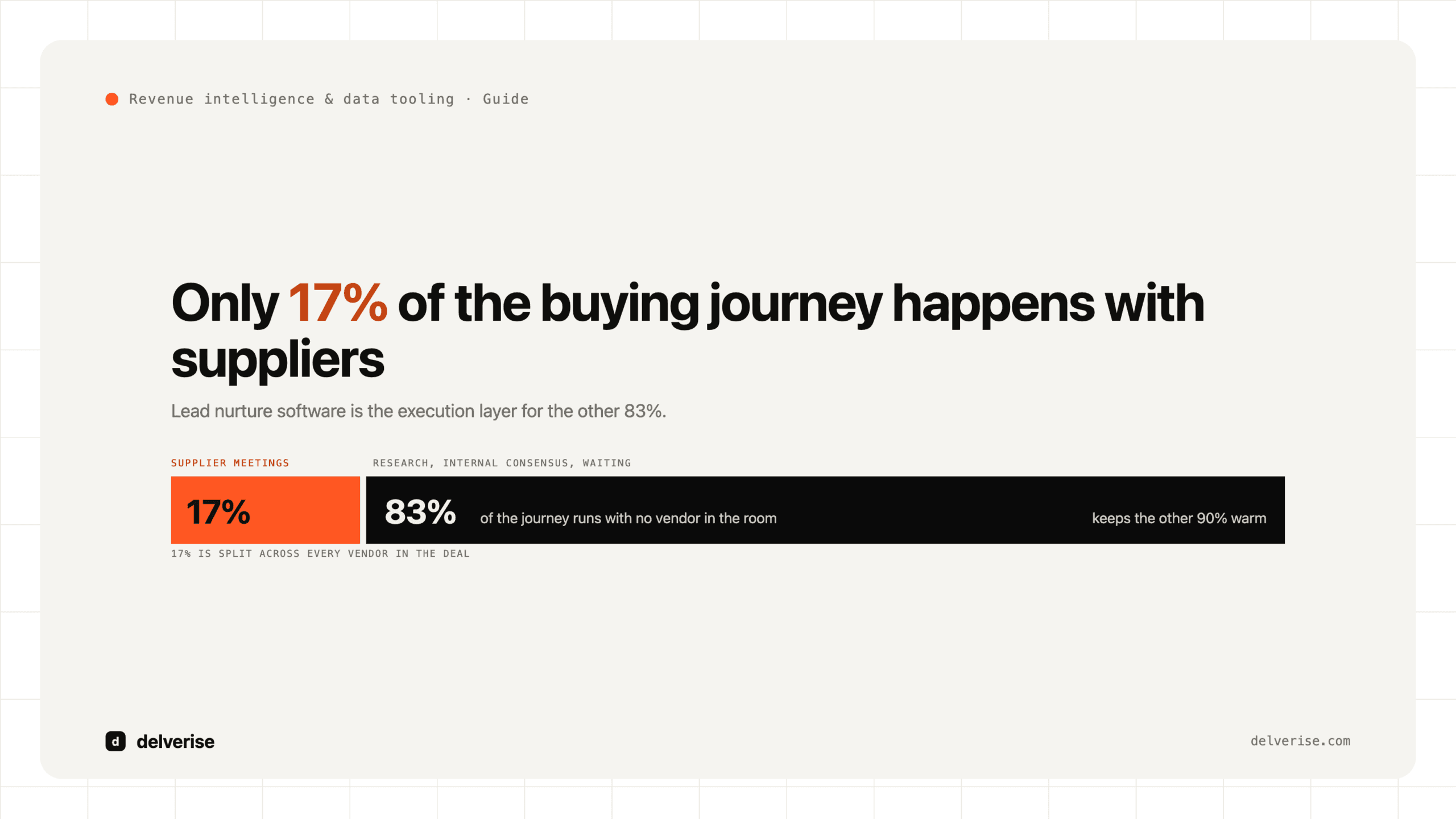
- Gartner’s research on B2B buying found that buyers spend only about 17% of their purchase journey meeting with potential suppliers, split across every vendor in the deal. Nurture is how you stay useful during the other 83%.
- Budget for implementation at roughly the same order of magnitude as year-one license cost. Teams that skip this end up with an expensive drip campaign.
What is lead nurture software, exactly?
Lead nurture software is the system that decides what happens to a lead between “they raised a hand” and “sales has a qualified conversation.” It listens for signals (a pricing page visit, a webinar registration, a job change, a product trial that stalled at step three), evaluates them against rules or a score, and fires the next touch.
Two terms worth defining, because vendors blur them. Nurture means multi-touch follow-up over weeks or months for leads who are not yet sales-ready. Sequencing or cadence means short, sales-owned outreach over days for leads who are. Different tools are good at each. Buying one and expecting it to do both is the most common and most expensive mistake in this category.
Nurture sits inside a larger flow. If your funnel model is fuzzy about what a stage means and who owns it, no software will fix that downstream.
Why do most lead nurture programs stall after the first three emails?
Three reasons, in order of how often we see them.

The data cannot support the branching. A nurture track that segments by company size, tech stack, and role requires those fields to be populated on 80%+ of records. Most Seed to Series B CRMs are at 30 to 50%. So the “personalized” track collapses into one generic path, and performance matches.
Nobody owns the content refresh. A nurture program is a content obligation, not a one-time build. Five tracks with six emails each is 30 assets that decay. Without a named owner, the program runs stale copy for eighteen months and everyone blames the platform.
The handoff to sales is undefined. Marketing marks a lead as engaged, sales says the lead is junk, and the loop never closes. This is a lead scoring and definitions problem that surfaces as a software complaint. Fix the definition of “sales-ready” with both teams in the room before you touch the tool.
There is also a speed problem hiding underneath. The classic Harvard Business Review analysis of online sales leads found that companies responding within an hour were dramatically more likely to qualify the lead than those waiting even a few hours longer. If your nurture software is holding a hot inbound lead in a five-day drip because the score threshold is set too high, it is actively costing you pipeline.
What are the categories of lead nurture software, and which do you need?
| Category | Representative tools | Best when | Where it breaks |
|---|---|---|---|
| Marketing automation suite | HubSpot Marketing Hub, Marketo, Pardot | You need email nurture, forms, landing pages, and scoring in one place with native CRM sync | Complex branching gets slow and expensive; real-time behavioral triggers are weak |
| Sales engagement platform | Outreach, Salesloft, Apollo | Reps own the follow-up and you need call, email, and task cadences in the rep’s workflow | Poor fit for long-horizon nurture; sequences are built for weeks, not quarters |
| Lifecycle and product messaging | Customer.io, Braze, Intercom | Product usage is your strongest buying signal (PLG or hybrid motion) | Weak firmographic segmentation; needs an event pipeline someone has to build |
| Data and orchestration layer | Clay, n8n, Census, reverse ETL | Your bottleneck is enrichment, dedupe, routing logic, or signal detection | Sends nothing on its own; it feeds the tools above and needs technical ownership |
Most B2B SaaS teams between Seed and Series B land on a suite plus an orchestration layer. The suite sends; the orchestration layer decides who gets what. If you are evaluating that second piece, Clay is worth a look. It chains enrichment providers, runs AI research on accounts, and writes clean segmentation fields back into your CRM, which is the input nurture branching actually depends on. It is credit-priced, so cost scales with how much you enrich, and it rewards teams willing to think in tables and waterfalls. When teams want that built and maintained rather than learned from scratch, that is where our Clay implementation work comes in.

For a deeper look at how enrichment and signal tooling fits together, see our breakdown of the lead intelligence platform category.
Is your data ready for nurture automation?
Run this before you sign anything. If you fail more than two lines, spend the first 60 days on data and routing instead of licenses.

- Company size, industry, and role are populated on at least 70% of net-new leads within 24 hours of creation
- Duplicate contact rate in the CRM is under 5% and there is an automated dedupe rule, not a quarterly cleanup
- “Marketing qualified” has a written definition that a sales leader has signed off on in the last six months
- Website and product events flow into the CRM or CDP with under five minutes of latency
- You can report conversion rate from each nurture track to opportunity, not just to email click
- One named person owns nurture content refresh with time allocated for it
What does the math actually look like?
Take a $15,000 ACV product with 500 net-new inbound leads a month. Historically, 8% convert to a sales conversation within 90 days and 20% of those close, giving 8 new customers a month, or $1.44M in new ARR annually.
Now assume nurture software does two realistic things. First, it cuts response time on the top-fit 15% of leads from 26 hours to 10 minutes by routing them straight to a rep instead of into a drip. Second, it recycles the 92% who did not convert into a fit-based track with quarterly reactivation triggers.
If fast routing lifts conversion on that top slice from 8% to 14%, and recycling recovers just 2% of the remaining pool over a year, you add roughly 5 to 6 customers a month at the same lead volume. That is $900K to $1.1M of incremental ARR against a platform and implementation cost typically in the $40K to $90K range for year one. The sensitivity to note: the entire model depends on correctly identifying the top-fit 15%. Get the fit definition wrong and you have just built a faster way to route bad leads.
Should you build the logic in-house or buy a platform that includes it?
Buy the sending infrastructure. Almost nobody should build email delivery, suppression management, and unsubscribe compliance. Own the routing and scoring logic, because that is where your commercial judgment lives and it will change four times a year.
The practical split we recommend: a mainstream suite for execution, an orchestration layer for enrichment and decisioning, and internal ownership of the rules. That last part needs a person. Whether that is a RevOps hire, a marketing operations lead, or a fractional resource depends on stage, and our guide to the GTM role you actually need next covers the tradeoffs. Systems built without a named owner degrade within two quarters. This is the core of GTM engineering as a discipline: treating the revenue system as something designed, instrumented, and maintained.
One honest caution on AI features. Every vendor in this category now ships AI copy generation and predictive scoring. The copy tools are genuinely useful for producing track variants at volume. The predictive scoring is only as good as your closed-won history, and below roughly 200 to 300 closed deals the models overfit. Our guide to what an AI sales assistant can and cannot do goes deeper on where the line sits today. McKinsey’s research on B2B buying has consistently found that buyers now move across ten or more channels in a single purchase journey, which is a good argument for orchestration across channels and a poor argument for trusting any single-channel engagement score.
Frequently Asked Questions
What is the difference between lead nurture software and marketing automation?
Marketing automation is the broader platform category covering email, forms, landing pages, and campaign management. Lead nurture is one workflow that runs inside it. Some teams run nurture entirely in a marketing automation suite; others run it across a sales engagement tool and a lifecycle messaging tool because the audience and time horizon differ.
How long should a B2B nurture sequence be?
Match it to your sales cycle rather than a default. For a 60-day cycle, six to eight touches over eight weeks is reasonable. For an enterprise motion with a nine-month cycle, plan quarterly value touches over a year or more, with reactivation triggers tied to job changes, funding events, and hiring signals rather than time alone.
Do we need lead scoring before we buy nurture software?
You need a fit definition, which is simpler than a score. Write down the three to five attributes that make an account worth a rep’s time. That alone supports meaningful branching. Behavioral scoring can come later once you have enough conversion data to validate which signals actually predict opportunities.
What does lead nurture software cost for a Series A SaaS company?
Platform licenses commonly run $1,000 to $5,000 a month at that stage depending on contact volume and tier, with enrichment credits and orchestration adding a few hundred to a few thousand more. Implementation, data cleanup, and track build typically cost a comparable amount in year one, whether paid to a partner or absorbed as internal headcount time.
How do we measure whether nurture is working?
Track conversion from nurture entry to sales-accepted opportunity by track, and the pipeline value of recycled leads that would otherwise have been closed-lost. Open and click rates tell you whether the email landed. They say nothing about revenue. Our guide to B2B customer engagement strategies covers the downstream metrics that connect engagement to retained revenue.
Read next