←Back to blog
Revenue Intelligence & Data ToolingGuideJuly 12, 20268 min read
SignalHire Free Trial: What Revenue Leaders Should Test Before They Buy
The SignalHire free trial gives you a small number of credits to reveal business and personal contact details from LinkedIn profiles, mostly through its browser extension. For a revenue leader, it is a fast way to test data accuracy and coverage against your real target accounts before you commit budget to any single contact-data source.
The SignalHire free trial gives you a small number of credits to reveal business and personal contact details from LinkedIn profiles, mostly through its browser extension. For a revenue leader, it is a fast way to test data accuracy and coverage against your real target accounts before you commit budget to any single contact-data source.
Key takeaways
- SignalHire is a contact-finding tool that reveals professional and personal emails and phone numbers from public profiles, used mainly as a LinkedIn extension.
- The free trial is enough to judge data quality on your own accounts, and too small to judge whether the tool scales for a whole GTM motion.
- Evaluate a free trial on match rate, phone accuracy, and deliverability against your ideal customer profile, not on a random sample of easy contacts.
- Any single contact source has blind spots, so most mature revenue teams treat tools like SignalHire as one input in a waterfall, not the whole system.
- The buying decision is an operations question about coverage and cost per verified contact, and it belongs inside your broader data strategy.
What is SignalHire, and what does the free trial actually include?
SignalHire is a B2B contact-data tool. Its core job is contact enrichment: taking a name and a company or a LinkedIn profile and returning a work email, a personal email, and often a direct or mobile phone number. Most people use it through a Chrome extension that sits on top of LinkedIn, with bulk search and a basic recruiting workflow available on paid tiers.

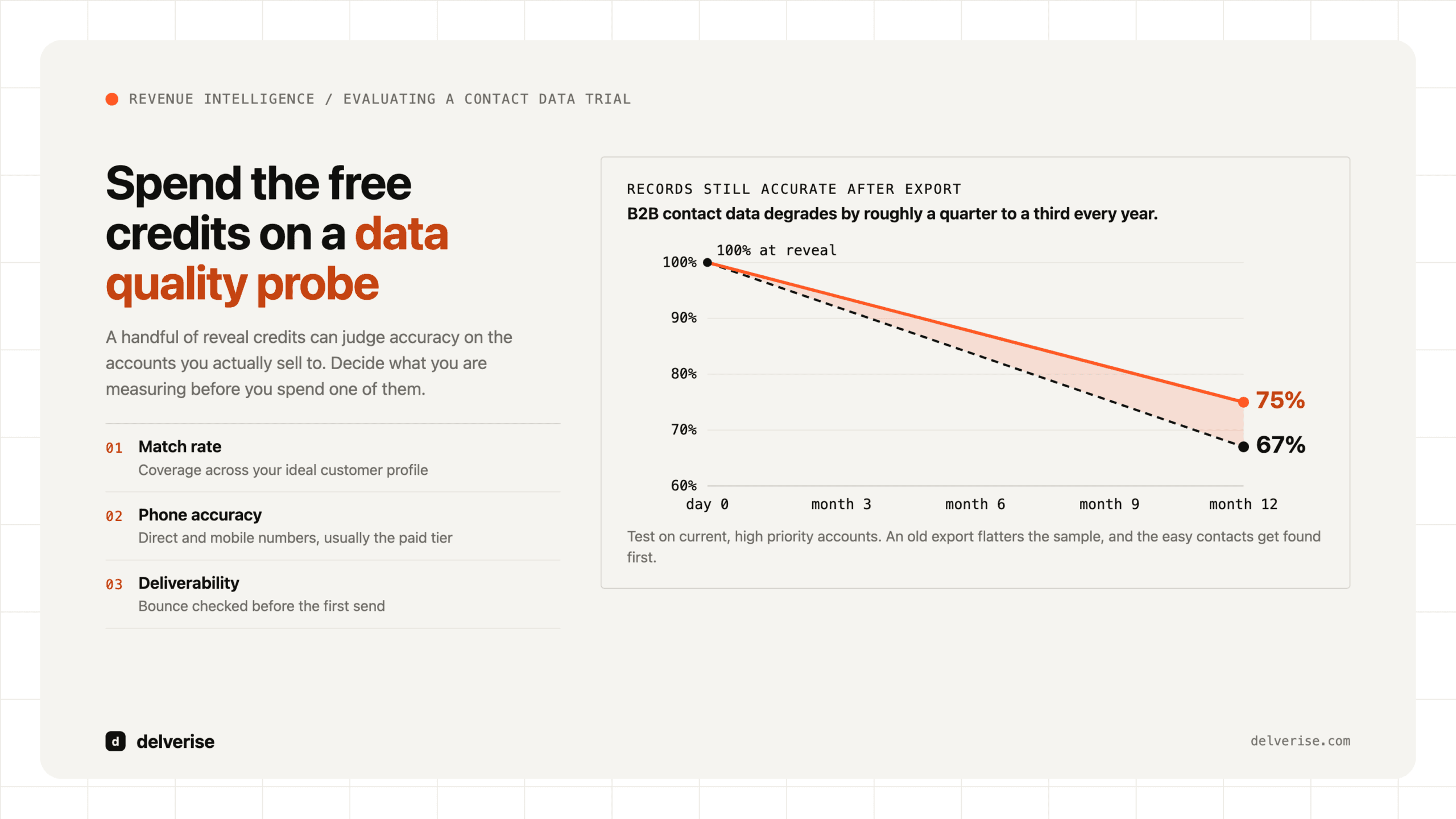
The free trial works on a credit system. You get a handful of free credits to reveal contacts, with email reveals generally more available than phone reveals, which tend to sit behind paid plans. That structure matters for how you test it. A phone-heavy outbound team and an email-first demand team will get very different signals from the same free allotment, so decide what you are actually measuring before you spend a single credit.
What can you realistically learn from a free trial?
A free trial answers one question well: is this data good enough on the accounts I care about? It cannot tell you whether the tool holds up across thousands of enrichments a month, because the sample is too small and the easy contacts get found first. Treat the trial as a data-quality probe, not a scale test.

The reason quality matters so much is decay. Industry research on B2B contact data consistently estimates that records degrade by roughly a quarter to a third every year as people change roles, companies, and numbers. Gartner has long flagged poor data quality as a direct drag on revenue operations. So a tool that looks accurate on a stale list can still fail you six months later, which is why you test against current, high-priority accounts rather than an old export.
Buyer behavior raises the stakes further. McKinsey’s research on B2B buying found that customers now move across many channels and expect the vendor to already understand their context. Gartner’s work on the buying journey found that buyers spend only a small fraction of their time actually meeting with sales. When your window is that narrow, reaching the right person on the first attempt with a correct number or address is the difference between a booked meeting and a wasted cycle.
How do you test contact data accuracy in a free trial?
Run the trial as a controlled test on your ideal customer profile, the specific segment you sell to best. Pull 15 to 25 real target contacts you already know something about, ideally people whose direct details a colleague can confirm. Then measure three things.

- Match rate: of the contacts you searched, how many returned any usable email or phone at all.
- Accuracy: of the details returned, how many are correct when you verify them against a known-good source or a real send.
- Deliverability: for emails, how many pass verification and land, rather than bouncing or hitting a catch-all.
Here is a worked example. Say you reveal 20 mid-market contacts and get some form of contact detail on 16, a match rate of 80 percent. Of those 16 emails, 13 verify cleanly, so your usable rate is 65 percent of the original list. That number, not the headline match rate, is what actually reaches your sequences. Compare it honestly against the coverage you already get from your current stack before you decide the tool earns a paid seat. Our guide to lead generation platforms walks through the same scoring approach across categories.
How does SignalHire compare to other contact-data tools?
Contact-data tools cluster into a few types. Understanding the category is more useful than any single brand comparison, because coverage varies by geography, seniority, and industry in ways a free trial on 20 contacts will not fully expose.
| Approach | What it is | Best fit | Main tradeoff |
|---|---|---|---|
| LinkedIn-extension finders (SignalHire and similar) | Reveal contact details profile by profile, often with phone data | Reps prospecting live inside LinkedIn | Manual at volume, coverage varies by region |
| All-in-one prospecting databases | Large built-in contact database plus sequencing | Teams wanting data and outreach in one tool | Data depth can lag on niche or non-US segments |
| Waterfall enrichment | Query multiple data providers in sequence and keep the first good hit | Teams optimizing coverage and cost per verified contact | Needs setup and orchestration to run well |
If your team lives inside a broader database and sequencer, it is worth reading our take on the Apollo email finder and the wider Apollo.io overview alongside any SignalHire trial, since those platforms solve an overlapping problem with a different shape.
Where does SignalHire fit in a modern GTM data stack?
No single provider wins on every segment. A tool might be strong on US mobile numbers and thin on European emails, or excellent for tech buyers and weak for healthcare. This is why experienced revenue teams rarely rely on one source. They build a waterfall: enrich a contact through provider A, and if the result is empty or unverified, fall through to provider B, then C, keeping the first verified hit and paying only for what returns real data.
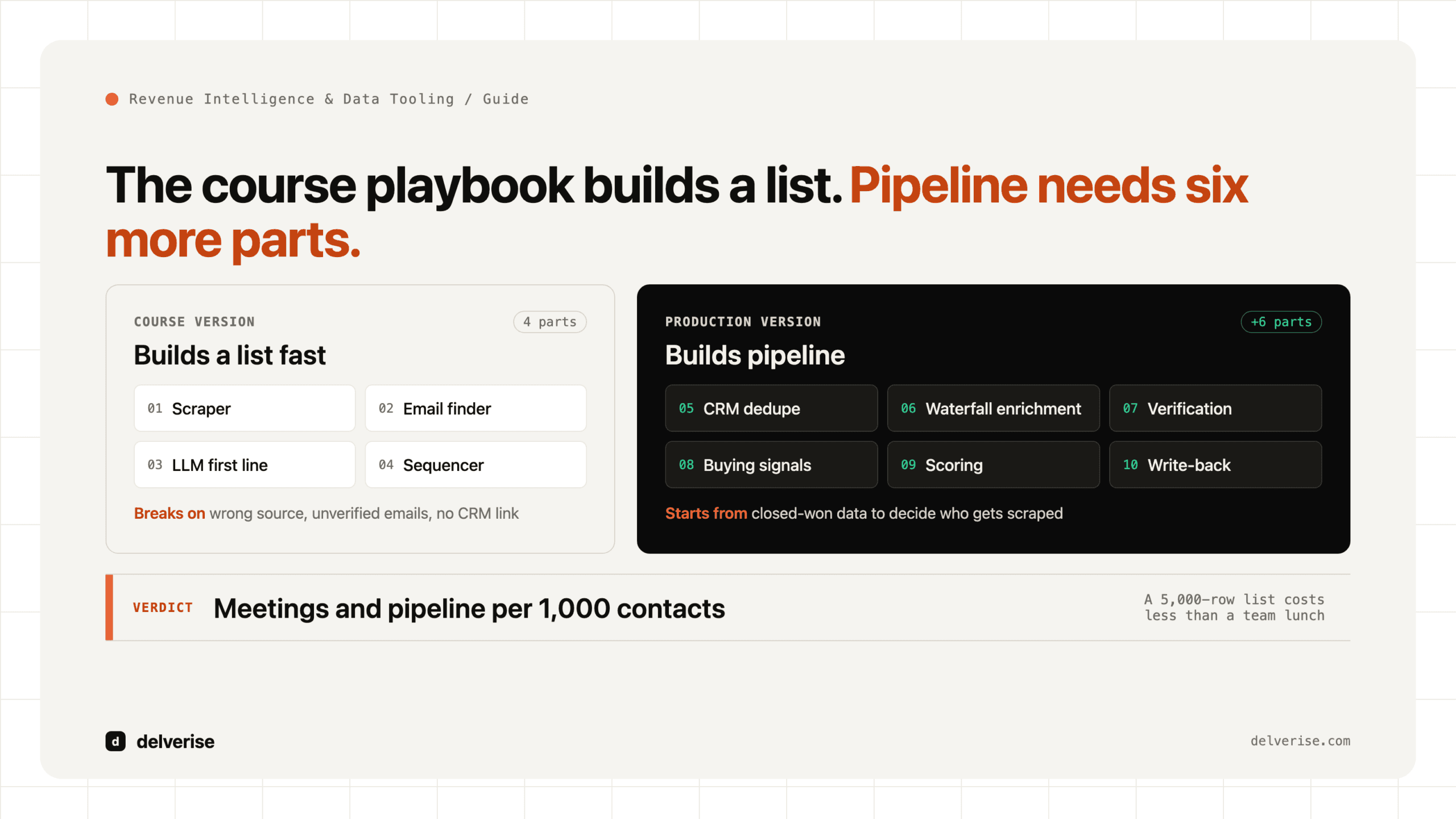
Orchestration tools like Clay make this practical by chaining multiple data vendors, including tools in the SignalHire category, behind one workflow with verification built in. In that model, a SignalHire subscription becomes one waterfall step chosen for the segments where its data is strongest, rather than the entire foundation of your outbound. Our breakdown of Clay waterfall enrichment and the wider enrichment tool comparison show how the pieces connect. This is the layer we build for teams on the CRM enrichment side of GTM engineering.
The point for a revenue leader is that the free trial should inform a system decision. Cleaner contact data feeds directly into lead scoring, routing, and reporting, so a tool that looks minor at the reveal step compounds across the whole funnel.
How should a revenue leader run a SignalHire trial evaluation?
Give the trial a real, time-boxed test with clear pass criteria. Use this checklist to keep it honest.
- Define the exact ICP segment you are testing, including region and seniority.
- Pull 15 to 25 real target contacts, not a random or easy sample.
- Record match rate, accuracy, and email deliverability separately.
- Verify phone numbers on a small set with a real dial or a known source.
- Compare usable-contact rate against your current stack, not against zero.
- Estimate cost per verified contact at your real monthly volume, not at trial size.
- Decide whether it earns a standalone seat or a slot in a waterfall.
That last line is the decision most teams get wrong. A tool can pass the accuracy test and still be the wrong way to buy data at scale, because paying per seat for manual reveals rarely competes with a verified waterfall on cost per contact once volume climbs. If you want help designing that comparison and the system behind it, that is the work we do on the GTM engineering side, and specifically through our Clay partner practice.
What does good contact data actually cost at scale?
Free trials hide the real cost because the credits are free. The number that matters is cost per verified, deliverable contact at your true monthly volume. Model it directly: take the usable-contact rate from your trial, apply it to the paid plan’s credit price, and add the human time to run manual reveals if the workflow is not automated. Then compare that figure against a waterfall that only charges for successful, verified hits. G2 reviews are useful for spotting recurring complaints about coverage or billing that a short trial will not surface, so read them before you scale spend. The teams that win here treat contact data as an operations line item with a unit economic target, which is the same discipline behind strong marketing operations.
Frequently Asked Questions
Is the SignalHire free trial enough to decide whether to buy?
It is enough to judge data quality on your own accounts and not enough to judge scale. Use it to measure match rate, accuracy, and deliverability on a real ICP sample, then model cost per verified contact at your true monthly volume before committing to a paid plan.
Does the SignalHire free trial include phone numbers?
Email reveals are generally more available on free credits, while direct and mobile phone reveals usually sit behind paid tiers. If phone data drives your outbound, confirm exactly how many phone reveals the trial allows and test those specifically, since that is where accuracy varies most.
How is SignalHire different from Apollo or a full prospecting database?
SignalHire is primarily a profile-by-profile finder used inside LinkedIn, strong for reps prospecting live. All-in-one platforms combine a large database with sequencing in one place. The right choice depends on whether you want data and outreach unified or want a best-of-breed data layer feeding your existing stack.
Should we rely on a single contact-data tool?
Most mature revenue teams do not, because no provider has complete coverage across every region and role. A waterfall that queries several sources and keeps the first verified result almost always beats a single tool on coverage and cost per verified contact, especially as volume grows.
How do we measure whether the data is actually good?
Track three numbers on a real ICP sample: match rate (how many contacts return any detail), accuracy (how many details are correct), and deliverability (how many emails verify and land). The usable-contact rate, not the headline match rate, tells you what will really reach your sequences.
Read next