←Back to blog
Revenue Intelligence & Data ToolingGuideNovember 21, 20268 min read
Salesloft Cost: What You Actually Pay and What It’s Worth
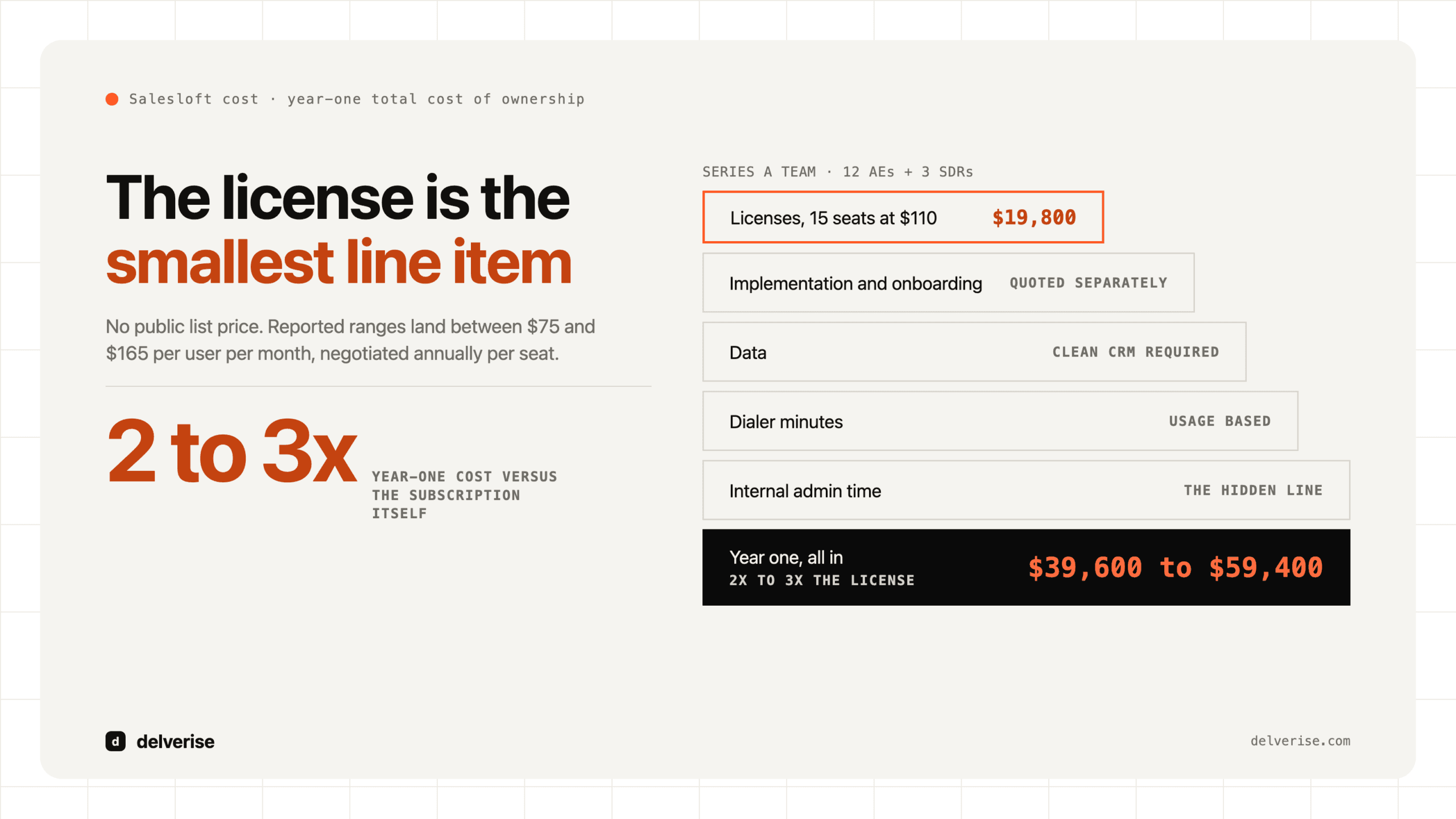
Salesloft does not publish list pricing. Deals are negotiated annually per seat, and publicly reported ranges land between roughly $75 and $165 per user per month depending on edition, seat count, and modules. Expect onboarding fees, a seat minimum, and real costs in admin time beyond the license itself.
Salesloft does not publish list pricing. Deals are negotiated annually per seat, and publicly reported ranges land between roughly $75 and $165 per user per month depending on edition, seat count, and modules. Expect onboarding fees, a seat minimum, and real costs in admin time beyond the license itself.
Key takeaways
- Salesloft sells annual, per-seat contracts through a sales-assisted quote process, so your price depends on seat volume, term length, and which modules you attach.
- The license is usually the smallest line item. Implementation, data, dialer minutes, and internal admin time typically push year-one cost to two or three times the subscription.
- Seat minimums matter more than per-seat price for small teams. A five-person sales org often pays for capacity it cannot use.
- The decision that moves your P&L is whether the sequencing motion works at all, since one extra closed-won deal per rep per year usually clears the entire platform cost.
- Buy Salesloft when you have enough reps, enough list volume, and clean CRM data. Without those, cheaper tooling plus better data engineering produces more pipeline for less money.
How does Salesloft pricing actually work?
Salesloft is a sales engagement platform, meaning software that sequences multi-step outreach across email, phone, and LinkedIn, logs the activity to your CRM, and reports on what converted. It is sold as a bundled platform rather than a menu of features, with tiers that historically split along the lines of core cadence execution, then added dialer and conversation intelligence, then deal management and forecasting.

Three variables set your number:
- Seat count. Per-seat rates fall as volume rises. Reported enterprise deals land well below published marketplace rates because discounting scales with commitment.
- Edition and modules. Conversation intelligence (call recording plus AI transcription and coaching) and deal or forecast management are typically the upgrade triggers. Each step up has historically added meaningful cost per seat.
- Term. Annual is standard. Multi-year commitments buy discount, and they also buy risk if your headcount plan changes.
Third-party marketplace listings and G2 reviewer commentary consistently put entry editions in the $75 to $125 per user per month band and upper editions above that, with onboarding fees quoted separately. Treat those as reference points for negotiation, not as a price list. The only real number is the one in your quote.
Why doesn’t Salesloft publish its price?
Because opaque pricing protects discount flexibility. When list price is private, the vendor can quote $160 per seat to a 200-seat enterprise with procurement leverage and $95 to a 15-seat Series A team, and neither learns what the other paid. This is standard practice across the category, and it means your leverage comes from preparation rather than from comparison shopping a public page.

It also means the quote you receive reflects what the rep thinks you will pay. Walking in with a documented seat plan, a defined pilot scope, and a named alternative changes the number more than any procurement tactic applied later.
What is the real total cost of ownership?
Here is a concrete build for a Series A B2B SaaS team running 12 account executives and 3 SDRs.

| Cost line | Year one | Notes |
|---|---|---|
| Licenses, 15 seats at a negotiated $110 per seat per month | $19,800 | The number most teams budget for |
| Implementation and onboarding | $2,500 to $10,000 | One-time, frequently negotiable |
| Internal admin, roughly 0.25 FTE of RevOps time | ~$30,000 | Cadence governance, CRM field mapping, reporting, deliverability |
| Dialer minutes and phone numbers | $1,000 to $4,000 | Varies heavily with call volume |
| Contact data and enrichment | Separate | Salesloft executes sequences, it does not build your list |
| Realistic year-one total | $55,000 to $65,000 | Roughly 3x the license line |
Now run the return side. At a $25,000 average contract value, a $60,000 year-one cost clears a 3x internal hurdle if the platform contributes about seven additional closed-won deals across the year. Spread over 15 reps, that is well under one extra deal per rep annually. Sales engagement tooling is cheap compared to the people using it, which is exactly why license price deserves less of your attention than whether the underlying motion produces meetings. Our breakdown of what one outbound SDR actually produces gives you the per-rep math to sanity-check that assumption before you sign.
How does Salesloft cost compare to the alternatives?
Published figures move, so confirm before you budget. The pricing model is the durable difference.
| Option | Pricing model | Typical entry point | Best fit |
|---|---|---|---|
| Salesloft | Quote-based, annual, per seat, seat minimums | Reported $75 to $165 per seat per month | 10+ rep teams wanting sequencing, dialer, and coaching in one governed system |
| Outreach | Quote-based, annual, per seat | Comparable to Salesloft, often quoted higher | Larger orgs with heavy workflow customization needs |
| Apollo | Published self-serve tiers, per seat, with credit limits | Roughly $50 to $120 per seat per month | Early teams who want data and sequencing bundled cheaply |
| HubSpot Sales Hub | Published per-seat tiers, bundled with the CRM | Professional and Enterprise seats at roughly $100 to $150 | Teams already standardized on HubSpot who want fewer vendors |
| Data-layer stack (Clay plus a sending tool) | Credit-based platform fee plus tool costs | Free tier, paid plans from low hundreds monthly | Teams whose constraint is list quality and targeting rather than rep capacity |
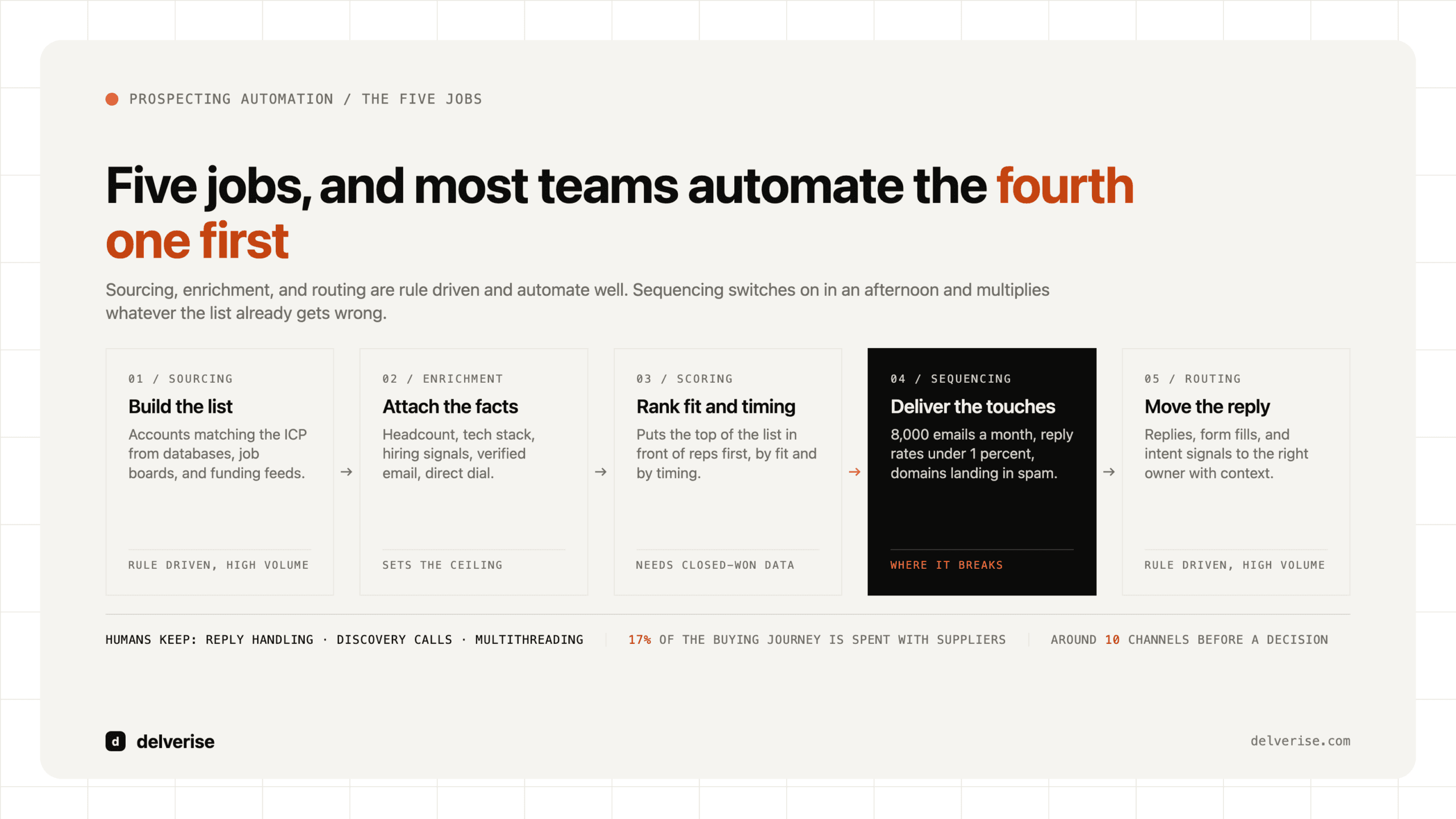
That last row is the one revenue leaders underweight. Gartner’s research on B2B buying has found that buyers spend only a small share of their decision time with any single supplier’s sellers, roughly 17% across all vendors under consideration. McKinsey’s B2B Pulse work points the same direction, showing buyers moving across a large number of channels before they commit. Both findings say the binding constraint is usually relevance and timing, not how many sequence steps you can fire.
If your reply rates are low because you are emailing weakly qualified accounts, a more expensive sequencer sends the same weak emails faster. Clay sits earlier in the chain, assembling and enriching target lists from multiple data sources so the accounts entering your cadences deserve to be there. We cover that split between data work and execution work in what to automate and what to keep human, and if you want the data layer built rather than learned, our Clay implementation work is where teams usually start.
When is Salesloft worth the money?
Salesloft earns its cost under specific conditions:
- You have enough reps to govern. Below roughly eight to ten sellers, cadence standardization and coaching analytics solve a problem you do not yet have.
- Your CRM data is trustworthy. Activity logging and attribution reporting inherit whatever mess exists in Salesforce or HubSpot. Fix the object model first, as laid out in the six foundation pieces under every revenue stack.
- Call volume is material. If phone is a real channel for you, the integrated dialer and conversation intelligence consolidate two or three separate purchases.
- Forecast discipline is a board-level issue. The deal and forecast modules only pay back when pipeline hygiene is already enforced. Our guide to building a forecast that holds covers the process side that software cannot supply.
It is a weak purchase when you have four reps, an unvalidated ICP, and no reliable source of contact data. Gartner’s work on sales technology adoption has repeatedly found that a large share of purchased seller tools go underused, and sequencing platforms bought ahead of process maturity are a common example. For the full feature-level picture, see our deeper look at what Salesloft does and who it fits.
How do you negotiate a better Salesloft contract?
Run this before you accept a quote:
- Get quotes from at least one direct alternative and one cheaper substitute, and say so during the call.
- Ask for the per-seat rate at your current headcount and at your 12-month plan, separately, so growth does not silently reprice you.
- Push implementation fees toward zero or toward a credit, since these are the most discountable line in most quotes.
- Time the conversation to the vendor’s quarter or fiscal year end.
- Cap the auto-renewal uplift in writing, and negotiate a seat-reduction clause rather than seats-only-up terms.
- Run a scoped 60-day pilot with two or three reps and a defined meetings-booked target before committing the full team.
- Price the admin load honestly, then name the person who owns it. An unowned platform decays within two quarters.
If the negotiation reveals that most of your gap sits in list quality, sequencing logic, or CRM plumbing rather than in the sending tool, the license decision matters less than how the surrounding system is engineered. That is the work we do in GTM engineering: building the data, routing, and measurement layers that decide whether any engagement platform earns its cost.
Frequently Asked Questions
Does Salesloft have a free trial or free plan?
Salesloft does not offer a public free tier. Access typically comes through a demo and a sales-assisted evaluation, sometimes with a short scoped pilot for a subset of seats. If you want to test sequencing mechanics at zero cost before committing, start with a self-serve tool that publishes its pricing, then migrate once you have validated that the motion works.
How many seats do you need to buy?
Salesloft has historically enforced a seat minimum, so very small teams end up paying for unused capacity. Ask for the exact minimum in writing early in the conversation, because it often determines whether the platform is viable for your team size at all.
Is Salesloft more expensive than Outreach?
Both use quote-based annual per-seat pricing in a similar band, and the winner on price depends entirely on your seat count, term, and how hard each vendor wants the logo. Reviewer commentary on G2 suggests Outreach quotes often come in slightly higher at comparable scale, though discounting varies enough that running both processes in parallel is the only reliable way to find out.
What costs do teams forget to budget for?
Three items: internal administration time, which is the largest hidden cost in most deployments; contact data and enrichment, which Salesloft does not provide; and dialer or phone number charges if calling is a real channel. Deliverability infrastructure, meaning domains, warmup, and inbox monitoring, is also a separate spend that determines whether your sequences reach anyone.
Can a cheaper stack produce the same pipeline?
Often yes, at smaller scale. A data-first stack that builds tightly targeted lists and sends fewer, more relevant emails frequently outperforms an expensive sequencer pointed at a generic list. Salesloft’s advantage appears once you have enough reps that consistency, coaching, and governance become the actual bottleneck, which is usually past 10 to 15 sellers.