←Back to blog
Revenue Intelligence & Data ToolingGuideNovember 18, 20269 min read
What Is GTM Intelligence? A Revenue Leader’s Guide to Building It
GTM intelligence is the layer that turns account, buyer, behavioral, and pipeline data into decisions a revenue team can act on today. It joins firmographic data, intent and product signals, CRM history, and conversation data into scored, routed, timed actions. Done well, it answers who to work, when to work them, and with what message.
GTM intelligence is the layer that turns account, buyer, behavioral, and pipeline data into decisions a revenue team can act on today. It joins firmographic data, intent and product signals, CRM history, and conversation data into scored, routed, timed actions. Done well, it answers who to work, when to work them, and with what message.
Key takeaways
- GTM intelligence is an operating layer, not a product category. Most teams assemble it from a CRM, an enrichment stack, a warehouse, and a routing engine.
- Sales intelligence tells you who exists. Revenue intelligence tells you what happened in deals. GTM intelligence connects both to an action that fires while the signal is still warm.
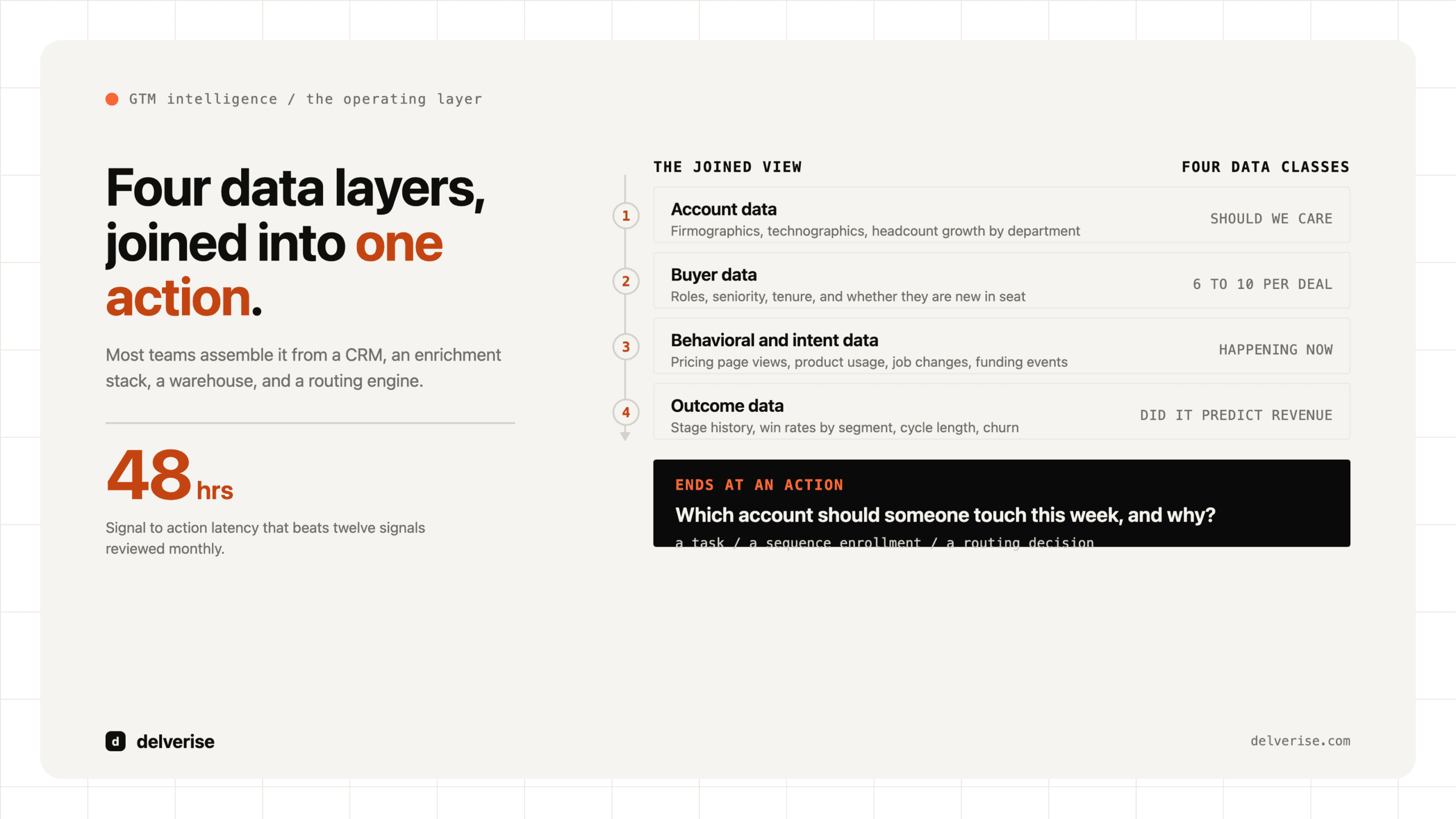
- Signal-to-action latency matters more than signal volume. A good signal acted on in 48 hours beats twelve signals reviewed monthly.
- The common failure is scoring built on opinion instead of closed-won evidence, which quietly trains reps to ignore the system.
- Start with the three or four signals that already correlate with your wins, then expand once routing and attribution hold up.
What does GTM intelligence actually include?
Four classes of data sit underneath every working system.

Account data covers firmographics (company size, industry, geography, funding stage), technographics (what software they already run), and structural facts like headcount growth by department. This is the “should we care” layer.
Buyer data covers the people: roles, seniority, tenure, reporting lines, and whether they are new in seat. Gartner’s research on complex B2B purchases has consistently found buying groups of roughly six to ten decision makers, so coverage of one champion is rarely enough to model a deal.
Behavioral and intent data covers what is happening right now: site visits, pricing page views, product usage, job changes, hiring posts, funding events, review site activity, and email or call engagement. Intent data means inferred buying interest based on observed research behavior, and the quality varies sharply by vendor.
Outcome data covers pipeline: stage history, win rates by segment, cycle length, conversation content, and churn. This is the layer that tells you which of the other three actually predicted revenue.
GTM intelligence is the joined view across all four, plus the rules that convert that view into work sitting in a rep’s queue.
How is it different from sales intelligence or revenue intelligence?
These terms get used interchangeably in vendor marketing, which makes buying harder than it needs to be. The distinction that matters is where each layer stops.
| Layer | Core question it answers | Typical owner | Where it stops |
|---|---|---|---|
| Sales intelligence | Who exists, and how do I reach them? | SDR and AE teams | Delivers records. Has no view of your pipeline outcomes. |
| Revenue intelligence | What happened in the deals we already have? | Sales leadership, RevOps | Looks backward at open and closed pipeline. Blind to accounts not yet in CRM. |
| Marketing analytics | Which programs created demand? | MarOps, demand gen | Attribution and reporting. Rarely triggers account-level action. |
| GTM intelligence | Which account should someone touch this week, and why? | RevOps or a GTM engineering function | Ends at an action: a task, a sequence enrollment, a routing decision, a forecast adjustment. |
A team can own excellent tools in the first three rows and still have no GTM intelligence, because nothing joins them. That gap is where pipeline quietly leaks. If you are still sorting out which foundation pieces you have, our breakdown of the six pieces under every revenue stack is the better starting point.
Which signals are actually worth building on?
Most teams overbuild here. Start with signals that are cheap to observe, hard to fake, and already visible in your closed-won history.

- Fit signals (stable): employee count band, funding stage, tech stack presence, department headcount. These decide whether an account belongs in your addressable set at all.
- Change signals (time-bound): new executive in a relevant seat, funding round, hiring for roles your product supports, a competitor tool appearing or disappearing. These carry the strongest timing value and decay within weeks.
- Engagement signals (first-party): repeat pricing page visits, docs traffic, webinar attendance, product usage crossing a threshold in a PLG motion. First-party signals beat third-party intent almost every time, because you can verify them.
- Deal-health signals: multithreading depth, stage velocity against your own baseline, silence after a demo.
Be honest about third-party intent. It is directional, it is noisy at the account level, and it is often most useful as a tiebreaker between two accounts that already passed a fit filter. Treat it as one input rather than a trigger on its own. The same discipline applies to scoring generally, which we cover in depth in how to build AI lead qualification that actually scores the right things.
What does a working GTM intelligence stack look like?
Here is a concrete shape, illustrative rather than drawn from any specific company, for a Series A SaaS business doing $4M ARR with two SDRs, four AEs, and one RevOps hire.

- System of record: one CRM, with a defined account object and an enforced schema. Every downstream decision reads from here.
- Enrichment and signal capture: a waterfall that hits multiple providers in sequence so you pay for the cheapest source that returns a valid result. Teams building this layer usually land on something like Clay for orchestration, since it handles provider fallback, conditional runs, and AI research columns in one place. Vendor-level data providers such as SalesIntel sit inside that waterfall as sources rather than as the system itself.
- Storage and joining: a warehouse table that combines CRM records, product usage, and enriched account attributes. Small teams can survive on CRM plus a scheduled sync for a while, though the warehouse becomes necessary once product data enters the picture.
- Scoring: a fit score trained on closed-won patterns, plus a separate timing score driven by change signals. Keep them separate. A perfect-fit account with no timing signal deserves nurture, while a mediocre-fit account with a strong trigger deserves one thoughtful touch.
- Activation: rules that push the result into the place work actually happens. High fit plus high timing routes to an AE with a research brief attached. High fit plus low timing enters a long-cycle nurture. Low fit gets suppressed so reps stop seeing it.
In this shape, the SDRs stop building lists. Their queue arrives pre-scored with a one-paragraph reason for the touch, which changes what they write. The mechanics of turning those signals into messaging are covered in what to automate and what to keep human in outbound.
The engineering work of wiring these layers together is what GTM engineering means in practice, and if Clay is the orchestration piece you are evaluating, our Clay implementation page explains how that build typically runs.
How do you know your GTM intelligence is working?
Four measures separate a live system from an expensive dashboard.
- Coverage: the percentage of target accounts with complete fit attributes. Below roughly 80 percent, your scoring is mostly guessing.
- Signal-to-action latency: median hours between a trigger firing and a human or sequence touching the account. This is the single most diagnostic number in the whole system.
- Lift: meeting rate on signal-triggered outreach compared with your static-list baseline. If there is no meaningful gap, your signals are not predictive and you should cut them.
- Forecast reliability: better inputs should tighten your forecast variance over two or three quarters. We break the mechanics down in how B2B SaaS teams build a forecast that holds.
A quick readiness check before you invest:
- One CRM holds the authoritative account record, with duplicates under control
- You can name the three account attributes most common across your last 20 closed-won deals
- Product usage or first-party web behavior reaches your CRM without a manual export
- A named person owns scoring logic and reviews it quarterly
- Reps can see why an account entered their queue, in one sentence
- Suppression rules exist so low-fit accounts stay out of sequences
Where does GTM intelligence usually break?
Three failure modes account for most of it.
Scoring by committee opinion. Weights get assigned in a workshop, nobody validates them against closed-won data, and within a quarter reps learn the scores are noise. Fix this by back-testing any scoring model against the last four quarters of outcomes before it goes live.
Data decay with no refresh policy. Contact and firmographic data degrades continuously as people change jobs and companies restructure. Gartner has estimated the cost of poor data quality to organizations at roughly $12.9 million per year on average, and the smaller version of that number shows up in your bounce rates and misrouted leads. Set a refresh cadence per field class instead of enriching once at import. Our guide to CRM enrichment covers the waterfall design that keeps this affordable.
Signals with no owner. A trigger that fires into a Slack channel nobody owns is decoration. Every signal needs a destination, an owner, and an SLA.
There is also a structural reason this layer earns its cost. Gartner’s research on B2B buying found that buyers spend only about 17 percent of their total purchase journey meeting with potential suppliers, and that time splits across every vendor under consideration. McKinsey’s work on B2B buying behavior found customers now move across ten or more channels during a purchase, up sharply from a decade ago. Harvard Business Review, reporting Gartner’s buyer enablement research, found that customers who rated supplier information as genuinely helpful in advancing their purchase were substantially more likely to buy a larger deal with less regret. When your access to the buyer is that thin and that fragmented, the quality of your targeting and timing carries most of the weight.
Frequently Asked Questions
Is GTM intelligence a tool I can buy?
Several vendors market themselves under this label, and most cover one or two of the four data classes well. The joined layer across account, buyer, behavioral, and outcome data is almost always assembled from your CRM, an enrichment and orchestration tool, a warehouse, and routing logic. Treat vendor claims of full coverage with healthy skepticism and map any demo against the four classes above.
When is a company too early for this?
Below roughly $1M ARR with a founder-led sales motion, the founder’s judgment usually outperforms any scoring model, because the sample size of wins is too small to train on. The right time is typically when you have 30 to 50 closed-won deals, more than two reps, and list building has become a meaningful share of someone’s week.
How much does a GTM intelligence layer cost to run?
Data and orchestration costs for a Seed to Series B team commonly land between $1,500 and $6,000 per month depending on record volume and how many providers sit in the waterfall. The larger cost is build and maintenance time. A system with no owner degrades within two quarters, so budget for ongoing ownership rather than a one-time project.
Does AI change how this gets built?
It changes the research step most. Tasks that previously required a human reading a website, such as classifying a company’s business model or checking whether they run a specific motion, can now run as an AI column at scale with reasonable accuracy. Validation still matters: spot-check a sample before you let any AI-derived field drive routing. We cover the practical boundaries in how to use AI for lead generation.
Who should own GTM intelligence internally?
RevOps owns it in most companies at this stage, with a GTM engineer or technical operator doing the build. Sales leadership should own the scoring definitions, since they carry the consequences. The pattern that fails reliably is ownership split across marketing and sales with no single person accountable for the schema.