←Back to blog
Revenue Intelligence & Data ToolingGuideNovember 20, 20268 min read
What Is Prospecting Automation? What to Automate and Where It Breaks
Prospecting automation is the use of software and data pipelines to handle the repeatable parts of finding, researching, and reaching buyers: sourcing accounts, enriching records, scoring fit, triggering sequences, and routing replies. Done well, it gives a small team the account coverage of a much larger one while keeping human judgment on messaging and calls.
Prospecting automation is the use of software and data pipelines to handle the repeatable parts of finding, researching, and reaching buyers: sourcing accounts, enriching records, scoring fit, triggering sequences, and routing replies. Done well, it gives a small team the account coverage of a much larger one while keeping human judgment on messaging and calls.
Key takeaways
- Prospecting automation covers five jobs: sourcing, enrichment, scoring, sequencing, and routing. Most teams automate sequencing first and wonder why nothing improves.
- Data quality sets the ceiling. Automating outreach on top of a stale or poorly defined list multiplies the error instead of fixing it.
- The measurable win is coverage per rep and speed to first touch, not raw email volume.
- Reply handling, discovery calls, and multithreading into a buying committee stay human.
- Budget for the pipeline, not just the licenses. Tooling is usually the smaller line item next to the engineering that connects it.
What does prospecting automation actually automate?
Strip away vendor language and there are five distinct jobs, each of which can be automated to a different degree.

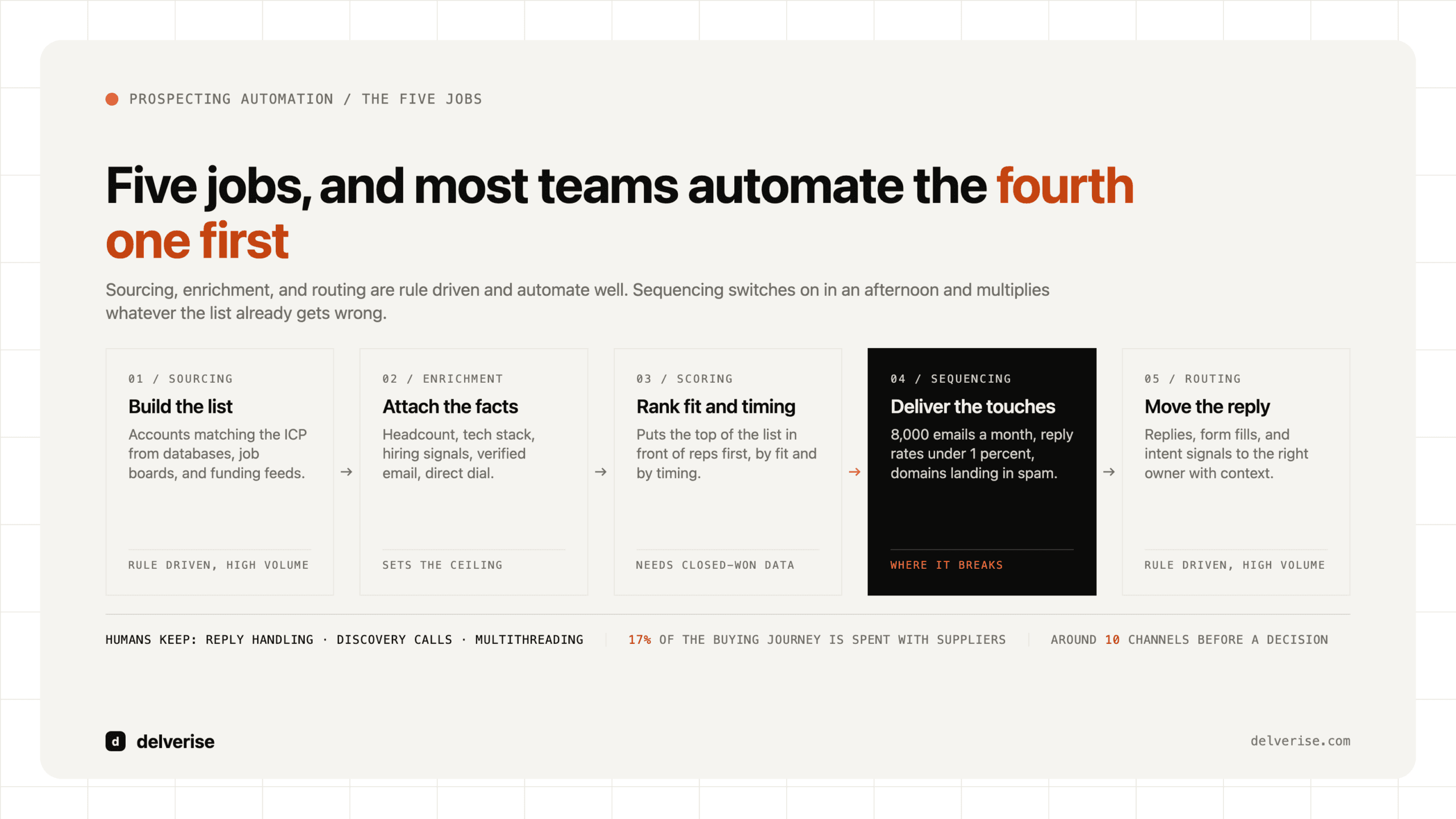
Sourcing means building the account and contact list: pulling companies that match your ideal customer profile from databases, job boards, funding feeds, review sites, or your own product usage. Enrichment means attaching the facts you need to make a decision: headcount, tech stack, hiring signals, funding stage, verified email, direct dial. Scoring ranks those records by fit and timing so reps work the top of the list first. Sequencing delivers the touches across email, LinkedIn, and phone. Routing moves replies, form fills, and intent signals to the right owner with the right context.
Sourcing, enrichment, and routing automate well because they are rule-driven and high-volume. Scoring automates well once you have enough closed-won data to train it against, and we cover that in more detail in AI lead qualification. Sequencing automates easily and is where most teams cause themselves damage, because the cost of sending a bad message at scale is borne by your domain reputation and your brand.
Why do most prospecting automation stacks stall?
The common failure is sequencing an unqualified list faster. A team buys a sales engagement platform, imports a database export, and sends 8,000 emails a month. Reply rates land under one percent, domains start landing in spam, and the conclusion is that outbound is dead.

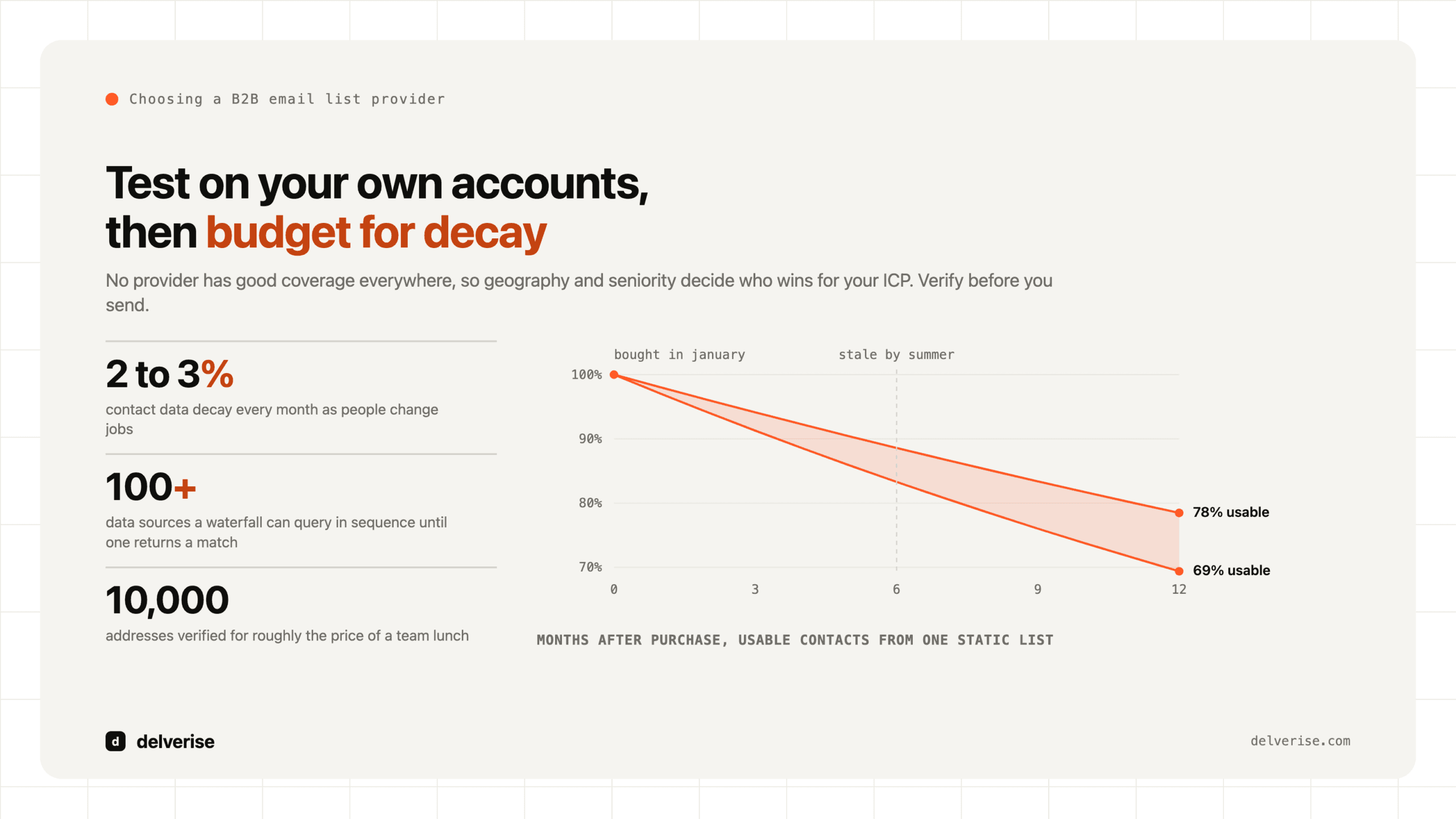
The real constraint sits upstream. B2B contact data decays continuously as people change roles, so a list built in January is materially wrong by June. Firmographic filters like “SaaS, 50 to 200 employees, Series A” describe a market segment rather than a buying trigger, and a segment does not tell you who has a reason to talk this quarter.
Buyer behavior makes this harder. Gartner’s research on B2B buying found that customers spend roughly 17 percent of their total purchase journey meeting with potential suppliers, and that time is split across every vendor they consider. McKinsey’s work on B2B decision journeys found buyers now move across around ten interaction channels before deciding, up from about five a decade ago. Your automated email is competing for a sliver of attention inside a journey you do not control. Precision beats volume when the window is that narrow.
The second failure is ownership. Prospecting automation crosses marketing, sales, and RevOps, and when no one owns the whole path, each team optimizes its own segment. Marketing tunes form conversion, sales tunes sequence copy, and nobody notices that 40 percent of enriched records never reach a rep because a routing rule silently drops records missing a country field.
What does a working prospecting automation system look like?
Think in layers. Each layer has a job, a failure mode, and a metric that tells you whether it is healthy.

| Layer | What it does | How it fails | Health metric |
|---|---|---|---|
| Source | Builds the account universe from ICP filters plus trigger events | Segment-only targeting with no reason to reach out now | Percent of accounts with a live trigger |
| Enrich | Adds firmographic, contact, and signal data via waterfall providers | Single-vendor dependency, low match rates, silent nulls | Coverage rate per required field |
| Score | Ranks fit and timing against closed-won patterns | Scores nobody trusts, so reps work the list by gut | Win rate of top decile vs. bottom |
| Sequence | Delivers multichannel touches with relevant context | Generic copy at volume, deliverability damage | Reply rate and positive reply share |
| Route | Moves replies and signals to an owner with context | Records stuck in limbo, slow first response | Median time to first human touch |
Two implementation notes matter more than tool choice. First, waterfall enrichment beats a single provider: query your cheapest source, then fall back to a second and third only for records that missed. Match rates per provider vary enough by geography and company size that any single vendor leaves gaps. Second, treat the whole path as one system with logging at each hop, so you can answer “where did these 2,000 accounts go” without a manual audit.
For the sourcing and enrichment layers, Clay has become the default orchestration surface for teams that want waterfalls, scraping, and AI research steps in one place without building it from scratch. The honest tradeoff: credit costs scale with list size and sloppy table design burns budget fast, and the platform rewards people who think in data pipelines. Teams that want the system built and maintained rather than learned can see how we approach it on our Clay partner page.
What does the math look like in practice?
Here is illustrative arithmetic for a Series A team with two SDRs, using round numbers you can substitute with your own.
The manual baseline: each rep researches and sends to roughly 30 accounts per day, so 1,200 accounts per month across two reps. At a 4 percent reply rate and a 30 percent positive share, that is around 14 conversations and perhaps 8 meetings held per month.
The automated version changes the shape rather than just the speed. Sourcing and enrichment run nightly on 2,500 accounts, scoring surfaces the 600 with a live trigger, and reps personalize the first touch for the top 300 while the remaining 300 receive a lighter templated sequence. Same two reps, roughly 900 accounts touched with the top tier getting real research time. If the personalized tier replies at 7 percent and the light tier at 2.5 percent, you get about 21 and 8 replies respectively, so roughly double the conversations with the same headcount.
The lever is reallocated rep time, not send volume. That distinction determines what you build and what you measure. For how this connects to quota design and rep capacity, see our breakdown of what an outbound SDR realistically produces.
What should stay human?
Automate research, list construction, data hygiene, routing, and the mechanical parts of follow-up. Keep humans on the first substantive message to a priority account, every reply, discovery, and the work of multithreading into a buying committee that Gartner’s research puts at six to ten people in a typical complex purchase.
The gray zone is AI-generated personalization. Model-written openers based on scraped context work when the underlying fact is genuinely specific and relevant to a problem you solve. They fail when they reference a funding round or a podcast appearance with no connection to the pitch, which buyers now recognize instantly. A useful test: if a human rep would not have bothered mentioning that detail, the model should not either. We go deeper on that line in what to automate and what to keep human.
What does it cost to build and run?
Three cost buckets, and teams consistently underestimate the third.
- Data and tooling: enrichment credits, a sequencing platform, a CRM. For a Seed to Series B team, commonly $1,500 to $6,000 per month depending on list volume and how many providers sit in the waterfall.
- Build: the engineering that connects sourcing to enrichment to CRM to sequencing, with logging and error handling. This is a project with a defined end, usually measured in weeks.
- Maintenance: providers change schemas, filters drift, deliverability rules tighten, and the ICP evolves after every quarterly board review. Systems without an owner degrade within two quarters.
Before you spend on any of it, run this check:
- We can state the ICP as filters a machine can apply, not as a description.
- We have at least two trigger events that correlate with closed-won deals.
- CRM object structure supports account-level and contact-level records cleanly.
- Someone owns deliverability: authentication, domain warmup, and inbox rotation.
- We can report reply-to-meeting and meeting-to-opportunity rates today.
- One named person owns the end-to-end path from source to routed reply.
Fewer than four checked means the automation will amplify a measurement problem. Start with the foundation pieces first. Teams further along can compare specific platforms in our guide to choosing an AI tool for sales prospecting, or look at how the layers assemble in our GTM engineering overview.
Frequently Asked Questions
Is prospecting automation the same as sales automation?
Prospecting automation covers the top of the funnel: building the list, enriching it, scoring it, and delivering first touches. Sales automation is broader and includes deal-stage workflows, quote generation, forecasting inputs, and post-meeting follow-up. They share infrastructure, mainly the CRM and data layer, and the same hygiene rules apply to both.
How long before prospecting automation produces pipeline?
Expect four to eight weeks to build and instrument the system, then a full sales cycle to judge it honestly. Reply and meeting data arrive within the first month, but win rate from automated sourcing takes a cycle to read. Judging the system on week-three reply rates leads teams to kill things that were working.
Do we need a data engineer to run this?
No, though you need someone comfortable with data structures, APIs, and debugging. Platforms like Clay, n8n, and modern CRM automation cover most of what a Seed to Series B team needs without custom code. The skill gap is usually systems thinking rather than programming.
What is the single most common mistake?
Automating outreach before defining what a qualified account looks like in machine-readable terms. Volume on a vague list produces low reply rates, domain damage, and a false conclusion that the channel does not work. Fix targeting and enrichment first, then scale the sending.
How does this affect deliverability?
Significantly. Automated sending at volume requires SPF, DKIM, and DMARC configured correctly, warmed sending domains separate from your primary, and per-inbox daily limits in the low tens. Mailbox providers now filter on engagement signals, so low reply rates on one domain degrade delivery across everything you send from it. Build deliverability monitoring into the system from day one rather than after the first drop.