←Back to blog
Revenue Intelligence & Data ToolingGuideAugust 18, 20268 min read
Salesloft Competitors: A Revenue Leader’s Guide to Sales Engagement Alternatives
The main Salesloft competitors are Outreach, Apollo.io, HubSpot Sales Hub, Clari (Groove), Gong Engage, and lightweight sequencers like Klenty and Reply.io. Which one wins depends on where your bottleneck sits: rep workflow discipline, data quality, forecasting, or email deliverability. The sequencer rarely fixes a pipeline problem on its own.
The main Salesloft competitors are Outreach, Apollo.io, HubSpot Sales Hub, Clari (Groove), Gong Engage, and lightweight sequencers like Klenty and Reply.io. Which one wins depends on where your bottleneck sits: rep workflow discipline, data quality, forecasting, or email deliverability. The sequencer rarely fixes a pipeline problem on its own.
Key takeaways
- A sales engagement platform (the category Salesloft created) sequences touches across email, calls, LinkedIn, and tasks. It executes a plan. It does not create one.
- Most teams evaluating Salesloft competitors are actually solving a data problem, a routing problem, or a deliverability problem that a different tool would solve better and cheaper.
- Outreach is the closest feature-for-feature swap. Apollo bundles data and sequencing for a fraction of the seat cost. HubSpot wins when the CRM is already HubSpot.
- Clari and Gong compete from the forecasting and conversation-intelligence side, pulling engagement into a revenue platform rather than the reverse.
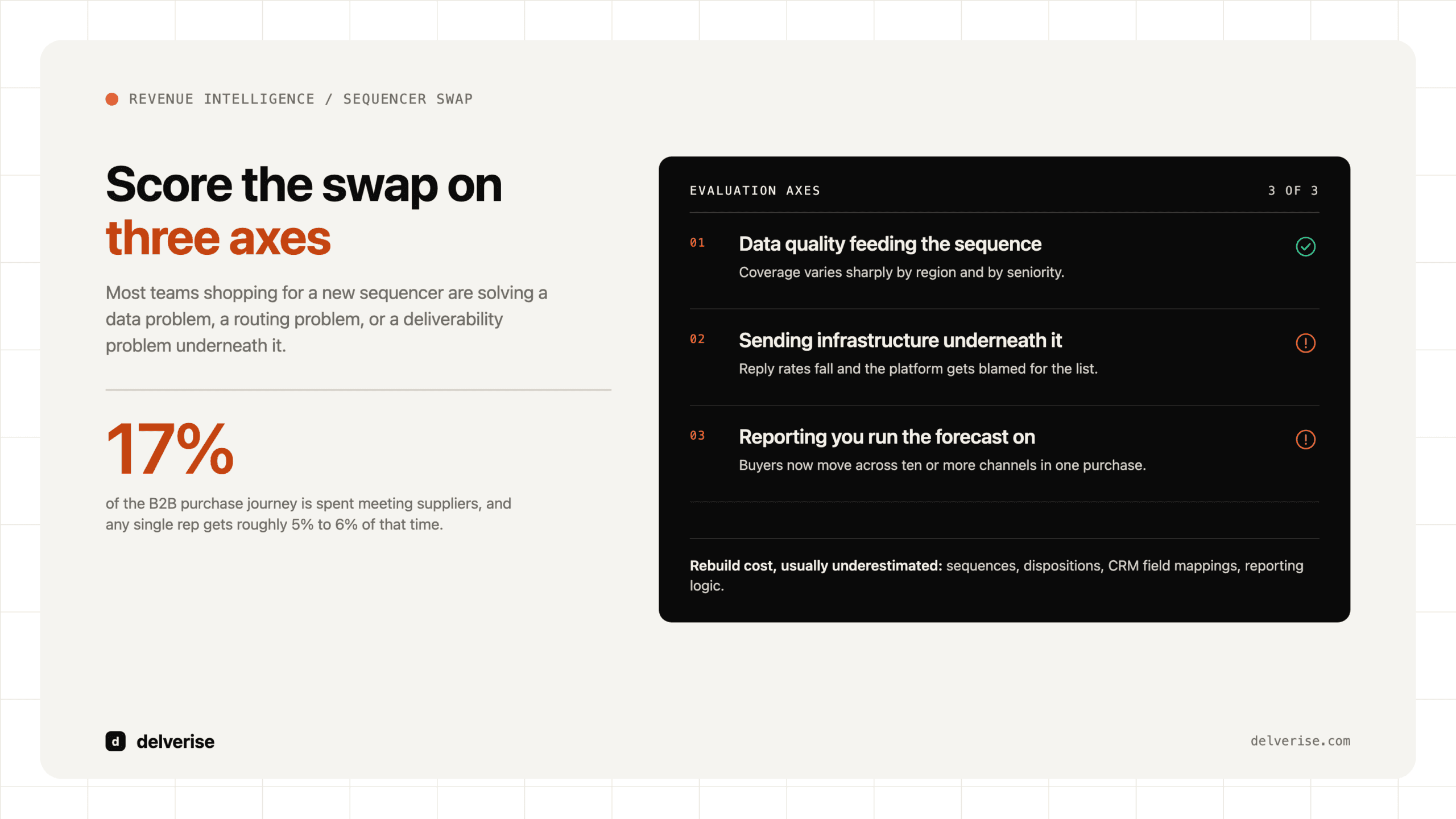
- Migration cost is usually underestimated: sequences, dispositions, CRM field mappings, and reporting logic all have to be rebuilt.
- Evaluate on three axes: data quality feeding the sequence, sending infrastructure underneath it, and the reporting you will actually run your forecast on.
What does Salesloft actually do, and why do teams look for alternatives?
Salesloft is a sales engagement platform: software that organizes multi-step outbound and follow-up “cadences” (sequenced touches across email, phone, LinkedIn, and manual tasks), logs activity to the CRM, and reports on rep effort and reply rates. It has been Vista Equity Partners-backed since 2022 and has expanded its positioning from cadences into broader revenue orchestration.

Teams start shopping for Salesloft competitors for four recurring reasons, and it is worth naming yours before you take a single demo:
- Cost per seat. Enterprise sequencers price in the high hundreds to low thousands per seat per year, and rarely publish list pricing. A 12-rep team feels that.
- Bundling. You are paying separately for contact data, sequencing, dialing, and conversation intelligence. Consolidation looks attractive on paper.
- Deliverability. Reply rates fell and the platform gets blamed. Usually the sending infrastructure and list quality are the cause.
- Adoption. Reps work around the tool. That is almost always a process problem wearing a software costume.
The buying context matters here. Gartner’s B2B buying research found that customers spend only around 17% of their total purchase journey meeting with potential suppliers, and when they are comparing several vendors, any single rep gets roughly 5% to 6% of that time. McKinsey’s B2B Pulse work found buyers now move across ten or more channels in a single purchase. A cadence tool improves how you use a shrinking slice of attention. It does not expand the slice.
Who are the main Salesloft competitors in 2026?
| Platform | Best fit | The honest tradeoff |
|---|---|---|
| Outreach | Enterprise sales orgs, 50+ seats, heavy Salesforce use, deal and forecast modules alongside sequencing | Closest like-for-like swap, which means similar cost and similar admin overhead. Migration effort is high for marginal gain unless a specific feature is the driver. |
| Apollo.io | Seed to Series A teams that want contact data, sequencing, and dialing in one seat | Data coverage varies sharply by region and seniority, and the bundled database tempts teams into volume-first outbound. |
| HubSpot Sales Hub | Teams already on HubSpot CRM where marketing and sales share one record | Sequencing depth and dialer maturity trail the specialists. Fine for follow-up, thinner for high-volume prospecting. |
| Clari (with Groove) | Revenue leaders whose primary pain is forecast accuracy and pipeline inspection | You are buying a forecasting platform that includes engagement. If your issue is top-of-funnel activity, the value is misallocated. |
| Gong Engage | Teams already running Gong for conversation intelligence and coaching | Strongest when call data drives the next action. Weaker as a standalone outbound engine. |
| Reply.io, Klenty, lemlist, Smartlead | Lean teams and agencies running high-volume email with tight budgets | Cheap and fast, with lighter CRM sync, weaker enterprise reporting, and more manual admin. |
| Clay plus dedicated sending infrastructure | Teams whose real problem is signal and data, not sequence UI | Requires build effort and someone who owns it. Highest ceiling, steepest setup. |
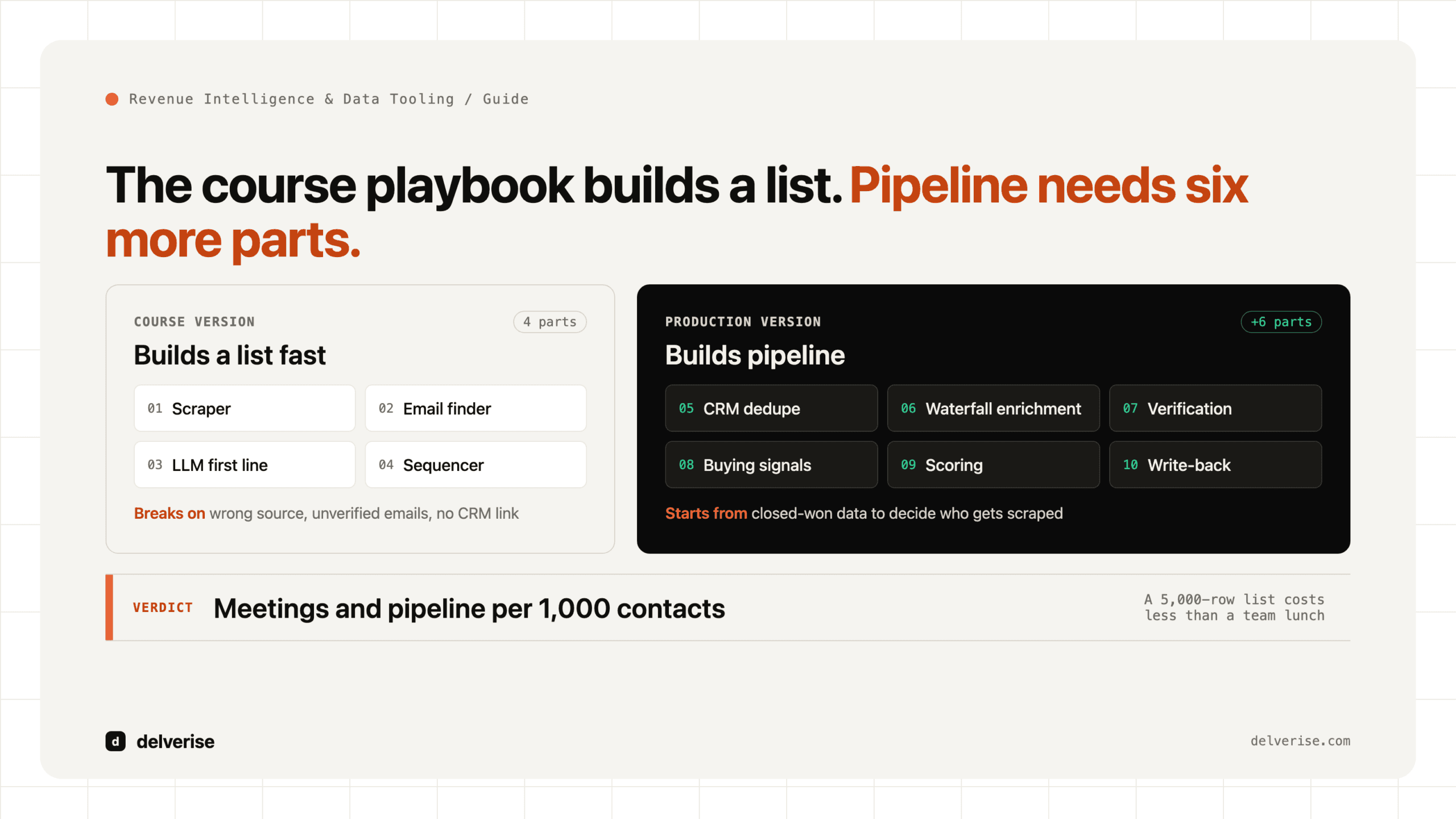
That last row deserves explanation. A growing pattern among Series A and B teams is to stop treating the sequencer as the center of the system. Clay sits upstream as a data and signal orchestration layer: it enriches accounts through multiple providers, scores them against your ICP, and pushes only qualified, well-researched contacts into whichever sending tool you use. The sequencer becomes a dumb executor, which is exactly what it should be. We cover the mechanics of chaining providers in the data enrichment waterfall, and delverise offers Clay implementation support for teams that want the system built rather than researched.
How should you choose between an all-in-one and a specialist?
Use headcount and data maturity as the deciding variables, not feature checklists.

Under 10 revenue seats: an all-in-one like Apollo or HubSpot Sales Hub is usually correct. The overhead of stitching four vendors together exceeds the benefit at that scale. Read our Apollo.io breakdown before assuming the bundled database covers your segment.
10 to 40 seats: this is where the specialist stack earns its keep. Separate data (Clay, ZoomInfo, or a provider waterfall), separate sending infrastructure, and a sequencer chosen for CRM fidelity and reporting. This is also where a dedicated ops owner becomes non-optional. Our guide to GTM operations covers who owns what.
40+ seats: the question shifts from sequencing to governance. Territory rules, routing, forecast hygiene, and permissions dominate. Outreach and Clari compete seriously here, and switching costs are real.
What actually breaks when you switch sales engagement platforms?
Here is a concrete picture. A Series A SaaS company with 6 AEs and 3 SDRs moves off Salesloft to save roughly $30,000 a year in seat cost. The migration surfaces work nobody scoped:

- Forty-two active cadences have to be rebuilt, and about half turn out to be duplicates or abandoned.
- Call dispositions and activity types no longer map cleanly to Salesforce fields, so eight months of trend reporting breaks.
- The old platform handled email throttling and domain rotation. The new one does not, and reply rates drop for three weeks until sending infrastructure is rebuilt.
- Two reps keep using personal Gmail for follow-up, so pipeline attribution goes soft.
Net result: the savings are real, and roughly one quarter of ramped selling time pays for them. That is often still the right call. It is a different decision from the one the pricing page implies.
What should you evaluate before you buy?
Run this list against every vendor, including your incumbent:
- Where does contact data come from, and what is verified bounce rate on a 500-record sample of your actual ICP?
- Does the tool manage sending domains, warmup, and throttling, or do you need separate infrastructure?
- Which CRM objects sync bidirectionally, and which fields are read-only?
- Can you rebuild your three most-used reports natively, without exporting to a spreadsheet?
- What is the real per-seat cost at 24 months including data credits, dialer minutes, and required add-ons?
- Who on your team owns admin, and do they have capacity for the first 90 days?
- What happens to sequence history and activity logs if you leave?
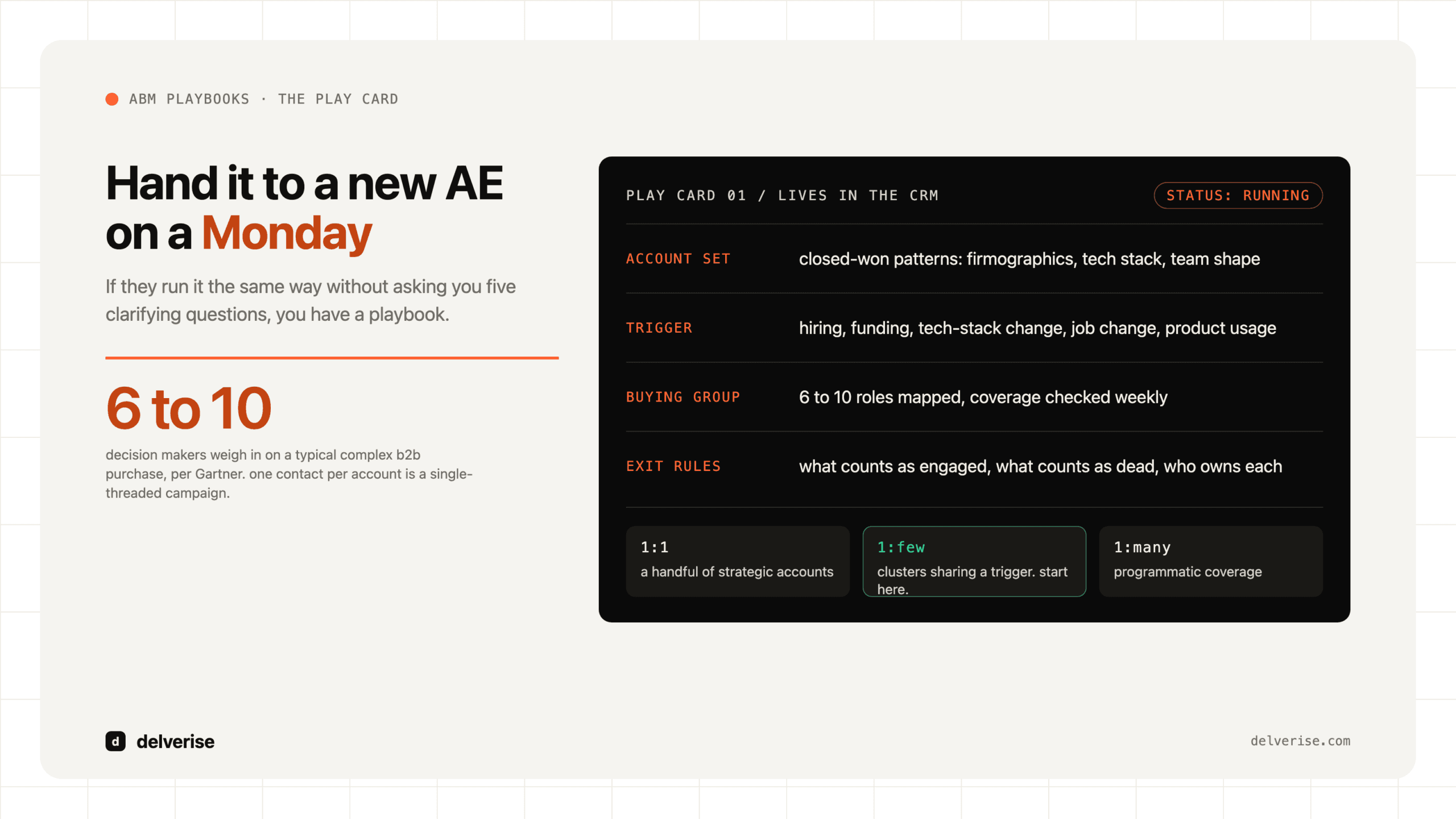
Gartner’s research on B2B buying groups puts a typical enterprise purchase in front of six to ten decision makers. Your sequencer has to support multithreading across that group, not just single-contact cadences. Ask vendors to demo an account-level sequence, not a contact-level one. If you are building the motion itself rather than just the tooling, our guides to AI sales tools and AI BDR limitations cover where automation genuinely holds and where it degrades.
Does the tool choice matter as much as buyers think?
Less than the shortlist suggests. HBR’s research on B2B purchase ease found that buyers who experienced supplier information as genuinely helpful were substantially more likely to buy a larger deal with less regret afterward. Nothing in that finding depends on which sequencer sent the email. G2 category reviews across sales engagement tools show remarkably similar satisfaction scores among the leaders, with complaints clustering on implementation and data quality rather than core sequencing.
The teams that get outsized returns from any of these platforms treat them as the execution layer of a designed system: clear ICP, enriched and scored accounts, routing rules that fire in minutes, and reporting the CRO trusts. That system is what delverise builds, and the sequencer is one replaceable component inside it. Our GTM engineering work starts from the signal layer and works forward.
Frequently Asked Questions
Is Outreach better than Salesloft?
Neither has a decisive edge for most mid-market teams. Outreach tends to be stronger on deal and forecast modules and on enterprise permissioning. Salesloft is often reported as easier for reps to adopt. If you are switching between them purely on features, the migration cost usually exceeds the gain. Switch for a specific capability gap or a specific commercial term.
What is the cheapest Salesloft alternative?
Reply.io, Klenty, lemlist, and Smartlead sit at the low end, typically under $100 per user per month. Apollo.io is the cheapest option that bundles a contact database with sequencing. The tradeoff at that tier is lighter CRM sync, thinner reporting, and more manual administration, which costs ops time you may not have.
Can Clay replace Salesloft?
No, and it is designed for a different job. Clay handles data enrichment, signal capture, and account scoring upstream of the sequence. Most teams run Clay alongside a sending tool, using Clay to decide who gets contacted and with what context, then passing that to the sequencer for execution.
How long does it take to migrate off a sales engagement platform?
Budget four to eight weeks for a team under 25 seats, assuming a dedicated owner. The sequence rebuild is fast. The CRM field mapping, reporting reconstruction, and sending infrastructure setup consume most of the timeline. Run both platforms in parallel for at least two weeks before cutting the old contract.
Do we need a sales engagement platform at all under 10 reps?
Only if follow-up is genuinely being missed. Below roughly five reps, HubSpot sequences or Apollo cover the requirement. Buy a dedicated platform when you need enforced process across a team, activity reporting your forecast depends on, or multithreaded account cadences that a basic tool cannot express.
Read next