←Back to blog
Revenue Intelligence & Data ToolingGuideAugust 20, 20268 min read
Lead Gen Data: What B2B SaaS Revenue Teams Actually Need
Lead gen data is the account, contact, and signal information that tells a revenue team who to sell to, how to reach them, and when. It covers firmographics, verified contact details, technographics, and intent. Quality matters more than volume: coverage, accuracy, and freshness decide whether campaigns produce pipeline or noise.
Lead gen data is the account, contact, and signal information that tells a revenue team who to sell to, how to reach them, and when. It covers firmographics, verified contact details, technographics, and intent. Quality matters more than volume: coverage, accuracy, and freshness decide whether campaigns produce pipeline or noise.
Key takeaways
- Three properties determine whether lead gen data works: coverage (what share of your target list you can actually reach), accuracy (whether the record is correct today), and freshness (how fast it decays).
- Single-provider strategies leave reachable buyers on the table. Chaining providers in sequence typically lifts usable coverage by 20 to 40 percent on the same list.
- Intent data is directional, not deterministic. It changes sequencing and prioritization far more than it changes messaging.
- Your own first-party data (product usage, web sessions, CRM history) usually outperforms anything you can buy, and most teams underuse it.
- Data spend without routing, scoring, and follow-up infrastructure produces cost, not pipeline. The system around the data is where the return lives.
What is lead gen data, exactly?
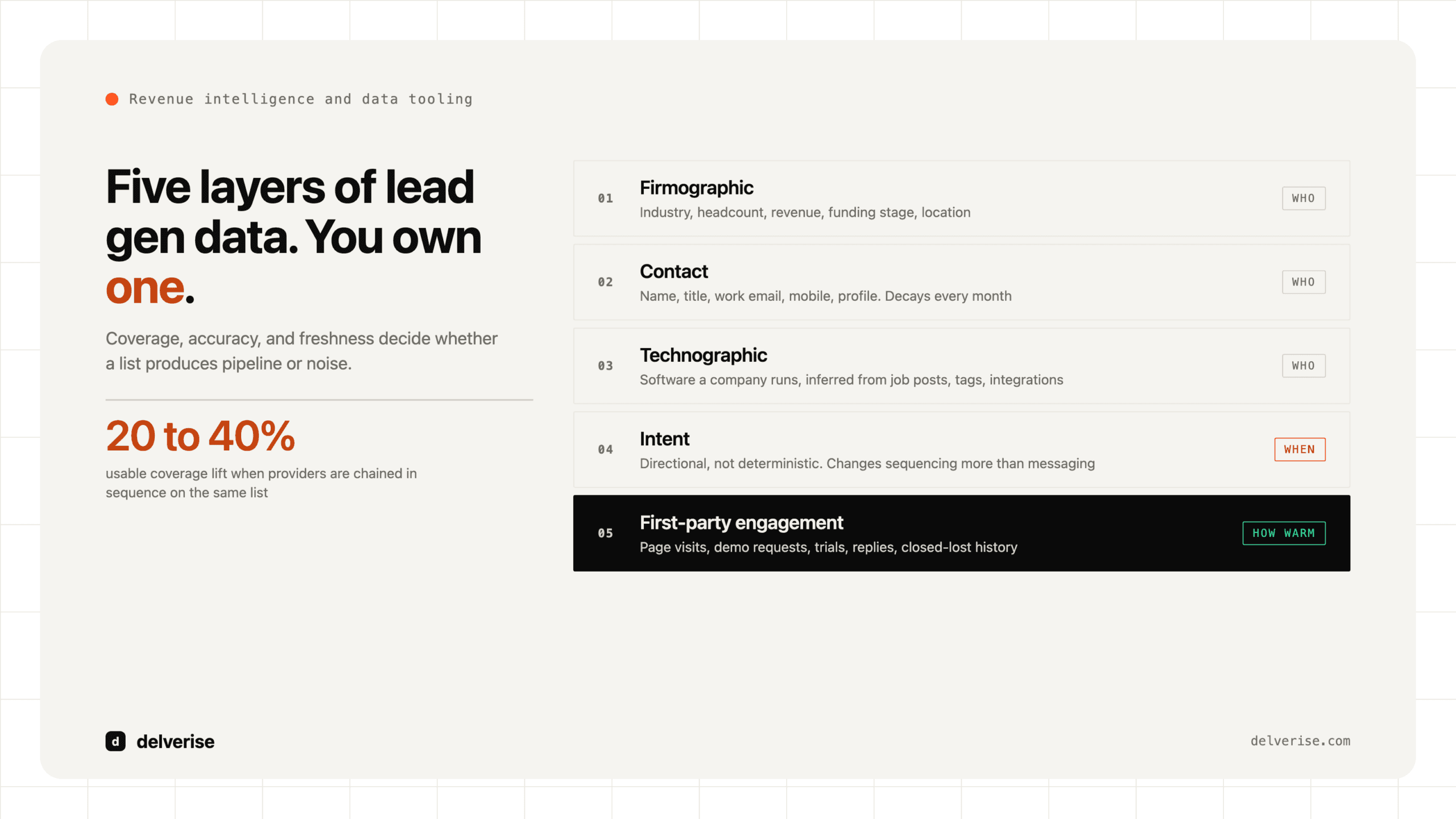
Lead gen data is the set of records a revenue team uses to define, find, reach, and prioritize potential buyers. It breaks into five categories, and buyers confuse them constantly.

Firmographic data describes the company: industry, headcount, revenue, funding stage, location, corporate structure. Contact data describes the person: name, title, work email, mobile, LinkedIn profile. Technographic data tells you what software a company runs, inferred from job posts, website tags, and public integrations. Intent data infers research behavior, either from third-party content networks (Bombora, G2, TrustRadius) or from your own site. First-party engagement data is what your own systems observe: page visits, demo requests, product trials, email replies, closed-lost history.
The first three answer “who.” Intent answers “when.” First-party engagement answers “how warm,” and it is the only category you own outright.
Why does most lead gen data fail to produce pipeline?
Because teams buy volume and inherit decay. A B2B contact database ages continuously as people change jobs, companies restructure, and domains migrate. A list purchased in January is meaningfully weaker by June, and nobody notices until reply rates sag.

The cost is real and measurable. Gartner has estimated that poor data quality costs organizations an average of $12.9 million a year across wasted effort, bad decisions, and rework. In a Seed to Series B SaaS company, that shows up as SDRs emailing people who left, forecasts built on stale account records, and marketing paying for impressions against companies that were never in the addressable market.
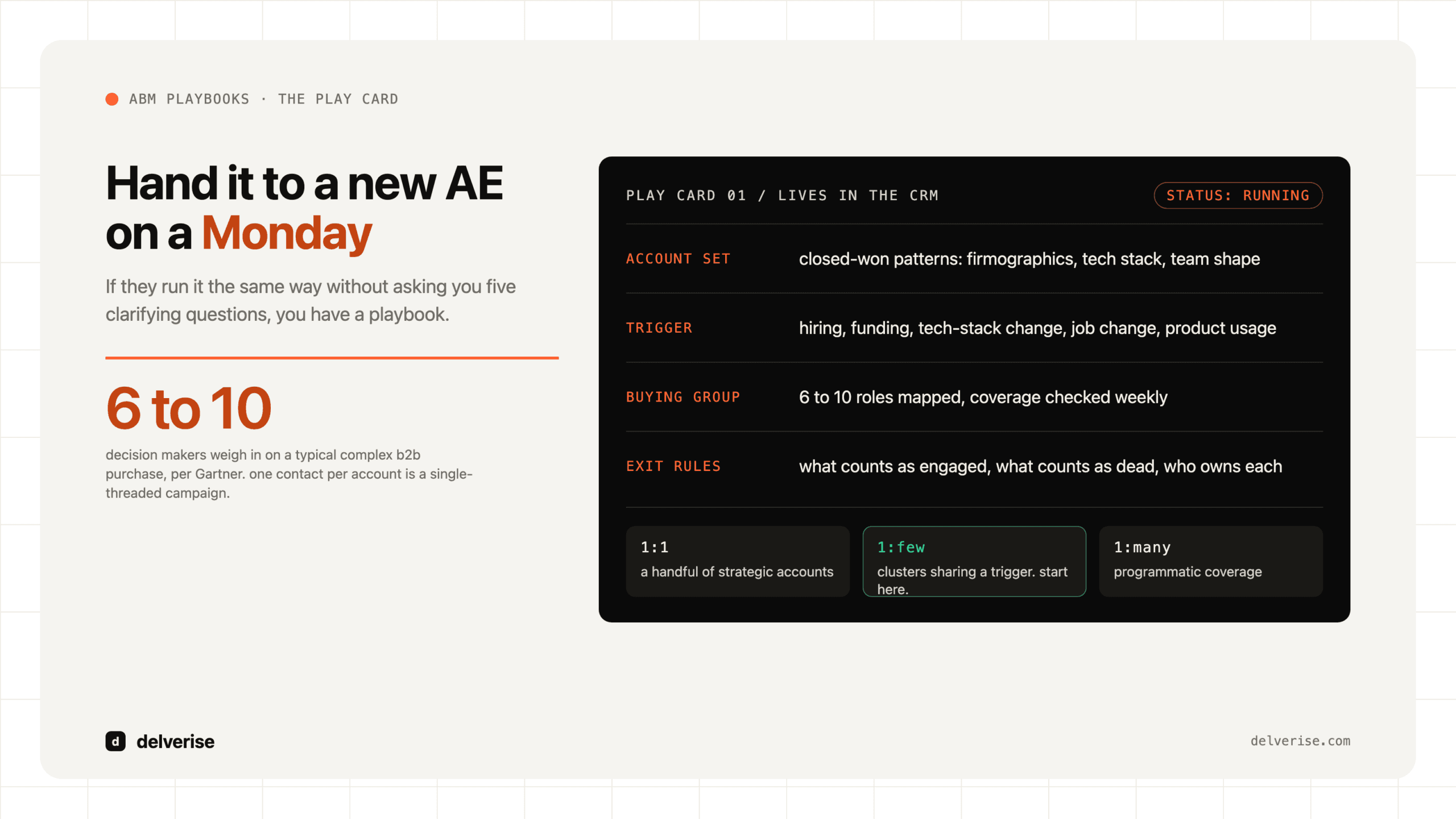
The second failure is structural. Gartner’s research on B2B buying found that customers spend only about 17 percent of their total purchase journey meeting with potential suppliers, and when they are comparing several vendors, any single rep gets roughly 5 or 6 percent of the buyer’s time. Data that reaches one contact at an account is data that reaches a fraction of a fraction of the decision. Gartner puts the typical B2B buying group at six to ten people, so single-threaded contact data almost guarantees you miss the person who can block or fund the deal.
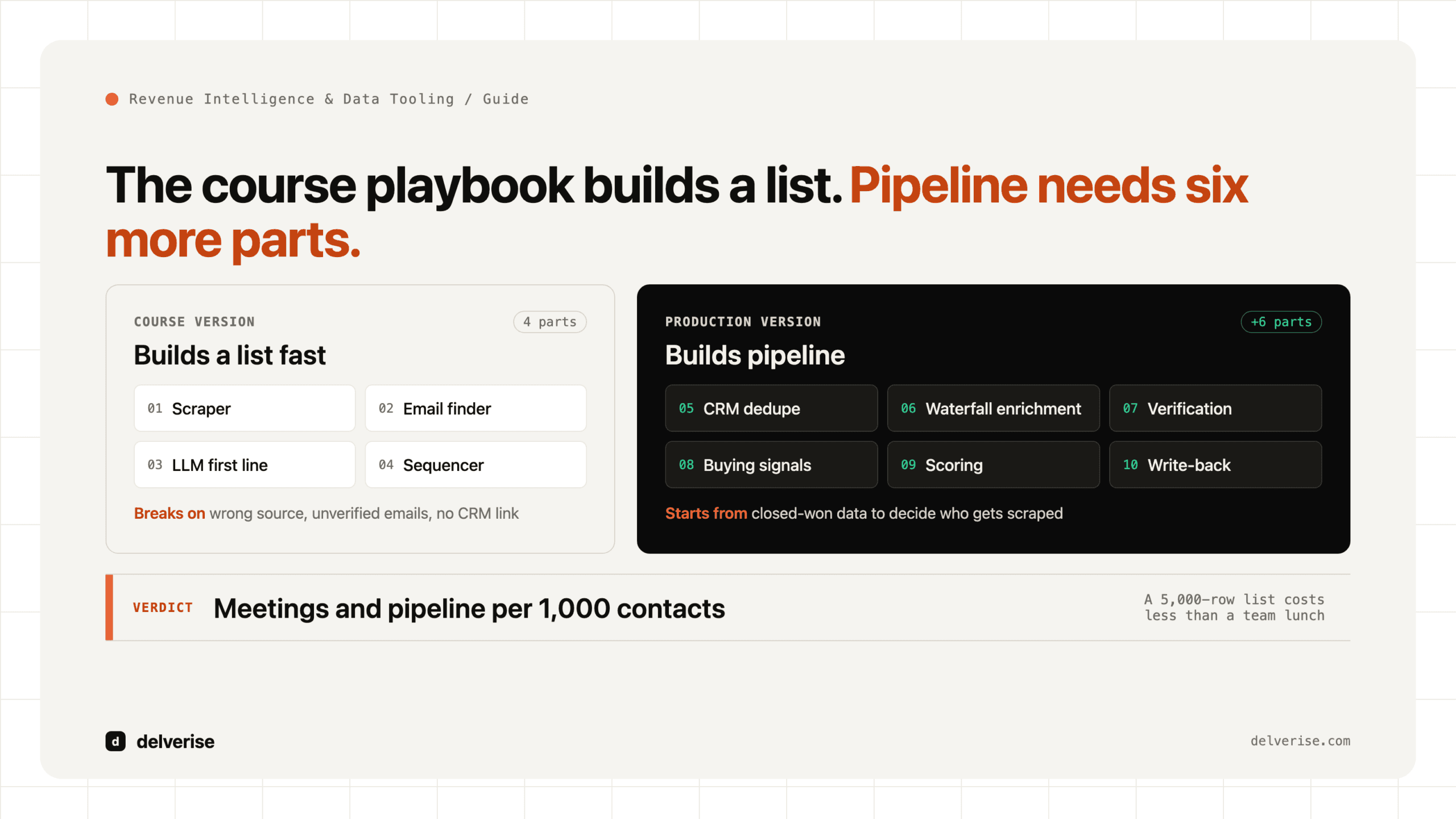
The third failure is that data arrives with no destination. Records land in a CSV, get uploaded to a sequencer, and never sync back to the CRM with the fields that would let you segment the next campaign. That is a plumbing problem, and it is the one GTM engineering work is built to solve.
Which types of lead gen data matter most?
| Data type | What it answers | Typical decay rate | Best use |
|---|---|---|---|
| Firmographic | Is this company in our market? | Slow (annual) | ICP definition, territory design, TAM sizing |
| Contact (email) | Can we reach this person? | Fast (job changes) | Outbound sequences, list building |
| Contact (mobile) | Can we call them? | Slow, but coverage is thin | Multithreading, late-stage deals |
| Technographic | Do they run adjacent tools? | Moderate | Displacement plays, integration angles |
| Third-party intent | Are they researching this category? | Very fast (weekly) | Prioritization and timing, rarely messaging |
| First-party engagement | Are they engaging with us? | Real time | Routing, scoring, follow-up triggers |
Note the asymmetry. Firmographics are cheap and durable. Contact emails are the expensive, perishable layer where most budget goes. Intent is the noisiest, and it earns its keep as a sequencing input rather than a source of truth. If you are evaluating an intent vendor, our breakdown of what buying intent data actually changes covers where the signal holds up and where it does not.
How do you know if your lead gen data is good enough?
Run the math on your own list instead of trusting a vendor’s published match rate. Here is a worked example from a typical Series A motion.

Start with 4,000 in-ICP accounts. At four relevant titles per account, that is 16,000 target contacts. A single provider returns work emails for 62 percent of them, so 9,920 records. Push those through verification and 84 percent come back deliverable: 8,333 usable contacts.
Now add two more sources in sequence, querying the second only for records the first missed, and the third only for what remains. Combined coverage rises to about 81 percent, and after verification you hold roughly 10,890 usable contacts. That is 2,557 additional reachable buyers, a 31 percent lift, for maybe 1.4x the data cost. At a 2 percent meeting rate, that is 51 extra meetings from the same target list and the same team.
Three numbers to track every quarter: match rate against your ICP list (not the vendor’s universe), bounce rate after verification, and the share of records that are still correct 90 days later. If a provider will not let you test against your own list before contracting, that is the answer.
Should you buy from one provider or chain several?
Chain them. No single database has complete coverage of any real market, and coverage varies sharply by geography, company size, and seniority. Some providers are strong on North American mid-market, others on EMEA, others on technical titles. Running them in sequence, cheapest and highest-hit-rate first, gets you better coverage at lower blended cost per usable record. We cover the mechanics of this in detail in the data enrichment waterfall.
The orchestration layer is where Clay earns its place: it lets one table call multiple providers conditionally, apply logic between steps, and write results back to your CRM without engineering time. The honest tradeoff is that Clay rewards operators who think in systems and punishes teams that treat it as a list-buying tool. Credits burn fast when enrichment runs without conditions, and a poorly built table can cost more than the providers it calls. Teams that want the workflows designed and maintained rather than assembled internally can look at how we approach Clay implementation.
For teams comparing packaged platforms against a chained stack, our lead intelligence platform buying guide lays out where each model wins.
What does a working lead gen data system look like?
McKinsey’s B2B Pulse research found that buyers now use around ten channels across a purchase decision, roughly double what they used a decade ago. Data that only feeds email is data working at a fraction of its value. The system, rather than any single vendor, is the asset.
- A written ICP with hard inclusion and exclusion rules, stored as CRM fields rather than a slide
- An account list built from that ICP, refreshed monthly, with clear ownership
- Multi-source enrichment with conditional logic and a per-record cost ceiling
- Email verification as a required step before any record enters a sequence
- Buying-group coverage: four or more relevant titles per target account, not one
- Bidirectional CRM sync so enrichment results are queryable for the next campaign
- Routing and SLA rules so inbound and signal-triggered leads reach a human quickly
- A quarterly decay audit measuring what percentage of records are still accurate
Most teams have items one, three, and four. The gaps are usually in ownership, sync, and routing, which is why buying more data rarely fixes the symptom. If nobody owns this end to end, our guide to GTM operations covers who should.
What should revenue leaders be skeptical about?
Vendor match rates quoted against their own universe. Intent scores presented without a baseline. Any provider that resists a paid pilot on your list. Claims of real-time data on a database refreshed quarterly. And AI-generated personalization built on thin firmographics, which produces confident, specific, and wrong opening lines at scale.
The useful mental shift is treating lead gen data as infrastructure with a maintenance cost rather than as a purchase. Budget for verification, refresh cycles, and the operator time to keep the routing honest. Teams that do this compound: every campaign leaves the data set better than it found it. Teams that do not buy the same list twice a year at full price. For the wider motion this data feeds, see how B2B SaaS teams build pipeline that compounds.
Frequently Asked Questions
What is lead gen data in B2B SaaS?
It is the combined account, contact, and signal data a revenue team uses to identify and reach buyers: firmographics, verified emails and phone numbers, technographics, third-party intent, and first-party engagement. In practice it is the input layer for outbound, ABM, scoring, and territory planning.
How much should we budget for lead gen data?
Most Seed to Series B SaaS teams land between 3 and 8 percent of sales and marketing spend on data and enrichment. The more useful test is cost per usable, verified, in-ICP contact. If that number is falling quarter over quarter while coverage holds, the budget is working. If you are paying for records nobody sequences, the number is too high regardless of the absolute figure.
How often does lead gen data need refreshing?
Contact records deserve a re-verification pass before any major campaign and at minimum quarterly. Firmographics can run on an annual cycle with event-based triggers for funding rounds and headcount changes. Third-party intent has a useful life measured in days, so it should be consumed continuously or skipped.
Is buying intent data worth it for an early-stage team?
Usually only after outbound fundamentals are working. Intent data improves the order in which you contact accounts, so it multiplies an existing motion. If reply rates are already weak because of coverage or messaging problems, intent adds cost without fixing the constraint. Revisit it once you have consistent meeting volume and need to prioritize a list too large to work evenly.
Can we build lead gen data in-house instead of buying it?
Partially. Scraping public sources, building your own account universe, and mining first-party engagement are all realistic in-house. Verified contact data at scale is worth buying, because maintaining accuracy across millions of records is a full business. The pragmatic split: own the ICP logic and the orchestration, buy the raw contact layer, and treat providers as interchangeable inputs rather than long-term commitments. A clear view of your addressable market makes that decision far easier.
Read next