←Back to blog
Growth & Demand GenerationGuideNovember 26, 20268 min read
GTM Systems: What They Are and How B2B SaaS Teams Build One That Scales
GTM systems are the connected set of data, tools, workflows, and metrics a B2B company uses to find, engage, convert, and expand customers. A working GTM system links targeting, outbound, inbound, CRM, and analytics so every signal flows to the right team at the right time, and leadership can see exactly what produces revenue.
GTM systems are the connected set of data, tools, workflows, and metrics a B2B company uses to find, engage, convert, and expand customers. A working GTM system links targeting, outbound, inbound, CRM, and analytics so every signal flows to the right team at the right time, and leadership can see exactly what produces revenue.
Key takeaways
- A GTM (go-to-market) system is the operating layer underneath your revenue team: data, routing, engagement, and measurement working as one.
- Most Seed to Series B companies have plenty of tools and very little system. The gaps between the tools are where pipeline leaks.
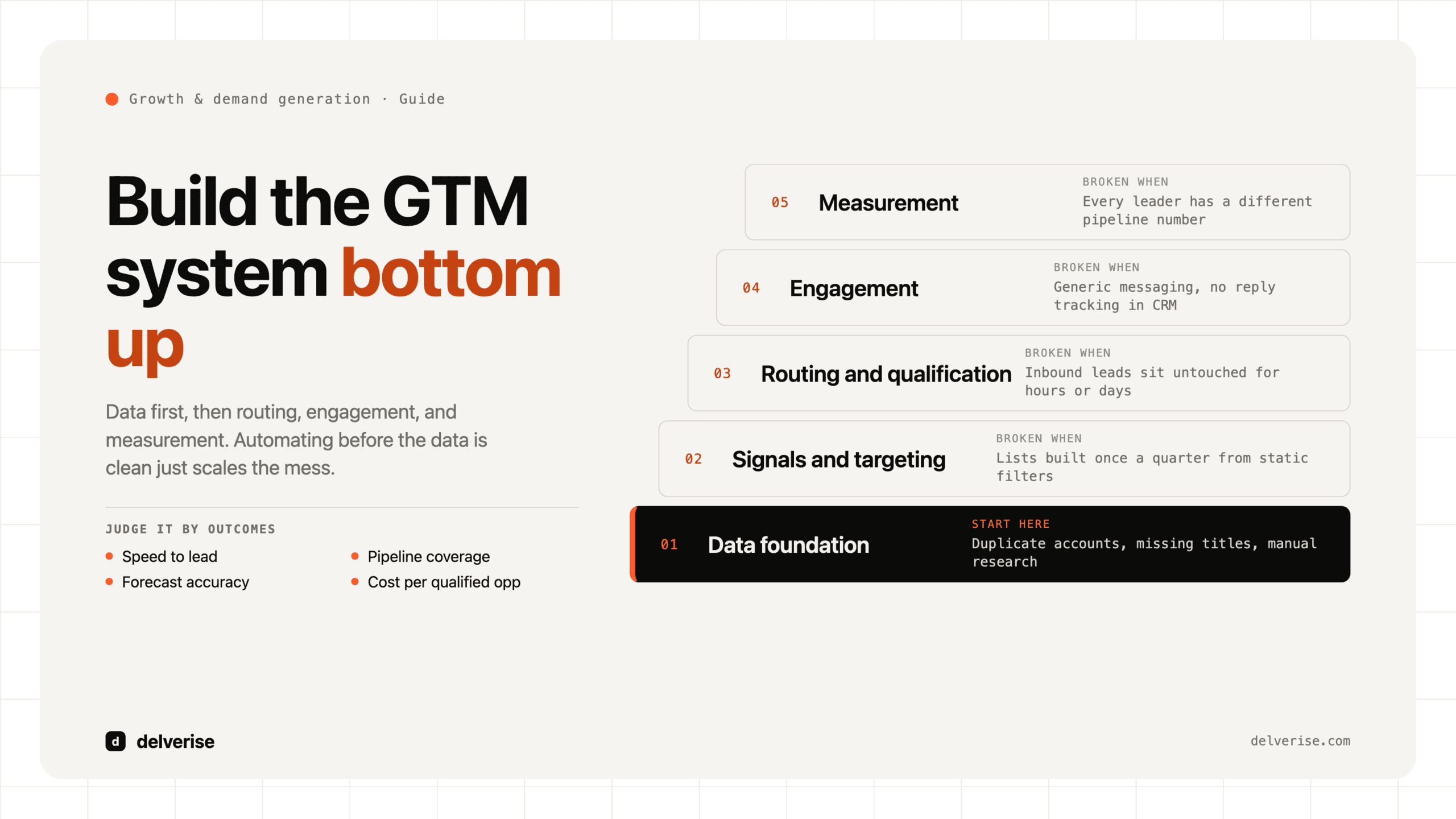
- Build in order: data foundation first, then routing and qualification, then engagement, then measurement. Automating before the data is clean just scales the mess.
- Judge the system by outcomes: speed to lead, pipeline coverage, forecast accuracy, and cost per qualified opportunity.
- Owning the architecture matters more than owning any single tool. Tools get swapped every few years, but a well-designed system keeps working when they do.
What is a GTM system, in plain terms?
Think of your go-to-market motion as a set of questions your company has to answer every day. Who should we sell to? Which of those accounts are showing intent right now? Who owns this lead? What should we say to them, and through which channel? Did it work, and what will we close this quarter?
A GTM system is the infrastructure that answers those questions automatically and consistently. It includes your CRM (the system of record for accounts, contacts, and deals), your enrichment and data sources, your engagement tools for email, calling, and LinkedIn, your routing and scoring logic, and the reporting layer that ties activity to revenue. The “system” part is the connective tissue: the field definitions, the sync rules, the handoff triggers, and the ownership model that keep all of it in agreement.
When that connective tissue is missing, you get the familiar symptoms. Reps work from spreadsheets. Marketing and sales argue about lead quality. Nobody trusts the pipeline report, and the board deck takes a week to assemble.
What are the layers of a GTM system?
Every durable GTM system has the same five layers, whatever tools you pick. We cover the foundational pieces in more depth in the six pieces under every revenue stack, but here is the working map:

| Layer | What it does | Typical tools | Sign it is broken |
|---|---|---|---|
| Data foundation | Defines your ICP (ideal customer profile), stores clean account and contact records, enriches them with firmographic and technographic data | Salesforce, HubSpot, Clay, Apollo | Duplicate accounts, missing titles, reps researching manually |
| Signals and targeting | Detects buying intent: hiring, funding, tech changes, website visits, product usage | Clay, intent providers, product analytics | Outbound lists built once a quarter from static filters |
| Routing and qualification | Scores leads, assigns owners, triggers handoffs between marketing, SDRs, and AEs | CRM workflows, n8n, scoring models | Inbound leads sit untouched for hours or days |
| Engagement | Runs sequences, calls, and personalized outreach across channels | Outreach, Salesloft, HubSpot Sequences | Generic messaging, high bounce rates, no reply tracking in CRM |
| Measurement | Attributes pipeline to sources, tracks conversion by stage, feeds the forecast | CRM reporting, BI tools, warehouse | Every leader has a different pipeline number |
The layers depend on each other in sequence. Engagement tools are only as good as the data feeding them, and measurement is only as good as the stage definitions reps follow.
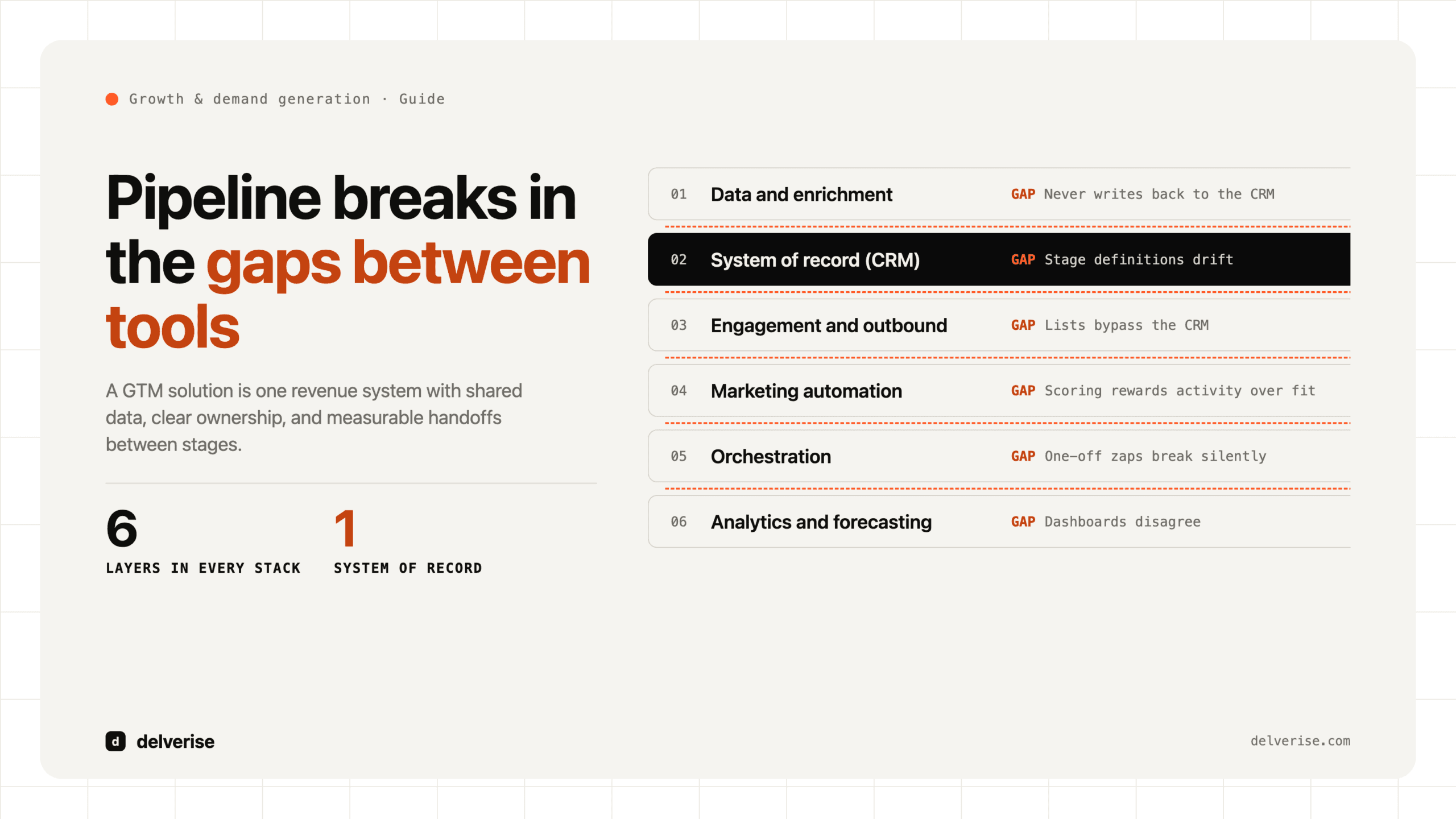
Why do most GTM systems break between Seed and Series B?
Early-stage companies buy tools to solve the problem in front of them. A founder signs up for a CRM, a sequencing tool, a data provider, and maybe a calling platform. Each one works on its own. Then the team grows from two sellers to twelve, and the tools start contradicting each other.

Three failure patterns show up constantly:
- No shared definitions. Marketing calls something an MQL (marketing qualified lead) that sales would never accept. Stage names mean different things to different reps. Reports built on those definitions can’t be trusted.
- Manual handoffs. Leads move between teams through Slack messages and spreadsheet exports. Speed to lead collapses, and HBR’s widely cited research on lead response found that companies contacting leads within an hour were dramatically more likely to qualify them than those waiting even a little longer.
- Tool sprawl without an owner. Nobody is accountable for how the stack fits together, so every new tool adds a fresh integration problem.
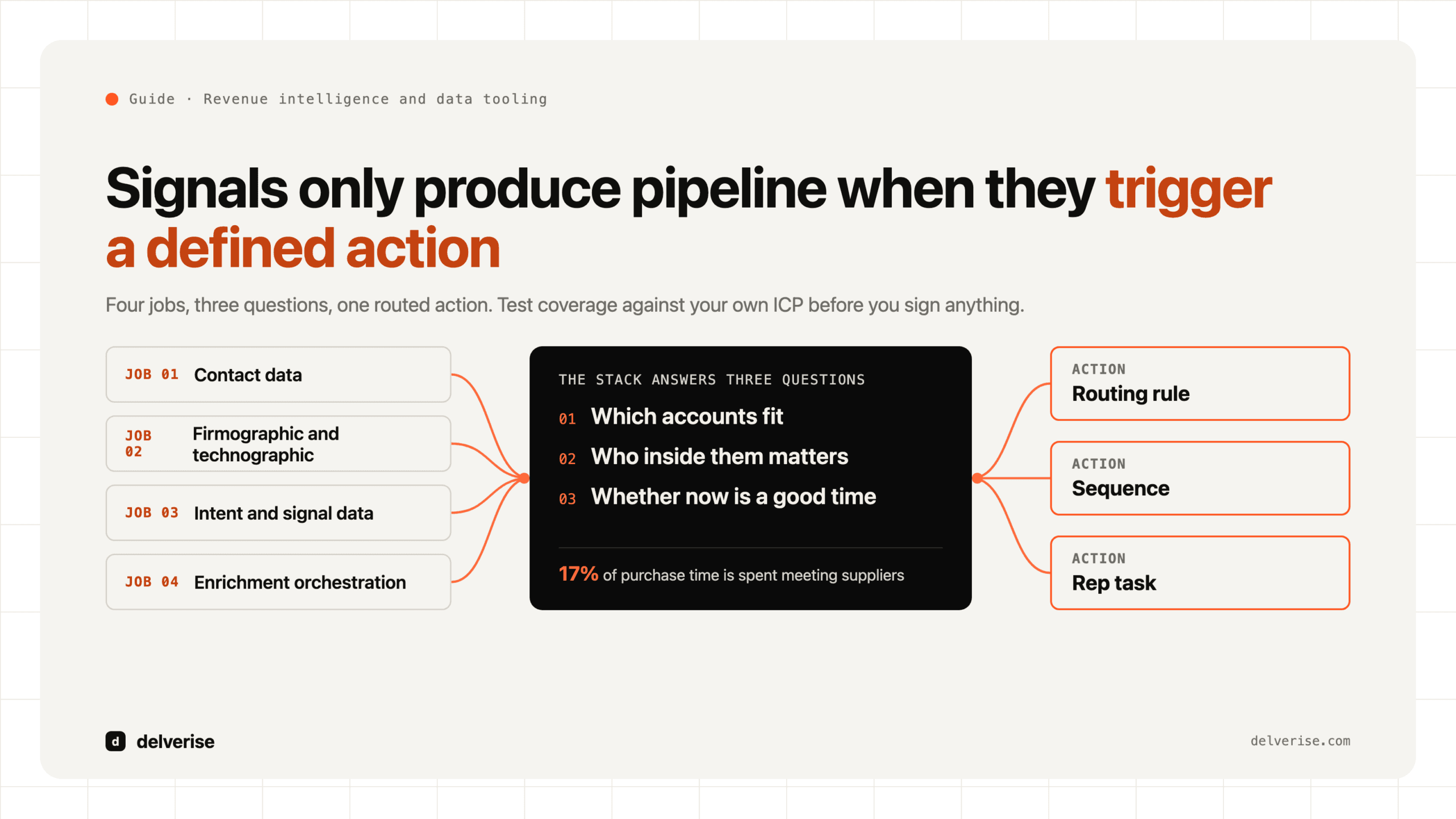
The buyer side makes these gaps more costly. Gartner’s research on B2B buying found that buyers spend only about 17% of their total buying time meeting with potential suppliers, and that time is split across every vendor they’re evaluating. McKinsey’s B2B Pulse research has shown buyers routinely using ten or more channels during a purchase. When buyers are mostly self-directed and spread across many channels, a disconnected system misses the signals that show where they are.
How should you sequence the build?
Order matters more than tool choice. Here is the build sequence that holds up for most B2B SaaS companies:

1. Lock the data foundation
Write down your ICP in terms a machine can filter on: employee range, industry, tech stack, geography, funding stage. Clean and dedupe the CRM. Set up an enrichment workflow so every new account and contact arrives complete. This is where CRM enrichment earns its keep, because every downstream layer inherits the quality of these records.
2. Define stages and ownership
Agree on lifecycle stages, entry and exit criteria for each, and who owns the record at every step. Document it. This is a leadership decision more than a technical one, and skipping it is the most common reason reporting fails later.
3. Automate routing and qualification
Build scoring and assignment rules so inbound leads reach an owner in minutes. For a deeper look at scoring logic, see our guide to AI lead qualification.
4. Layer in signals and engagement
Now connect intent signals to outreach. Many teams use Clay here as an orchestration layer: it pulls from dozens of data providers, runs AI research on each account, and pushes enriched, prioritized records into your sequencer. Clay is flexible, and that flexibility means it needs deliberate table design and credit management, otherwise costs and complexity creep up. Our breakdown of outbound sales automation covers which steps to automate and which to keep human.
5. Close the loop with measurement
Instrument every stage so you can see conversion rates, velocity, and source attribution. That data becomes the input to a forecast you can defend, which we walk through in revenue forecasting for B2B SaaS.
What does a working GTM system look like in practice?
Here is an illustrative example of a single account moving through a well-built system at a Series A company selling to mid-market finance teams:
- A target account posts a job for a new VP of Finance. The signal layer catches it and flags the account.
- Enrichment fills in the finance leadership contacts, verifies emails, and appends the company’s current ERP from technographic data.
- The account scores above threshold, so routing assigns it to the SDR who owns that territory and creates a task in the CRM.
- A sequence launches with a first line referencing the hiring change and the ERP, reviewed by the rep before sending.
- The prospect replies. The reply is logged, the contact moves to “engaged,” and a meeting booked through the calendar link creates an opportunity with the source attributed to “signal: hiring.”
- At quarter end, leadership sees that hiring-signal accounts convert to opportunities at a higher rate than static-list accounts, and shifts SDR capacity accordingly.
None of those steps needs heroics from anyone on the team. The system does the connecting, and people spend their time on conversations. That’s the practical payoff: the same headcount produces more qualified pipeline, and you can tell which motions are working. If you want the full funnel view, our piece on building an outbound funnel that converts goes stage by stage.
Should you build it in-house or bring in outside help?
There are honest tradeoffs either way.
Building in-house works when you already have a strong RevOps or GTM engineering hire who has done this before, and when leadership can give them time without pulling them into daily reporting requests. The downside is speed: one person building five layers while also running operations usually takes several quarters.
Bringing in specialists makes sense when you need the system running this quarter, when your team lacks deep experience with specific platforms, or when you want an architecture designed to survive tool changes. The risk is ending up with a system nobody internal understands, so insist on documentation and a real handoff.
A hybrid often works best: outside specialists design and build the architecture, and an internal owner runs and extends it. That’s the model behind delverise’s GTM engineering work, and if Clay is part of your stack, our Clay implementation team can handle the table architecture and integrations.
How do you know your GTM system is working?
Use this checklist as a quarterly health review:
- Inbound leads reach an owner within minutes, and you can prove it with a report
- Every rep, marketer, and executive quotes the same pipeline number
- New records arrive enriched, with fewer than a small fraction missing key fields
- Every opportunity has a source attributed, and you can compare conversion by source
- Your forecast lands within an acceptable range of actuals, quarter over quarter
- You can swap one tool in the stack without rebuilding the others
- Reps spend most of their time selling, with research and data entry largely automated
If you can’t tick most of these, the fix is usually in the data or definitions layers. Adding another tool rarely helps.
Frequently Asked Questions
What is the difference between a GTM system and a tech stack?
A tech stack is the list of tools you pay for. A GTM system is how those tools connect: the shared data model, routing rules, stage definitions, and reporting that make them work together. Two companies can run identical stacks and get very different results depending on the system around them.
When should a startup invest in building GTM systems?
Usually once you have early product-market fit and more than two or three people selling. Before that, founder-led sales with a simple CRM is fine. After that, every month without a system adds data debt that gets more expensive to clean up.
Who should own the GTM system internally?
One accountable owner, typically a Head of RevOps or GTM engineer reporting into the CRO or CEO. Shared ownership across sales and marketing tends to mean no ownership, which is how tool sprawl starts.
How long does it take to build a GTM system?
A focused build of the core layers, covering data foundation, routing, engagement integration, and baseline reporting, typically takes one to three months with experienced builders. Refinement continues after that as you add signals and tune scoring against real conversion data.
Do GTM systems require AI?
No. The fundamentals are clean data, clear definitions, and reliable automation. AI helps with account research, personalization, and qualification at scale, but it amplifies whatever system it sits on. Get the foundation right first, then add AI where it measurably improves conversion or saves rep time.