←Back to blog
Revenue Intelligence & Data ToolingGuideSeptember 10, 20268 min read
How to Use AI for Lead Generation: A Revenue Leader’s System Guide
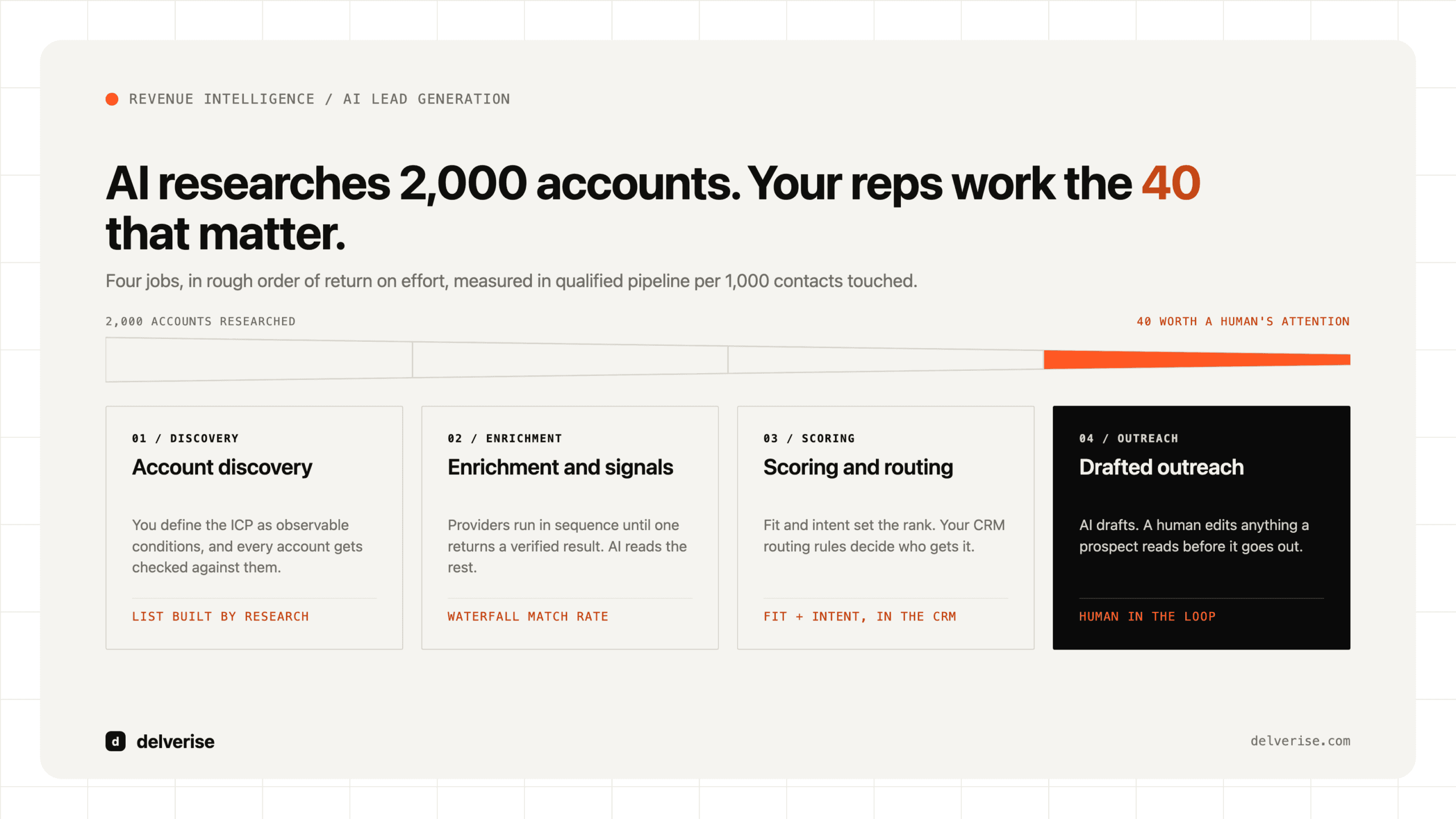
To use AI for lead generation, apply it to four jobs: finding accounts that match your best customers, enriching them with signals your reps cannot gather manually, scoring and routing leads by fit and intent, and drafting outreach a human edits before sending. AI compounds an existing system. It cannot substitute for one.
To use AI for lead generation, apply it to four jobs: finding accounts that match your best customers, enriching them with signals your reps cannot gather manually, scoring and routing leads by fit and intent, and drafting outreach a human edits before sending. AI compounds an existing system. It cannot substitute for one.
Key takeaways
- AI improves lead generation at the data and research layer first. Copy generation is the lowest-value place to start and the most common place teams start.
- Your ICP definition, CRM data hygiene, and routing rules determine your ceiling. Bad inputs get amplified faster with AI, not corrected.
- Volume is the wrong success metric. Track qualified pipeline per 1,000 contacts touched and reply-to-meeting rate.
- Expect a research-and-enrichment layer (Clay, Apollo), an engagement layer (Outreach, Salesloft, HubSpot), and a scoring layer connected to your CRM.
- Keep a human in the loop on anything a prospect reads. Fully automated sending at volume is how domains get burned.
What does “using AI for lead generation” actually mean?
Lead generation is the process of identifying companies and people who match your ideal customer profile (ICP) and converting them into qualified conversations. AI enters that process in specific, narrow places.
The useful mental model: AI is a research analyst that works at machine speed and never gets bored. It reads job postings, 10-Ks, review sites, LinkedIn activity, product changelogs, and hiring pages, then extracts a structured answer to a question you defined. That is genuinely new capability. Before, a rep researched 20 accounts a day. Now a system researches 2,000 and returns only the 40 worth a human’s attention.
What AI does not do: it does not know your ICP, define what “qualified” means at your company, or fix a CRM where 40% of accounts have no industry field populated. Those are decisions and data problems that sit upstream. We cover the underlying stack in the six foundation pieces under every revenue stack.
Where does AI actually create lift in the lead gen funnel?
Four places, in rough order of return on effort.

1. Account discovery and list building
Instead of buying a static list filtered by employee count and industry code, you define your ICP as a set of observable conditions and have AI check every account against them. “Companies running Shopify Plus with more than 15 people in customer support and an open req for a Head of CX.” That is a research question, and it is now cheap to answer at scale.
Clay is the common tool here because it chains data providers together and runs AI research prompts per row. If you are evaluating it, start with Clay directly. The honest tradeoff: it is a build tool, not a push-button product. Teams that get value from it either have someone who enjoys building tables or bring in help. Our Clay implementation work exists for the second case.
2. Enrichment and signal capture
Waterfall enrichment runs a contact through multiple data providers in sequence until one returns a verified result, which lifts match rates well above any single vendor. Layer AI on top to extract things no provider sells: what a company’s pricing page implies about their sales motion, whether their careers page signals a new market push, what their last product release suggests about roadmap. See how AI email finders work and where they fail for the mechanics and the accuracy limits.
3. Scoring and routing
This is where most teams under-invest. A scoring model that combines firmographic fit with behavioral intent lets you route the top 10% to a human immediately and everything else to nurture. Forrester’s research on lead management has consistently found that a large share of leads passed to sales are never worked at all, and speed-to-first-touch is one of the strongest predictors of conversion. Automated scoring plus instant routing addresses both. Details in what AI lead qualification actually scores.
4. Message drafting
Useful, and the most oversold. AI can research an account and draft a first line that references something real. It cannot decide your positioning or know which of three value props lands with a VP of Engineering versus a CFO. Treat generated copy as a draft that a human approves. Our take on what actually converts is in the cold email template breakdown.
What does the buildout actually look like?
Here is a concrete example for a Series A SaaS company selling compliance software to fintechs, running two SDRs and a $1.2M pipeline target per quarter.

Before: SDRs pull a list from Apollo filtered by industry and headcount, roughly 3,000 contacts per quarter. They send sequences with light personalization. Reply rate sits near 3%, positive reply rate near 0.6%, producing about 18 meetings a quarter across both reps.
After the system is built: A Clay table ingests companies from three sources, runs waterfall enrichment for contacts, then runs three AI research prompts per account: does their site mention SOC 2 or ISO 27001, have they hired a compliance or risk role in the last 90 days, and do they sell into regulated buyers. Accounts scoring on two of three conditions go to outbound. The rest go to a nurture track. Roughly 3,000 accounts researched narrows to 700 worth touching.
Result pattern: Fewer contacts, higher reply rate, and the SDRs spend their time on calls instead of research. The gain does not come from AI writing better emails. It comes from cutting the 2,300 accounts that were never going to buy.
Which parts should you automate versus keep human?
| Task | Automate with AI | Keep human | Why |
|---|---|---|---|
| Account research | Yes, fully | Spot-check 20 rows | Volume work with verifiable output |
| Contact finding and verification | Yes, fully | No | Deterministic, measurable accuracy |
| ICP definition | No | Yes | Requires closed-won analysis and judgment |
| Lead scoring | Yes, model-driven | Quarterly recalibration | Models drift as the market shifts |
| First-touch email copy | Draft only | Approve before send | Brand risk and deliverability risk |
| Discovery calls | No | Yes | Buyers detect and reject synthetic conversation |
| Inbound chat triage | Yes, with escalation path | Handoff on qualified | Speed matters more than nuance at triage |
Gartner’s work on B2B buying has repeatedly found that buyers spend a small minority of their purchase journey with any sales rep, most of it on independent research. That argues for spending your automation budget on being present with the right message at the right moment rather than on sending more messages. The lead generation bot piece covers the inbound side of that equation.

What breaks when teams add AI to lead generation?
Garbage inputs, amplified. If your closed-won analysis is thin and your ICP is a guess, AI executes that guess 100x faster. Start by running a real analysis of your last 40 closed-won deals: what did they have in common that your current filters do not capture?
Deliverability collapse. More sending capacity plus generic AI copy equals spam complaints. Domain reputation takes months to rebuild. Cap daily volume per mailbox, keep sending domains separate from your corporate domain, and monitor reply rate as a health metric.
Tool sprawl without a system. Six AI tools that do not talk to each other produce six data silos and no attribution. Every tool should write back to one system of record. Our buying guide for AI lead gen tools works through the evaluation criteria.
No owner. These systems need someone accountable for maintenance. Data providers change, prompts drift, scoring models decay. G2 review data on sales intelligence tools consistently shows that reported satisfaction tracks with implementation quality more than with feature depth, which is a polite way of saying most failures are deployment failures. If you are weighing internal hiring against outside help, this comparison lays out the decision.
How do you measure whether it is working?
Replace volume metrics with efficiency metrics. Track these monthly:
- Qualified pipeline generated per 1,000 contacts touched
- Reply rate and positive reply rate, tracked separately
- Positive reply to meeting held conversion
- Meeting to opportunity conversion, split by source
- Cost per qualified opportunity, including tooling and headcount
- Data accuracy rate, sampled from 50 records monthly
- Median time from lead creation to first human touch
If AI increases contacts touched but the first metric stays flat, you have built a faster way to do the same thing. That is a signal to fix targeting, not to add more volume. The measurement discipline behind a converting outbound funnel applies directly here.
Where should a revenue leader start?
In order, over roughly a quarter:
Weeks 1 to 2: Run closed-won analysis. Write down your ICP as observable conditions, not adjectives. Audit CRM field completeness on accounts and contacts.
Weeks 3 to 5: Build one enriched, AI-researched account list against that ICP. Keep it small, 200 to 500 accounts. Have a human read 20 rows and grade the research quality before anything sends.
Weeks 6 to 9: Run outbound to that list with human-approved copy. Instrument the funnel. Compare against your existing baseline on reply and meeting rates.
Weeks 10 to 12: Add scoring and routing so inbound and outbound share one qualification standard. Then scale the parts that showed lift. Broader context on where this sits in the org is in what a GTM function actually is, and the full stack view is on our GTM engineering page.
The teams that get real return from AI in lead generation treat it as infrastructure with an owner, a data model, and metrics. The teams that do not treat it as a tool purchase.
Frequently Asked Questions
Can AI replace SDRs for lead generation?
No. AI replaces the research and list-building portion of the SDR role, which is often 40 to 60% of their week. It does not replace live conversation, objection handling, or judgment on which accounts deserve a second attempt. The realistic outcome is fewer SDRs each producing more, with the research work moved to a system. See what an outbound SDR actually produces.
How much does an AI lead generation system cost to run?
Tooling for a Seed to Series B team typically lands between $1,500 and $6,000 per month across enrichment credits, a research platform, a sequencing tool, and email infrastructure. The larger cost is the build and the ownership. Budget for someone maintaining it, whether internal or external, because unmaintained systems degrade within two quarters.
Do we need AI if we already have Apollo or ZoomInfo?
Those are databases with filters. AI adds the research layer on top: answering questions about accounts that no database has a field for. If your ICP is fully expressible in standard firmographic filters, you may not need more. If your best customers share a trait that only shows up on their website or in their hiring, that gap is exactly what AI research closes. Compare approaches in picking an AI prospecting tool.
Is AI-generated outreach hurting deliverability?
Generic AI copy sent at high volume is, yes. Mailbox providers filter on engagement signals, and low reply rates with high send volume is the pattern they penalize. The fix is sending less to better-targeted lists with copy a human approved. Volume caps and separate sending domains are baseline hygiene.
How long before we see pipeline from this?
Expect 6 to 10 weeks to a first clean read: roughly three weeks to build and validate the data layer, then a full sales cycle’s worth of sending to get statistically useful reply and meeting data. Anyone promising qualified pipeline in three weeks is either shipping a list you already had or sending to people who should not have been contacted.
Read next