←Back to blog
Revenue Intelligence & Data ToolingGuideAugust 20, 20268 min read
AI Agents for Lead Generation: What They Actually Do (and Where They Break)
AI agents for lead generation are software systems that plan and execute multi-step prospecting work on their own: finding accounts, researching them, enriching contacts, scoring intent, and drafting outreach. They perform best on high-volume research and routing tasks inside a clean data system. They perform worst when the underlying data, ICP definition, or offer is weak.
AI agents for lead generation are software systems that plan and execute multi-step prospecting work on their own: finding accounts, researching them, enriching contacts, scoring intent, and drafting outreach. They perform best on high-volume research and routing tasks inside a clean data system. They perform worst when the underlying data, ICP definition, or offer is weak.
Key takeaways
- An agent differs from a workflow automation because it decides the sequence of steps at runtime instead of following a fixed path you hardcoded.
- The highest-return agent work today is research and enrichment, where a human would spend 8 to 12 minutes per account and an agent spends seconds.
- Gartner has warned that a large share of agentic AI projects will be scrapped before they produce value, usually for cost and governance reasons rather than model quality.
- Agents amplify whatever your data layer already is. Bad ICP definitions and stale contact records get executed faster, at higher volume.
- Measure agents on qualified pipeline per rep hour saved and on reply-to-meeting rate, never on activity volume.
What is an AI agent for lead generation?
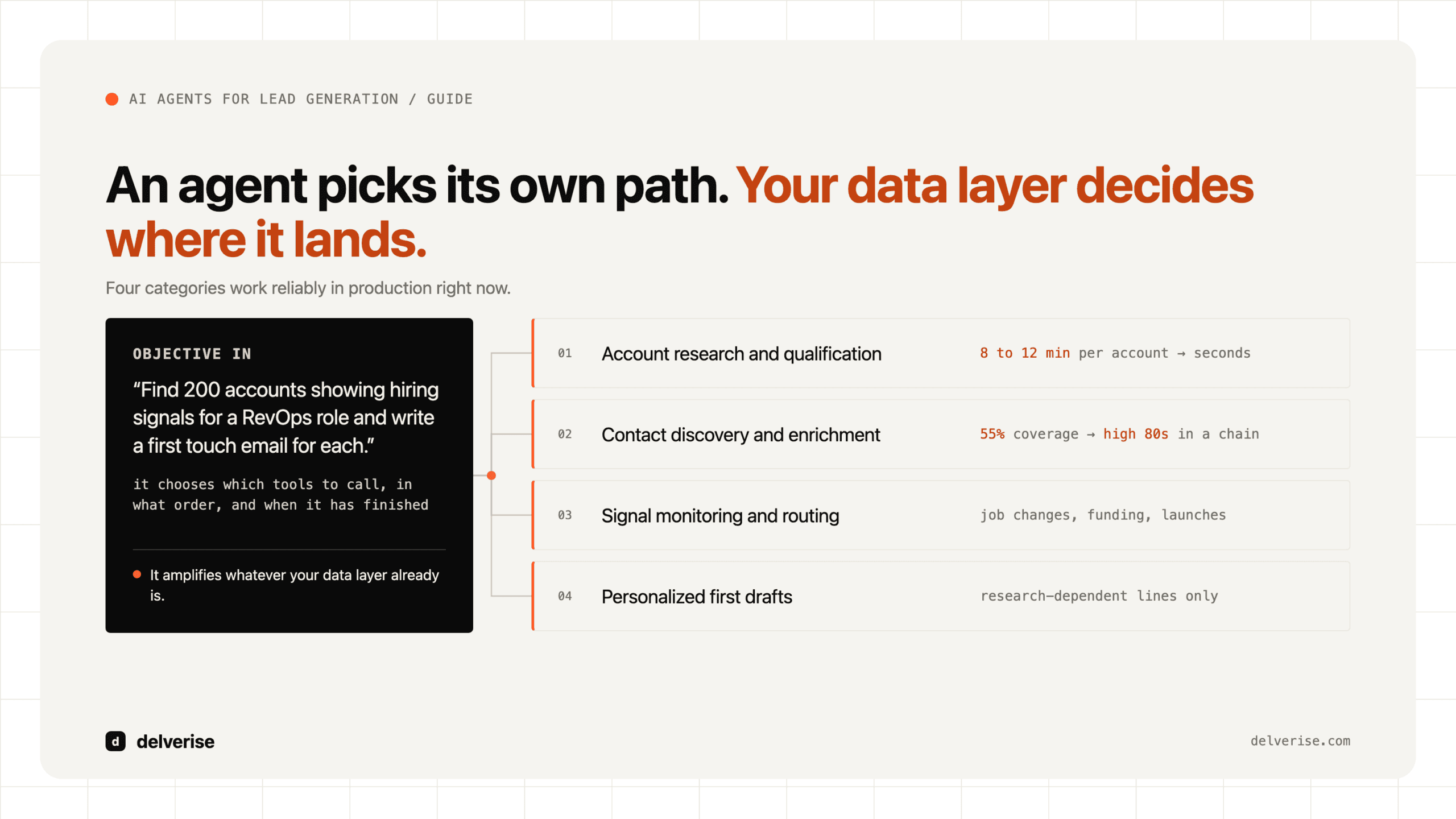
An AI agent is a large language model wrapped in tools, memory, and a goal. Give it an objective (“find me 200 accounts showing hiring signals for a RevOps role and write a first-touch email for each”), and it chooses which tools to call, in what order, and when it has finished. A traditional automation runs the same eleven steps every time. An agent picks its own path.


That distinction matters commercially. Deterministic workflows are cheap, auditable, and predictable. Agents are more expensive per run and harder to debug, and they earn their cost only on tasks where the right next step genuinely varies by account. Most of what vendors label “AI agents for lead generation” is a deterministic pipeline with a language model doing one or two judgment steps inside it. That is often the correct architecture, and it is worth knowing which one you are buying.
What can AI agents actually automate in lead generation today?
Four categories work reliably in production right now.
Account research and qualification. An agent reads a company’s site, job postings, funding history, tech stack, and recent news, then answers structured questions: do they run a product-led motion, how many AEs do they employ, are they hiring for the pain we solve. This replaces the most expensive manual step in outbound.
Contact discovery and enrichment. Agents chain data providers until a record is complete, falling back from one source to the next when coverage fails. This pattern, known as waterfall enrichment, typically lifts email coverage from roughly 55 percent on a single provider to the high 80s across a chain, at meaningfully lower cost per verified record than buying one premium source.
Signal monitoring and routing. Agents watch for job changes, funding rounds, product launches, review-site activity, and site visits, then route the account to the right play. Intent data, meaning behavioral signals that suggest a company is actively researching a category, becomes far more usable when an agent interprets it against your ICP instead of dumping a surge score into a queue. We covered the tradeoffs of buying that data in our breakdown of intent platforms.
Personalized first drafts. Agents write the research-dependent parts of a message. They do not replace positioning or offer design, and copy quality still tracks the quality of the research fed into it. Our post on AI email lead generation goes deeper on what survives contact with a real inbox.
What still fails: autonomous multithreading across a buying committee, objection handling, and anything requiring a commercial judgment call. Gartner’s B2B buying research found that buyers spend only about 17 percent of their purchase journey meeting with potential suppliers, and a fraction of that with any single vendor’s rep. Those few interactions carry disproportionate weight, and they are the last place to put an unsupervised agent.
AI agent, automation, or human: which should own which step?
| Work | Best owner | Why |
|---|---|---|
| Building and refreshing the target account list | Deterministic automation | Rules are stable and auditable; agent reasoning adds cost without accuracy |
| Account research and brief generation | AI agent | The relevant evidence differs per company; this is genuine judgment at volume |
| Contact enrichment and verification | Deterministic automation with agent fallback | Provider chains are rule-based; agents help only on ambiguous matches |
| First-touch message drafting | AI agent, human-reviewed | Quality is high, but brand and claim risk needs a checkpoint |
| Discovery, multithreading, negotiation | Human seller | Buying committees respond to accountability and commercial authority |
Where do AI agents for lead generation break?
Gartner published a prediction in 2025 that more than 40 percent of agentic AI projects would be canceled by the end of 2027, pointing to escalating costs, unclear business value, and inadequate risk controls. That matches what shows up in practice.

The most common failure is a data layer that cannot support autonomy. If your CRM has three competing definitions of “qualified,” duplicate account records, and no ownership rules, an agent will produce confident output built on contradictions. Fixing this is unglamorous GTM engineering work: object model, field governance, dedupe logic, and a single source of truth for ICP.
The second failure is volume without a throttle. An agent that can research 5,000 accounts a day will happily email 5,000 accounts a day, torch your domain reputation, and leave you rebuilding sending infrastructure for a quarter. Constrain output at the system level.
The third failure is no human checkpoint on claims. Agents will assert things about a prospect’s business that are plausible and wrong. One review step before send costs a few seconds per message and protects the brand.
The fourth is measurement. Teams instrument agents on emails sent and accounts researched, both of which go up automatically, and never instrument the conversion step where the value actually appears.
What does a working setup look like?
Here is a worked example using round numbers, for a Series A SaaS company with three SDRs and a 6,000-account addressable market.
Manually, an SDR researches and personalizes about 25 accounts a day at roughly 10 minutes each. Three SDRs cover 75 accounts a day, or about 1,500 a month at full capacity, which means one pass through the market takes four months. By then the earliest research is stale.
With an agent layer, the pipeline runs: pull accounts matching firmographic and signal criteria, agent researches each and writes a five-line brief plus a qualification verdict, waterfall enrichment fills contacts, agent drafts a first touch, SDR reviews in batches of 50. The research and drafting cost lands around 12 to 20 cents per account depending on model and depth. Six thousand accounts cost roughly $900 to $1,200 in compute and data per full refresh, and the market gets covered in days instead of months. The three SDRs shift from research to conversations and review, which is where their reply-to-meeting rate lives.
The teams that get this working usually build the orchestration in a data-first tool rather than writing it from scratch. Clay is the common choice because the enrichment waterfall, the agent research step, and the CRM write-back sit in one table, which makes the whole chain inspectable when a column starts returning garbage. It rewards operators who think in systems and frustrates those expecting a one-click tool. If you want the build handled rather than staffed internally, delverise runs these implementations as a Clay partner.
The last piece is speed. The long-standing Harvard Business Review research on lead response found that companies contacting an inbound lead within an hour were roughly seven times more likely to have a meaningful qualifying conversation than those that waited even one hour longer. Agents are unusually good at this, because instant enrichment plus instant routing removes the delay entirely. Our guide to lead follow-up covers how to wire it.
How should you measure AI agents in lead generation?
Three metrics, tracked monthly:
- Qualified pipeline per rep hour. The real question is whether the agent moved human time to higher-value work.
- Reply-to-meeting rate. Volume metrics rise mechanically. Conversion rate tells you whether the research is actually improving relevance.
- Cost per qualified opportunity, fully loaded. Include model spend, data credits, tooling, and the review time you did not eliminate.
McKinsey’s B2B Pulse research found buyers now move across roughly ten channels during a single purchase decision, up from about five a decade earlier. Attribution gets harder every year, so keep the metric set small and hold it stable long enough to read a trend.
What should you build first?
- Write one ICP definition, stored as structured fields, that every system reads from
- Dedupe and govern the CRM account object before adding any agent write access
- Stand up waterfall enrichment and measure coverage and cost per verified contact
- Add one agent step, research and brief generation, and A/B it against manual research
- Put a human review gate between agent drafts and send, and keep it there
- Instrument reply-to-meeting rate and fully loaded cost per opportunity before scaling volume
Sequence matters. Teams that add agents to a clean data layer see compounding returns. Teams that add agents to a broken one buy a faster way to be wrong. If you are still deciding who owns which part of this internally, our guide to GTM operations maps the ownership question.
Frequently Asked Questions
Are AI agents for lead generation the same thing as an AI SDR?
No. An AI SDR is a packaged product that bundles list building, writing, and sending into one vendor-owned workflow. AI agents are a building block you compose into your own system, with your data and your rules. Packaged tools ship faster; composed systems keep the data and logic under your control. We compared the tradeoffs in our post on AI BDRs.
How much does an AI agent lead generation stack cost to run?
For a Series A team covering a few thousand accounts, budget $500 to $2,000 a month in combined model, enrichment, and orchestration spend, plus the tooling you already pay for. The larger cost is implementation: expect four to eight weeks of engineering to get a governed pipeline into production, whether staffed internally or externally.
Will AI agents replace SDRs?
They replace the research and list-hygiene portion of the SDR role, which is most of the hours and none of the pipeline. What remains is conversation quality, multithreading, and judgment. The practical effect is fewer, more senior prospecting hires supported by a system that does the preparation.
What data do I need before deploying agents?
A deduplicated account object, a documented ICP with structured fields, verified contact data with known coverage rates, and defined stage exit criteria. Without those, agent output cannot be evaluated because you have no reliable definition of a good lead. Our lead intelligence platform guide covers what to assemble.
Can agents handle inbound leads as well as outbound?
Yes, and inbound is often the faster win. Enriching, scoring, and routing an inbound form fill in under 60 seconds is a well-bounded task with clear success criteria, and the response-time research suggests it moves conversion more than most outbound improvements do.
Read next