←Back to blog
Growth & Demand GenerationGuideNovember 25, 20269 min read
B2B Database Providers: How Revenue Leaders Choose One That Actually Fits
B2B database providers are companies that sell access to contact and company data, like emails, direct dials, firmographics, technographics, and intent signals, so sales teams can find and reach buyers. The leading options include ZoomInfo, Apollo, Cognism, Lusha, SalesIntel, and Dun & Bradstreet, and the right choice depends on your ideal customer profile, region, and sales motion.
B2B database providers are companies that sell access to contact and company data, like emails, direct dials, firmographics, technographics, and intent signals, so sales teams can find and reach buyers. The leading options include ZoomInfo, Apollo, Cognism, Lusha, SalesIntel, and Dun & Bradstreet, and the right choice depends on your ideal customer profile, region, and sales motion.
Key takeaways
- No single provider has the best data for every market. Coverage and accuracy vary sharply by region, industry, company size, and job function.
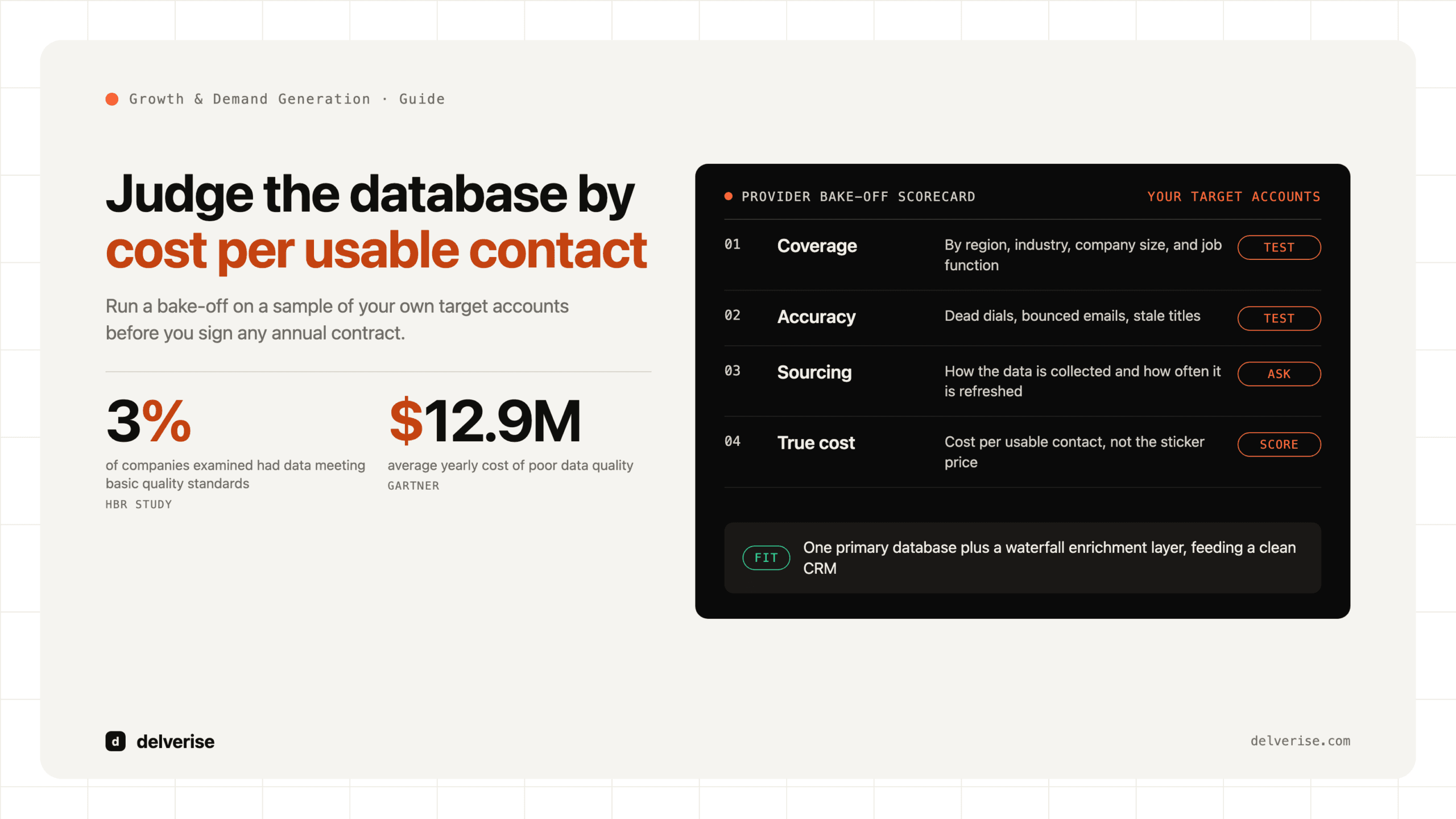
- Judge providers on cost per usable contact. A lower sticker price can still be the more expensive choice, and a higher one can be the cheaper.
- Run a bake-off on a sample of your own target accounts before you sign any annual contract.
- Many Seed to Series B teams get better results from one primary database plus a waterfall enrichment layer than from one expensive all-in-one license.
- The database only pays off when it feeds a clean CRM, clear routing, and a working outbound motion.
What does a B2B database provider actually sell?
At the simplest level, a B2B database provider sells records. Each record describes a company, a person, or both. The data usually falls into five layers:

- Contact data: work email, direct dial, mobile number, LinkedIn URL, title, and seniority.
- Firmographics: company attributes like headcount, revenue band, industry, location, and funding stage.
- Technographics: the software a company uses, inferred from website scripts, job posts, and other signals.
- Intent data: signals that an account is researching a topic, usually taken from content consumption across a publisher network or from review site activity.
- Change signals: job changes, new hires, funding rounds, and leadership moves that suggest a buying window.
Providers build this data in different ways. Some crowdsource it from browser extensions and email signature scraping. Some pay human researchers to verify contacts. Others aggregate public records and web data at scale. These collection methods explain most of the differences in accuracy and coverage you will see, so ask every vendor how their data is sourced and how often it is refreshed.
Why does data quality matter so much to the revenue number?
Bad data creates costs that rarely show up as a line item. Reps waste dials on dead numbers, bounced emails damage sender reputation, and misrouted leads sit untouched. Gartner has estimated that poor data quality costs organizations an average of $12.9 million a year. A widely cited HBR study by Tadhg Nagle, Thomas Redman, and David Sammon found that only 3% of the companies they examined had data meeting basic quality standards.

Buyer behavior makes this worse. Gartner’s research on B2B buying found that buyers spend only about 17% of their purchase journey meeting with potential suppliers. With that little time in front of vendors, every wrong title, stale email, or missed account takes away a chance you may not get back. For the full picture of how data fits into pipeline generation, see our guide on how to get B2B leads.
How do the major B2B database providers compare?
The table below gives a vendor-neutral summary of where each major provider tends to fit. Treat it as a shortlist starting point. Your own bake-off results should decide the final choice.
| Provider | Typical best fit | Strengths | Tradeoffs to test |
|---|---|---|---|
| ZoomInfo | Mid-market and enterprise sales teams, North America heavy | Broad US coverage, deep firmographics, intent and org chart features | Annual contracts at a premium price, and many features a small team will not use |
| Apollo | Early-stage teams wanting data plus sequencing in one tool | Large database, a free tier, and built-in engagement features | Accuracy varies by segment, and emails need verification before high-volume sends |
| Cognism | Teams selling into EMEA or running phone-heavy motions | Strong European coverage, a compliance focus, and phone-verified mobile numbers | US coverage in some niches can be thinner than US-first providers |
| Lusha | Smaller teams and individual reps prospecting from LinkedIn | Simple self-serve setup and a fast browser extension | Less depth for account-level research and large list building |
| SalesIntel | Teams that value verified contacts over raw volume | Human-verified contact records and re-verification cycles | Smaller raw record count than the volume players |
| Dun & Bradstreet | Account-based and enterprise motions needing company hierarchies | Deep firmographics, corporate family trees, and D-U-N-S identifiers | Contact-level data is less central to its offering than company data |
G2’s category grids for sales intelligence are a useful way to scan user sentiment, but read reviews from companies of your size and region. A glowing review from a 5,000-person enterprise tells you little about fit for a 40-person Series A team. For a closer look at one of these options, our breakdown of SalesIntel covers where verified data earns its price.
Should you buy one database or build a waterfall?
A waterfall is an enrichment setup that queries several data providers in sequence. If the first provider has no valid email for a contact, the request moves to the second, then the third, until one returns a verified result. Tools like Clay made this pattern accessible to teams without a data engineering function.

The case for a single database is simplicity: one contract, one integration, one place for reps to search. The case for a waterfall is coverage. Because no provider covers every segment well, stacking sources usually lifts match rates and lets you pay per successful lookup, which suits teams with uneven volume.
A practical pattern for Seed to Series B teams is a hybrid:
- One primary database for account search, list building, and rep prospecting.
- A waterfall layer for enrichment, filling gaps in emails, mobiles, and firmographics on inbound leads and target lists.
- An email verification step before anything enters a sequence.
- Scheduled re-enrichment on CRM records, since contact data decays as people change jobs.
This is where most of the real work sits. The database is one component. The value comes from how it connects to your CRM, routing, and outreach. Our CRM enrichment work focuses on exactly this layer.
How do you calculate the true cost of a data provider?
Sticker price misleads because providers differ in match rate and accuracy. The metric that matters is cost per usable contact: a record that matches your target, has a valid email or a working direct dial, and reaches the right person.
Here is a worked example with illustrative numbers. Plug in your own bake-off results.
| Metric | Provider A | Provider B |
|---|---|---|
| Annual cost | $30,000 | $12,000 |
| Records requested per year | 20,000 | 20,000 |
| Match rate on your ICP | 70% | 50% |
| Valid email rate on matches | 85% | 60% |
| Usable contacts | 11,900 | 6,000 |
| Cost per usable contact | $2.52 | $2.00 |
On these numbers, Provider B still wins per usable contact. However, if your plan needs 10,000 usable contacts a year, Provider B leaves you short by 4,000, and filling that gap costs money through a second source or rep time spent hunting manually. If your motion is phone-led, run the same math on connected dials, which often changes the ranking entirely. Your total cost also includes rep hours, bounce-related deliverability damage, and the integration work to keep the CRM clean.
How should you run a bake-off before signing?
A bake-off is a controlled test where you give multiple providers the same sample of target accounts and contacts and compare results. Most vendors will support a trial or a sample pull if you ask during the sales process. Use this checklist:
- Build a test list of 200 to 500 accounts drawn from your real ICP, including some closed-won customers you already have verified data for.
- Send the identical list to every provider on your shortlist.
- Measure match rate at the account level and at the persona level (for example, VP Finance at companies with 50 to 500 employees).
- Run every returned email through an independent verification tool and record the valid, risky, and invalid rates.
- Have a rep dial a sample of direct dials and mobiles, and log connect rates and wrong-person rates.
- Compare titles and employers against LinkedIn for a spot-check sample to measure data freshness.
- Confirm the native integration with your CRM, whether that is HubSpot, Salesforce, or a lighter system.
- Get written answers on data sourcing, refresh cadence, GDPR and CCPA posture, and opt-out handling.
- Calculate cost per usable contact for each provider using your actual volume targets.
Keep the test honest by scoring against your real segments. A provider that dominates US tech companies may struggle with European manufacturing or healthcare, and the averages vendors quote will hide that.
What compliance questions should a revenue leader ask?
If you sell into Europe, GDPR applies to how you process contact data, and outreach rules differ by country. In the US, state privacy laws like the CCPA add their own obligations. Ask each provider how they establish a lawful basis for their data, how they honor opt-out and deletion requests, and whether they screen against do-not-call registries for phone data. Then involve your own counsel. The provider’s compliance posture helps, but your team remains responsible for how the data is used.
Where does the database fit in the larger revenue system?
A database is an input. Pipeline comes from what happens after the data lands. Teams that buy a premium license and see weak results usually have a gap somewhere else: a vague ICP, no routing rules, messy CRM fields, or sequences that nobody tuned. Before you add data, check whether the foundation pieces are in place.
When they are, the data flows through a clear path. Accounts get scored against your ICP, contacts get enriched and verified, records sync to the CRM with consistent fields, and qualified contacts enter an outbound funnel with messaging built for each persona. AI prospecting tools can then sit on top of that clean foundation. Our guide to choosing an AI tool for sales prospecting covers how those tools depend on data quality underneath.
delverise builds this layer for B2B SaaS teams as part of broader GTM engineering work. That means provider selection, waterfall enrichment, CRM hygiene, and the outbound systems that turn records into meetings, all measured against pipeline outcomes.
Frequently Asked Questions
What is the most accurate B2B database provider?
No provider is the most accurate across every market. Accuracy depends on your region, industry, company size, and target personas. Providers that use human verification often score higher on contact accuracy for smaller record sets, while volume providers offer broader coverage. A bake-off on your own target accounts is the only reliable way to decide.
How much do B2B database providers cost?
Pricing ranges from free tiers and low monthly seat plans for self-serve tools to five- and six-figure annual contracts for enterprise platforms. Most providers price by seats, credits, or both. Compare options on cost per usable contact, which accounts for match rate and accuracy, instead of the list price alone.
How often does B2B contact data go out of date?
Contact data decays continuously as people change jobs, get promoted, and companies restructure. The exact rate varies by industry and seniority, but a meaningful share of any contact database becomes stale within a year. Schedule regular re-enrichment of CRM records and verify emails right before they enter a sequence.
Do early-stage startups need an enterprise data provider?
Usually not at Seed or early Series A. A lower-cost primary database paired with pay-per-lookup waterfall enrichment typically covers early needs with less commitment. Enterprise platforms start to make sense when you have a larger sales team, a defined account-based motion, and the operational capacity to use intent and org chart features.
Is buying B2B contact data legal?
Buying and using B2B contact data is legal in most markets, but it comes with obligations. GDPR governs processing of personal data about people in the EU, and US state privacy laws and do-not-call rules also apply. Choose providers with clear sourcing and opt-out processes, and have your counsel review how your team uses the data.