←Back to blog
Revenue Intelligence & Data ToolingGuideAugust 31, 20268 min read
How to Use AI in Sales: Where It Creates Revenue and Where It Breaks
Use AI in sales by pointing it at the parts of the revenue motion that are repetitive, data-heavy, and slow: account research, list building, enrichment, prioritization, call review, and CRM hygiene. AI raises rep throughput when the underlying data and process are sound. Weak data and unclear process turn AI into faster noise.
Use AI in sales by pointing it at the parts of the revenue motion that are repetitive, data-heavy, and slow: account research, list building, enrichment, prioritization, call review, and CRM hygiene. AI raises rep throughput when the underlying data and process are sound. Weak data and unclear process turn AI into faster noise.
Key takeaways
- AI creates the most reliable return in the research and data layers of the sales motion, well before it touches messaging.
- Output quality is capped by input quality. A model writing from a stale CRM record produces confident, wrong sentences at scale.
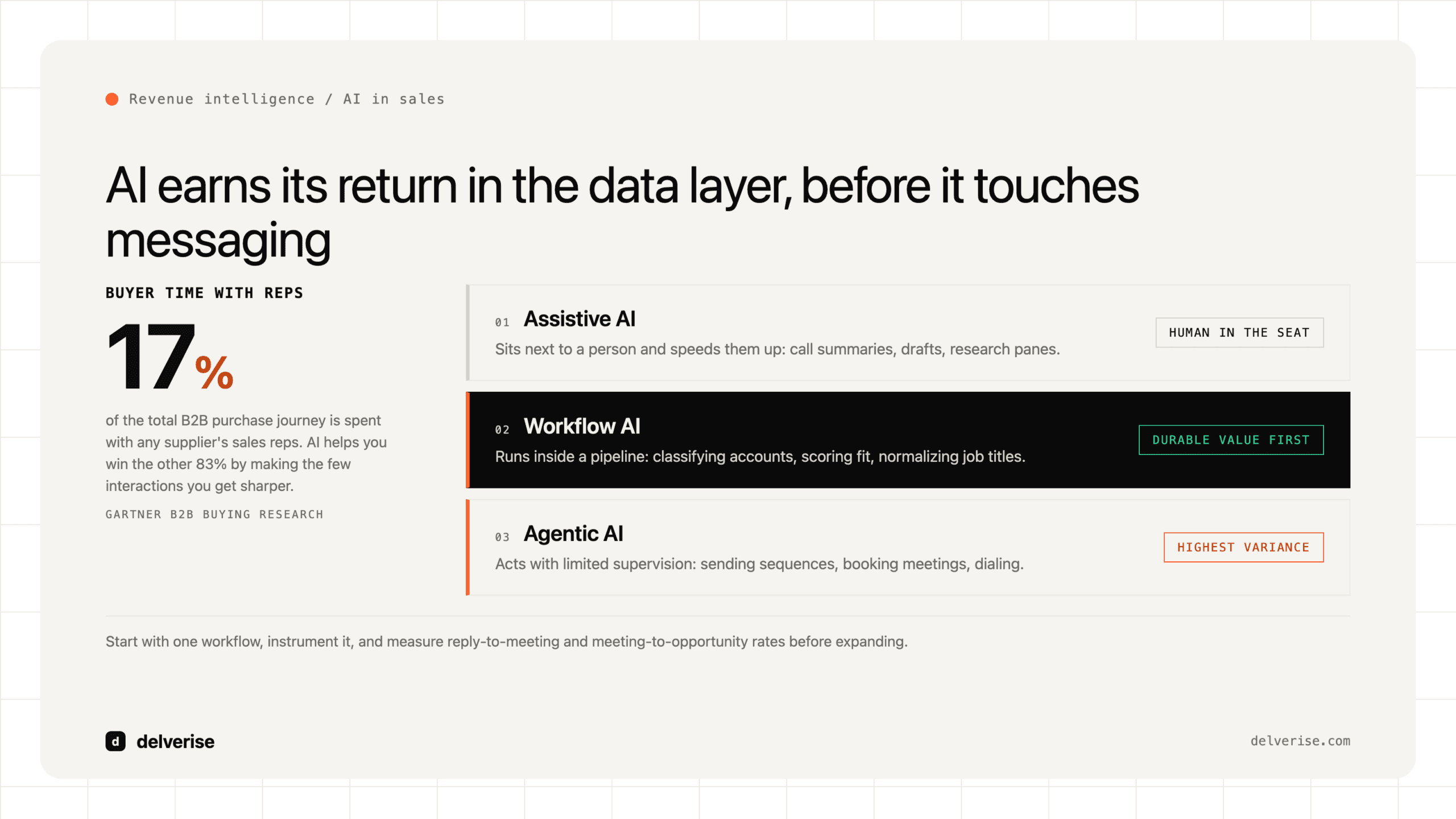
- Gartner’s B2B buying research found that buyers spend roughly 17% of the total purchase journey with any supplier’s sales reps. AI helps you win the other 83% by making the few interactions you get sharper.
- Start with one workflow, instrument it, and measure reply-to-meeting and meeting-to-opportunity rates before expanding.
- Autonomous agents that send email or make calls carry brand risk. Human review stays in the loop until the accept rate is proven.
What does it actually mean to use AI in sales?
“AI in sales” covers three distinct categories that get collapsed into one word, which is why buying decisions go wrong.

Assistive AI sits next to a person and speeds them up: a call summarizer, a draft generator, a research pane inside the CRM. Workflow AI runs inside a pipeline and makes structured decisions on data at volume: classifying accounts, scoring fit, extracting facts from a website, normalizing a job title. Agentic AI takes actions in the world with limited supervision: sending sequences, booking meetings, dialing prospects.
The return profile differs sharply across the three. Workflow AI is where most B2B SaaS teams find durable value first, because it operates on a defined input and produces a checkable output. Agentic AI carries the highest variance, since a bad decision reaches a buyer before anyone catches it. We cover the broader map of where models create measurable revenue in AI in B2B.
Where does AI create revenue in a B2B sales motion?
Here is the honest breakdown by layer, including what still needs a person.

| Layer | What AI does well today | What still needs a human | Failure mode |
|---|---|---|---|
| Account research | Reading 10-K filings, job posts, product pages, and news at volume; extracting structured facts | Deciding which facts predict a purchase | Summarizes accurately, and none of it is a buying signal |
| List building and enrichment | Finding lookalikes, normalizing firmographics, filling gaps across providers | Defining the ICP tightly enough to be falsifiable | Larger lists, lower conversion, faster domain burn |
| Prioritization and scoring | Ranking accounts against a rubric consistently across thousands of rows | Validating the rubric against closed-won data | Confident scores with no correlation to revenue |
| Message drafting | First drafts, variant generation, personalization from a research field | Positioning, offer, and voice | Grammatically clean email that says nothing a buyer cares about |
| Call review and coaching | Transcription, objection tagging, talk-ratio analysis, deal-risk flags | The coaching conversation itself | Dashboards nobody acts on |
| CRM hygiene and forecast | Field completion, deduplication, next-step extraction from calls | Rep accountability for the pipeline story | Cleaner data, same optimistic forecast |
The pattern across the table: AI is strongest where the task has a verifiable output and weakest where the task requires judgment about what a specific buyer values. That boundary is where your system design should sit.
What should a revenue leader automate first?
Automate research and data before you automate outreach. The reasoning is economic. A rep spending eight hours a week on manual account research costs you roughly a fifth of a headcount in pure input work, and that work is fully specifiable. Personalized messaging, by contrast, depends on positioning judgment that most teams have never written down.
McKinsey’s work on B2B buying behavior found that buyers now move across around ten interaction channels during a purchase, and they reward suppliers who show up with context rather than generic pitches. Research automation is what makes that context affordable at scale.
A practical sequencing for a Seed to Series B team:
- Define the ICP as a set of machine-checkable conditions, not a paragraph
- Consolidate contact and account data so one record is authoritative
- Automate research enrichment against that record
- Score and route accounts using a rubric tied to closed-won patterns
- Layer AI-assisted messaging on top of the research field
- Only then evaluate agentic sending or dialing
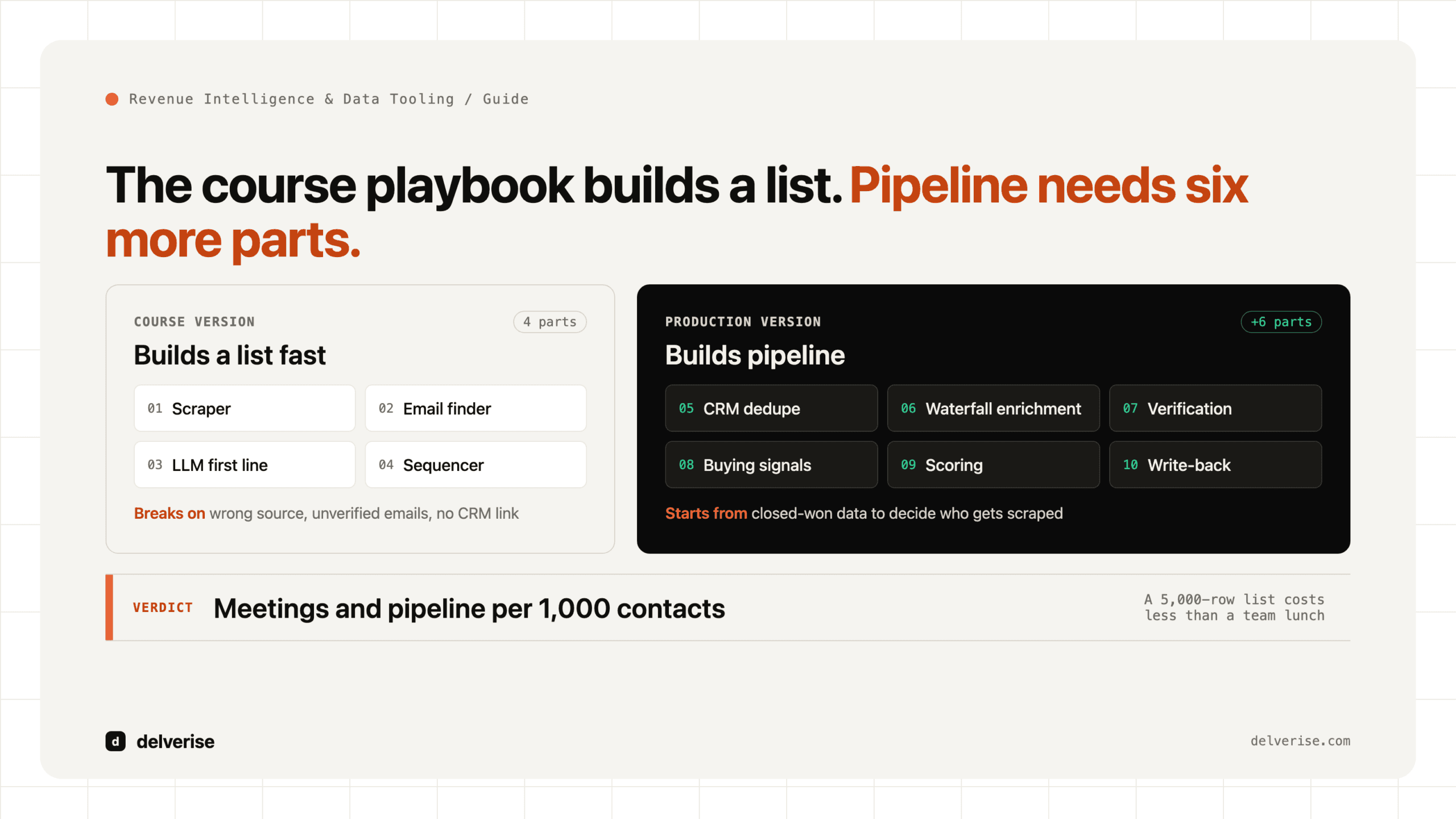
Teams that skip the first three steps and buy an AI SDR tool are buying volume on top of bad data. That question is worth its own evaluation, which we walk through in AI BDR software.
What does a working AI sales workflow look like end to end?
Here is a concrete, illustrative build for a Series A SaaS company selling compliance software to fintechs. The numbers below are a worked example to show the arithmetic, not a client result.

Trigger: a target-account list of 2,000 fintechs with 50 to 500 employees.
Step 1, enrichment. Waterfall enrichment fills firmographics and contact data across multiple providers, since single-source coverage on any given segment tends to sit well below what vendors advertise. Coverage lands at 78%, leaving 1,560 usable accounts.
Step 2, signal extraction. An AI step reads each company’s careers page and website for three specific conditions: an open compliance or risk role, a mention of entering a new regulated market, and a recent funding event. Only 214 accounts match at least two conditions.
Step 3, scoring. A rubric ranks those 214 against patterns pulled from your last 40 closed-won deals. The top 90 route to a rep-owned sequence, the rest go to nurture.
Step 4, messaging. The research field, meaning the actual extracted fact, becomes the first line of the email. A rep reviews and sends. At a 9% reply rate on 90 accounts, that is 8 replies, and at a 40% reply-to-meeting rate, roughly 3 meetings from a workflow that cost a few hundred dollars in credits.
Three meetings sounds small until you compare it to blasting all 2,000 accounts with generic copy, which typically produces a similar meeting count while consuming your domain reputation and your list. The comparison that matters is meetings per account burned.
Clay is the tool most teams use to build workflows shaped like this, because it combines waterfall enrichment with AI research columns in one place. The honest tradeoff: it is a builder’s environment with a real learning curve and credit costs that scale with usage, so it rewards teams that have a defined ICP and punishes teams that are still guessing. If you want the system architected and running rather than assembled internally over two quarters, that is what delverise does on our Clay implementation work. The broader stack decisions around it are covered in what a GTM tech stack actually is.
Where does AI in sales break?
Data quality. Every enrichment provider has coverage gaps, and models fill uncertainty with plausible text. A workflow that cannot distinguish “no signal found” from “signal absent” will manufacture reasons to contact accounts that have none. Force your prompts to return null and route null to a human queue. More on choosing sources in lead gen data.
Timing blindness. AI makes your outreach more relevant without making it better timed. A model can tell you an account fits perfectly and has no way of knowing they signed a three-year contract with an incumbent last month. This is the structural limit of batch outreach, which we unpack in why cold email has a blind spot.
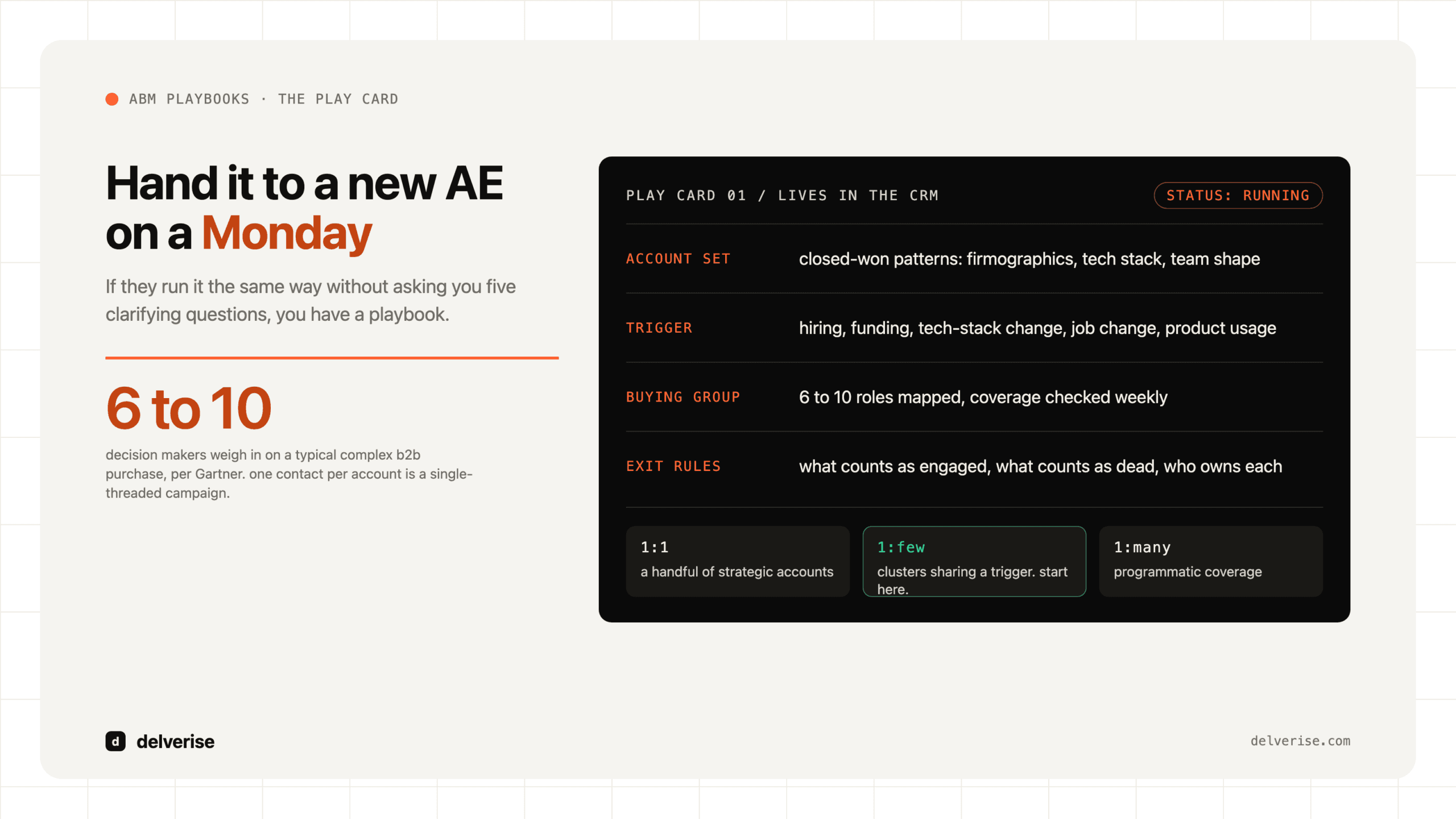
Buying-group complexity. Gartner’s research puts the typical B2B buying group at six to ten stakeholders, each arriving with their own information. Personalizing to one contact and calling it AI-driven selling misses the other five to nine people who will decide.
Organizational drift. Workflows degrade. Websites change structure, providers change schemas, prompts that worked in March return junk in September. Somebody has to own monitoring, or the system quietly stops working while the dashboard still shows green.
How do you measure whether AI in sales is working?
Measure at the conversion step immediately downstream of the thing AI touched, and hold the upstream volume constant.
If AI improved research, the metric is reply rate at constant send volume. If AI improved scoring, the metric is meeting-to-opportunity conversion in the top-scored tier versus the rest. If AI improved call review, the metric is stage-to-stage progression for coached reps versus a control group. Cost per meeting and cost per opportunity are the two rollups worth reporting to a board.
The metric to distrust is activity volume. Emails sent, calls made, and accounts enriched all go up the moment you add AI, and none of them tell you whether revenue moved. Forrester’s analyses of B2B performance consistently point to pipeline quality rather than activity as the leading indicator of revenue attainment, and AI makes it easier than ever to generate activity that looks like progress.
Run a holdout. Take 20% of your target accounts, work them the old way for one quarter, and compare. Most teams skip this and end up unable to defend the spend when the CFO asks. Full evaluation criteria for the prospecting side sit in how to use AI for sales prospecting, and the systems view of the whole build is on our GTM engineering page.
Frequently Asked Questions
Will AI replace SDRs?
AI is absorbing the research, list building, and data entry portions of the SDR role, which historically consumed most of the hours. The remaining work, meaning judgment about which accounts deserve effort, live conversation, and multi-threading a buying group, still needs people. Expect smaller SDR teams doing higher-skill work rather than the function disappearing.
How much should a Series A team budget for AI sales tooling?
Tooling costs are usually the smaller line. A workable research and enrichment stack runs in the low thousands per month for a team of five. The larger cost is the engineering time to build, monitor, and maintain the workflows, which is typically several times the software spend in year one. Budget for both or the tools sit unused.
Can AI write outbound emails that actually get replies?
AI writes competent prose reliably. Reply rates depend on whether the email references something specific and true about the account and whether the offer matches a live problem. Both come from the research layer feeding the model. Teams that see lifts from AI copy almost always built the research pipeline first.
What is the difference between AI scoring and traditional lead scoring?
Traditional lead scoring assigns fixed points to attributes and behaviors defined by a human. AI scoring evaluates unstructured evidence, such as website copy, job posts, or filings, against a rubric or learns weights from historical outcomes. The tradeoff is explainability. Point-based systems are easy to audit, and model-based scores need validation against closed-won data before you trust the routing.
Should we build these workflows internally or bring in outside help?
Build internally when you have a RevOps or GTM engineering hire with capacity and a stable ICP. Bring in outside help when the system needs to work this quarter and nobody on the team has built waterfall enrichment, signal extraction, and CRM sync before. delverise builds these as owned systems that your team runs afterward, with the architecture documented rather than held in someone’s head.
Read next