←Back to blog
Revenue Intelligence & Data ToolingGuideAugust 29, 20267 min read
Lead Gen Bots: What They Actually Automate and Where They Break
Lead gen bots are automated programs that capture, qualify, and route buyer interest without a human in the loop: website chat agents, AI SDR sequencers, form-replacement qualifiers, and scraping bots that build target lists. They compress response time and remove manual triage. They pay off when real demand already exists and your routing is instant.
Lead gen bots are automated programs that capture, qualify, and route buyer interest without a human in the loop: website chat agents, AI SDR sequencers, form-replacement qualifiers, and scraping bots that build target lists. They compress response time and remove manual triage. They pay off when real demand already exists and your routing is instant.
Key takeaways
- “Lead gen bot” covers four different machines with different economics. Buying the wrong one is the most common failure.
- Inbound bots win on speed and coverage. Outbound bots win on research volume. Neither creates demand that was absent.
- The bot is usually the cheapest part. Data quality, routing logic, and CRM hygiene decide whether it produces revenue.
- Measure booked and held meetings plus pipeline created, not conversations started.
- Gartner found most B2B buyers now prefer a rep-free experience, and that the same buyers report higher purchase regret afterward. Design for both facts.
What is a lead gen bot?
A lead gen bot is software that performs a repetitive lead generation task on a trigger, with a defined output, and without a person driving each step. The trigger might be a page visit, a hiring signal, a form fill, or a schedule. The output is a qualified contact, a booked meeting, or a row of enriched data.
Two words matter here. Bot means rules plus a model, running unattended. Agent usually means a bot with tool access and some latitude to decide its next step, which is a real capability difference and a real risk difference. We covered that distinction in more depth in our piece on AI agents for lead generation.
What types of lead gen bots are there?
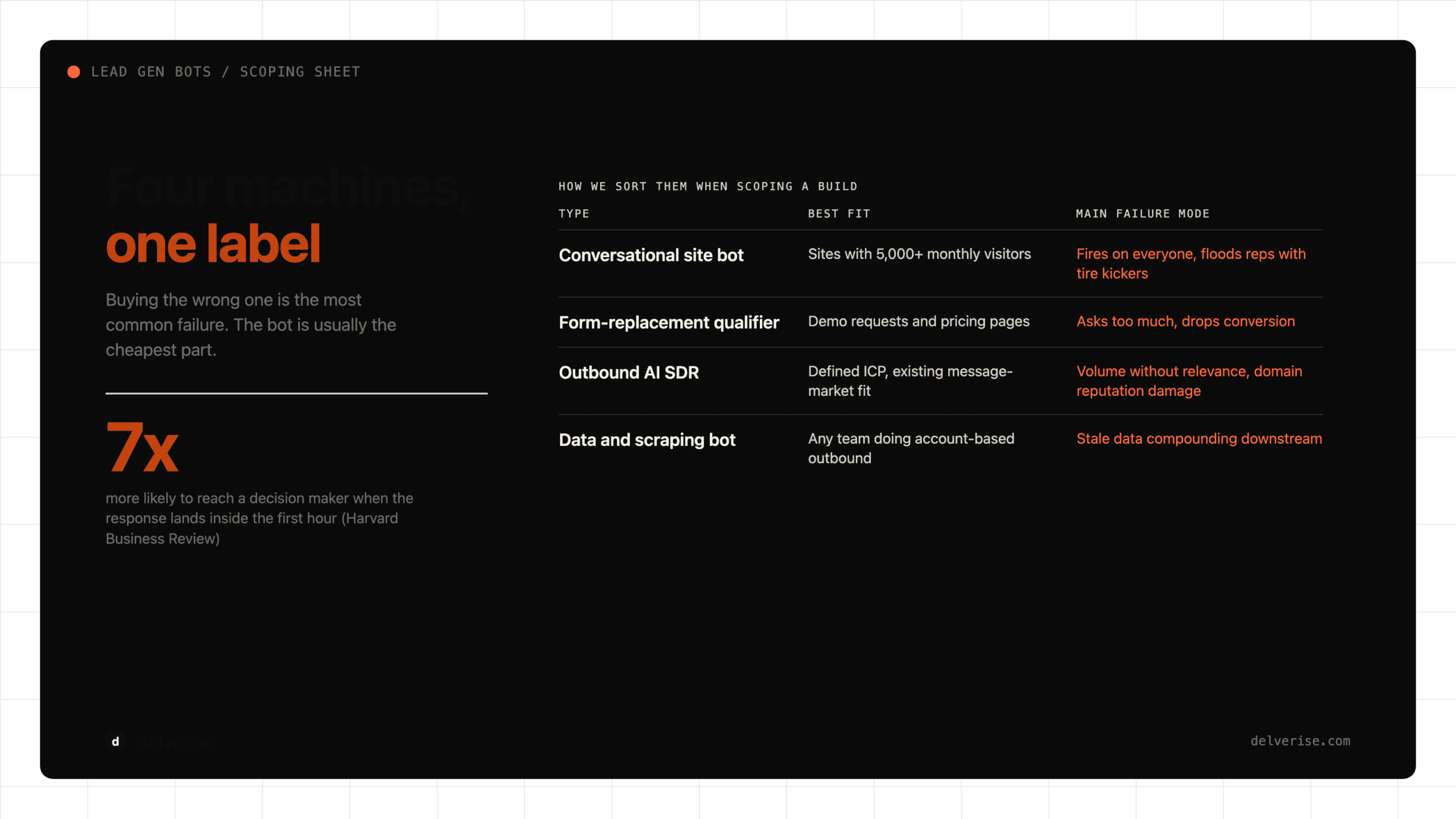
Vendors use one label for four categories. The table below is how we sort them when scoping a build.

| Type | What it does | Best fit | Main failure mode |
|---|---|---|---|
| Conversational site bot | Greets visitors, qualifies, books meetings on the calendar | PLG and mid-market sites with 5,000+ monthly visitors | Fires on everyone, floods reps with tire-kickers |
| Form-replacement qualifier | Replaces a static form with branching questions and instant routing | Demo requests and pricing pages | Adds friction and drops conversion if it asks too much |
| Outbound AI SDR | Researches accounts, drafts personalized email, runs sequences | Defined ICP, existing message-market fit | Volume without relevance, domain reputation damage |
| Data and scraping bot | Builds lists, enriches records, watches for trigger events | Any team doing account-based outbound | Stale or wrong data compounding downstream |
| Voice bot | Dials, qualifies, transfers or books | High-volume, low-ACV motions | Regulatory exposure and brand damage in enterprise segments |
Voice deserves its own evaluation. We wrote a full breakdown of where it holds up in AI cold calling bot, and the short version is that it works for confirmation and routing far better than it works for persuasion.
Do lead gen bots actually work?
Yes, in narrow and well-documented ways. The strongest evidence sits on the inbound side, where the constraint is response time. The classic Harvard Business Review study on the short life of online sales leads found that firms responding within an hour were roughly seven times more likely to have a meaningful conversation with a decision maker than firms that waited even one hour longer. A bot that books a meeting at 11pm on a Saturday is capturing intent that a human rota would lose.

The buyer-side data points the same direction. Gartner’s research found that B2B buyers spend only about 17% of their purchase journey meeting with potential suppliers, and that a large majority now prefer a rep-free buying experience where they can self-serve. McKinsey’s B2B Pulse research has consistently shown buyers moving across roughly ten channels during a single purchase. Bots let you staff the channels and hours your headcount cannot cover.
One honest caveat from the same Gartner work: buyers who complete rep-free purchases report significantly higher purchase regret. Automate the qualification and scheduling. Keep a human in the path before a real commitment.
Where do lead gen bots break?
Four places, in rough order of how often we see them.
Bad input data. An outbound bot with a 30% bounce list burns sending domains inside two weeks. The bot performed exactly as designed. The list was the problem. Contact data decay is real and continuous, which is why we treat sourcing as its own discipline in lead gen data.
Personalization that reads as automation. A generated first line that references a company’s About page is worse than no first line, because it signals a machine wrote it. The bar is whether a specific, non-obvious observation could only apply to that account. Our cold email template breakdown gets specific about what clears that bar.
Routing and handoff. A bot books a meeting into the wrong rep’s calendar, or writes a lead to a CRM field nothing reads. Pipeline dies in the gap between systems more often than it dies in the conversation.
No demand to capture. If your site gets 800 visitors a month and 12 are in-market, a chat bot changes very little. Fix distribution first, then automate the capture.
What does a working lead gen bot setup look like?
Here is a concrete worked example with realistic mid-market numbers.

A Series A SaaS company gets 9,000 monthly site visitors. Roughly 2% hit the pricing page, so 180 high-intent sessions a month. Their old flow was a demo form with 7 fields, which converted at 8% of pricing-page visitors, so about 14 requests, and reps replied in an average of 6 hours.
The rebuilt flow: a qualifier bot fires only on the pricing and integrations pages, asks three questions (team size, current tool, timeline), enriches the company in real time from the email domain, then either offers the calendar directly to accounts above 50 employees or routes smaller accounts to a self-serve trial. Enterprise-shaped accounts get flagged to a human within 60 seconds.
Result pattern we see with this shape: capture rate climbs to 12 to 15% because the calendar removes the wait, and the meetings held rate improves because unqualified traffic goes to trial rather than to a rep. The visible metric is meetings. The metric that actually moved is time-to-first-response and segment-correct routing.
Note what did the work. The bot handled the conversation. The enrichment call, the routing rules, and the CRM write handled the revenue. That plumbing is the part teams underbuild, and it is the core of any real GTM tech stack.
Should you buy a bot or build the system around it?
Buy the bot. Build the system. Point solutions for chat, dialing, and sequencing are commoditized and cheap. The differentiated asset is your data layer and your routing logic, because those encode who you sell to and how you qualify.
For the outbound and enrichment side, most teams we work with land on Clay as the orchestration layer, because it lets you chain waterfall enrichment, signal detection, and AI research in one place and push clean records into your CRM or sequencer. The honest tradeoff: Clay rewards teams with a clear ICP and someone who will own the tables. Without that ownership it becomes an expensive spreadsheet. If you want the workflows built and handed over running, that is what our Clay implementation work covers.
Whatever you buy, the sequencing rule holds: offer, then list, then message, then automation. A bot applied to the first three being broken just makes the breakage faster. Our AI outbound approach starts at that first layer for exactly this reason.
How do you measure whether a lead gen bot is paying off?
Conversation counts and “leads generated” are vanity by default. Track these instead, and require a baseline reading before launch:
- Median time from inbound signal to first response, measured in minutes
- Meetings booked, and separately, meetings held (the gap tells you about qualification quality)
- Pipeline created and win rate, segmented by bot-sourced versus human-sourced
- Bounce rate and spam complaint rate on any outbound bot, checked weekly
- Percentage of bot-created records that are complete and correctly routed in the CRM
- Cost per held meeting, fully loaded with tooling and data spend
Give any new bot a 60-day read window and a kill criterion written down before launch. If bot-sourced pipeline is not converting at a defensible fraction of your human-sourced rate by day 60, the problem is upstream of the bot.
Frequently Asked Questions
Are lead gen bots the same as AI SDRs?
An AI SDR is one category of lead gen bot, focused on outbound: account research, message drafting, and sequence execution. Chat bots, form qualifiers, and enrichment bots are separate categories with different economics. Most teams need the data and routing layer more than they need another sender.
Will a chat bot hurt our conversion rate?
It can, if it interrupts every visitor with a generic greeting or asks more questions than the form it replaced. Fire it on intent pages only, cap it at three questions, and always leave a path to the calendar or a human. Measure against your existing form as a control.
How much should we budget for this?
Tooling for a mid-market setup typically runs a few hundred to a few thousand dollars a month across chat, enrichment, and sequencing. Implementation is the larger line item, because the value sits in routing logic, data quality rules, and CRM integration rather than in the license itself.
Do lead gen bots work for enterprise deals?
For capture and routing, yes. For qualification and persuasion in six-figure deals, keep a human in the loop early. Use bots to make sure an enterprise-shaped visitor reaches the right rep within minutes, then let the rep own the conversation.
What is the first thing to automate?
Speed to lead on existing inbound demand. It has the clearest evidence base, the shortest build time, and it produces a measurable result inside one quarter. Outbound bots come after your ICP, offer, and message are already producing meetings manually. If you are weighing whether to build that capability internally or bring it in, our guide on choosing between in-house and outside GTM help lays out the decision.
Read next