←Back to blog
Revenue Intelligence & Data ToolingGuideAugust 5, 20268 min read
What Is SignalHire? A Revenue Leader’s Guide to Contact Data That Actually Converts
SignalHire is a contact data platform that finds work emails, personal emails, and phone numbers for people you have already identified. It works through a browser extension, a searchable people database, and an API, and it serves both sales prospecting and recruiting. Revenue teams treat it as a contact enrichment source sitting underneath their sales engagement stack.
SignalHire is a contact data platform that finds work emails, personal emails, and phone numbers for people you have already identified. It works through a browser extension, a searchable people database, and an API, and it serves both sales prospecting and recruiting. Revenue teams treat it as a contact enrichment source sitting underneath their sales engagement stack.
Key takeaways
- SignalHire is a contact finder and enrichment tool, strongest at turning a known person into a reachable person.
- Its differentiator is phone number coverage and reveal-time verification, priced through a credit model that separates email-only credits from email-plus-phone credits.
- It is a component, not a system. It will not build your ICP, score your accounts, or run your sequences.
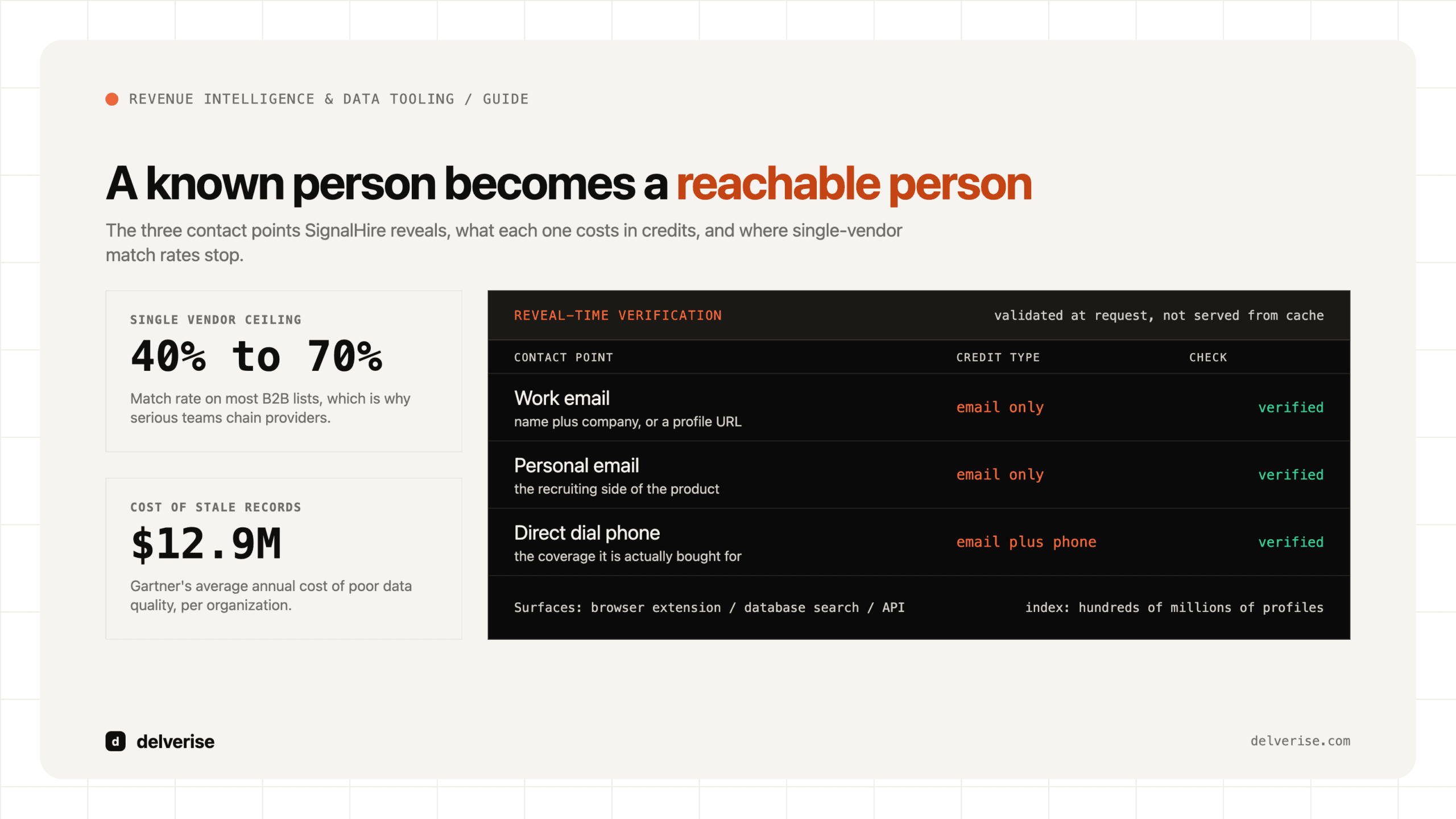
- Single-vendor contact data caps out somewhere between 40% and 70% match rates on most B2B lists, which is why serious teams chain providers.
- Buy it when your bottleneck is reachability on a list you already trust. Fix your targeting first if the bottleneck is upstream.
What does SignalHire actually do?
SignalHire operates on a simple premise: you know who you want to reach, and you need their contact details. Contact enrichment, in this context, means taking an identifier you already have (a name plus a company, a LinkedIn profile URL, a domain) and returning verified contact points you can act on.

Three surfaces do the work:
- Browser extension. Reveals contact details while you are on a LinkedIn profile, a GitHub page, or similar public profiles. This is the workflow most users encounter first, and it is genuinely fast for one-off reveals.
- Database search. Filter a large people index by title, company, location, industry, and skills, then bulk reveal the matches. SignalHire markets a database in the hundreds of millions of profiles.
- API and integrations. Programmatic reveals plus connections into ATS platforms and CRMs, which is the only surface that matters if you are running this at volume.
The technical claim worth understanding is reveal-time verification. Rather than serving a static record cached months ago, SignalHire attempts to validate the contact point at the moment you request it. That distinction matters because B2B contact data degrades fast. Forrester’s research on data quality has consistently found that contact records go stale within months as people change roles, and Gartner has put the average annual cost of poor data quality at $12.9 million per organization. A verified-at-request model is a reasonable answer to that decay problem, though no vendor solves it completely.
Who is SignalHire built for?
SignalHire serves two audiences with one product, which explains some of its odd edges. Recruiters use it to source candidates and often care about personal emails and mobile numbers. Sales teams use it to reach buyers and mostly care about work emails and direct dials.

The dual-audience design shows up in the feature set: you get candidate pipeline views and ATS integrations alongside sales-flavored bulk search. If you are a Seed to Series B SaaS company, you will use maybe 60% of what you are paying for, and the recruiting scaffolding is dead weight.
Where it fits well: a founder-led or two-rep sales motion that has a defensible target list and needs phone numbers that connect. Where it fits poorly: a team trying to run enrichment as a governed, automated layer across thousands of records per month. That is a GTM operations problem, and it needs orchestration rather than a single vendor.
How does SignalHire compare to other contact data tools?
Vendor-neutral read: SignalHire is a good specialist in a category where the generalists have more gravity.
| Dimension | SignalHire | All-in-one platforms (Apollo, ZoomInfo) | Orchestration layer (Clay) |
|---|---|---|---|
| Core job | Find contact details for known people | Database, enrichment, and sequencing in one | Chain and route multiple data providers |
| Phone coverage | A stated strength, priced separately | Varies widely by region and seniority | Depends on the providers you connect |
| Email waterfall | Single source | Single source, sometimes with a fallback | Native, multiple providers per record |
| Sequencing | Minimal | Built in | None, hands off to your engagement tool |
| Best for | Targeted reveals on a trusted list | Teams wanting one contract and one login | Teams where match rate and cost per contact are engineering problems |
If you want the deeper comparison on the generalist side, our Apollo.io guide covers where all-in-one platforms earn their price and where the bundled database quietly underperforms. For the category frame, read our take on what a lead intelligence platform is supposed to do.
What does SignalHire cost, and how do credits work?
Pricing is credit-based, with the important wrinkle that email-only credits cost meaningfully less than credits that also return a phone number. One reveal consumes one credit whether the data is useful or not, though most providers in this category do not charge for a null result.

Do the arithmetic before you commit. Here is a worked example using illustrative numbers you should replace with your own test results:
You have 3,000 ICP contacts. You need email plus mobile for the 600 senior titles and email only for the rest. At a plausible 55% match rate on phone-inclusive reveals and 75% on email-only reveals, you get roughly 330 phone-enabled contacts and 1,800 emails from 3,000 credits consumed. Your effective cost per usable contact is your monthly plan divided by 2,130, not by 3,000. Teams that skip this step routinely discover their real cost per reachable contact is two to three times what the pricing page implied.
Run this math on a sample before you buy. Our guide to the SignalHire free trial walks through exactly which segments to test so the trial produces a decision rather than a vibe.
Where does SignalHire break down at scale?
Three honest limitations.
Single-source ceiling. Every contact data vendor has coverage gaps shaped by how it acquires data. SignalHire is strong in some geographies and title bands and thin in others. On a typical mid-market B2B list, one provider gets you somewhere in the 40% to 70% range. The remaining 30% to 60% is not lost, it is just sitting in a different vendor’s index. Chaining providers so the second one only runs on records the first one missed is the standard fix, and we cover the mechanics in our waterfall enrichment guide.
Manual gravity. The browser extension is the best part of the product and also the trap. Extension-based reveals do not scale, do not create an audit trail, and quietly train your reps to work outside the CRM. Everything a rep reveals in a browser tab and does not push to your CRM is data your company paid for and does not own.
It solves the wrong bottleneck for most teams. Contact data fixes reachability. It does nothing for targeting, timing, or relevance. Gartner’s research on B2B buying found that buyers spend only about 17% of their purchase journey meeting with potential suppliers, split across every vendor they consider. More phone numbers do not expand that window. Better fit and better timing do.
How should a revenue team actually deploy it?
Treat SignalHire as one node in an enrichment chain that you own, with your CRM as the system of record. The practical sequence:
- Define the account and contact criteria first, in the CRM, so every reveal maps to a defined segment.
- Run enrichment through an orchestration layer rather than through individual reps’ browsers.
- Set a waterfall: cheapest adequate provider first, SignalHire on the misses where phone coverage matters, a third source for the long tail.
- Write every result back with source and timestamp attached, so you can measure match rate and cost per provider six months from now.
- Route enriched contacts into a sequenced follow-up motion with speed built in. HBR’s classic study on online sales leads found that firms attempting contact within an hour were roughly seven times more likely to qualify the lead than those waiting even one hour longer.
Clay is the tool most teams use for step 2 and 3, because it lets you call several providers per record conditionally and stop paying the moment one returns a good result. The honest tradeoff: Clay is a build surface, so it rewards teams who will actually maintain their tables and punishes teams who will not. If you want the chain designed and operated rather than assembled in-house, that is what our Clay implementation work exists for.
Should you buy SignalHire?
Use this as your gate:
- Our target list is defined and we trust the account selection.
- Phone connects, rather than email deliverability, are our current constraint.
- We tested match rate on a real sample of our ICP, not a demo list.
- We know our cost per usable contact, not just our cost per credit.
- Enriched records write back to the CRM automatically, with source attribution.
- We have a second provider ready for the records this one misses.
Four or more checked means SignalHire is a sensible line item. Two or fewer means your constraint sits upstream of contact data, and buying credits will produce activity without producing pipeline.
Frequently Asked Questions
Is SignalHire a CRM or a sales engagement platform?
No. SignalHire finds and verifies contact details. It has light pipeline and list features aimed at recruiters, but it does not replace Salesforce or HubSpot as a system of record, and it does not replace a sequencing tool like Outreach or Instantly for running cadences. Plan for it to sit alongside both.
How accurate is SignalHire data?
Accuracy varies by geography, seniority, and company size, which is true of every provider in this category. The reveal-time verification approach helps with staleness, but no vendor publishes an audited match rate you should take at face value. Test on 200 to 300 of your own ICP records and measure bounce rate and connect rate yourself.
Do I still need Apollo or ZoomInfo if I have SignalHire?
It depends on what you are buying them for. If you need the database as a market map and a place to build lists, an all-in-one platform does more. If you already have your target list from another source and need contact points, SignalHire covers that job at lower cost. Many teams run both and route records between them based on which one wins on coverage per segment.
What is the difference between email credits and phone credits?
SignalHire prices reveals that include a phone number higher than email-only reveals, since mobile numbers are harder to source and verify. Segment your list before you enrich: request phone numbers only for the titles you will actually call, and take email-only for the rest. This one decision often cuts enrichment spend by 40% or more.
Can SignalHire be automated into our GTM stack?
Yes, through its API or by calling it as an enrichment provider inside an orchestration tool. That is the right pattern for any team doing more than a few hundred reveals per month, because it keeps data in the CRM, makes provider performance measurable, and lets you swap sources without retraining reps. Building that layer well is a GTM engineering exercise, and it is where most of the return on contact data spend actually shows up.
Read next