←Back to blog
Revenue Intelligence & Data ToolingGuideAugust 18, 20268 min read
AI B2B: Where AI Actually Creates Revenue in B2B SaaS
AI in B2B is the use of machine learning and large language models to run parts of the revenue process: account research, scoring, message drafting, routing, forecasting, and post-sale signal detection. It creates pipeline when it runs on clean, current data inside a defined workflow. Without that foundation, it produces faster noise.
AI in B2B is the use of machine learning and large language models to run parts of the revenue process: account research, scoring, message drafting, routing, forecasting, and post-sale signal detection. It creates pipeline when it runs on clean, current data inside a defined workflow. Without that foundation, it produces faster noise.
Key takeaways
- The bottleneck in most B2B AI projects sits upstream of the model, in the data and the process definition.
- AI performs best on high-volume, low-judgment steps: research, summarization, matching, classification, and first-draft writing.
- It performs worst on steps that require account-specific judgment, negotiation, or accountability for an outcome.
- Buy tools for commodity capabilities. Build the workflow that connects them, because that is where your competitive difference lives.
- Measure AI against pipeline and cycle time, not against activity volume or “hours saved.”
What does “AI B2B” actually mean in a revenue system?
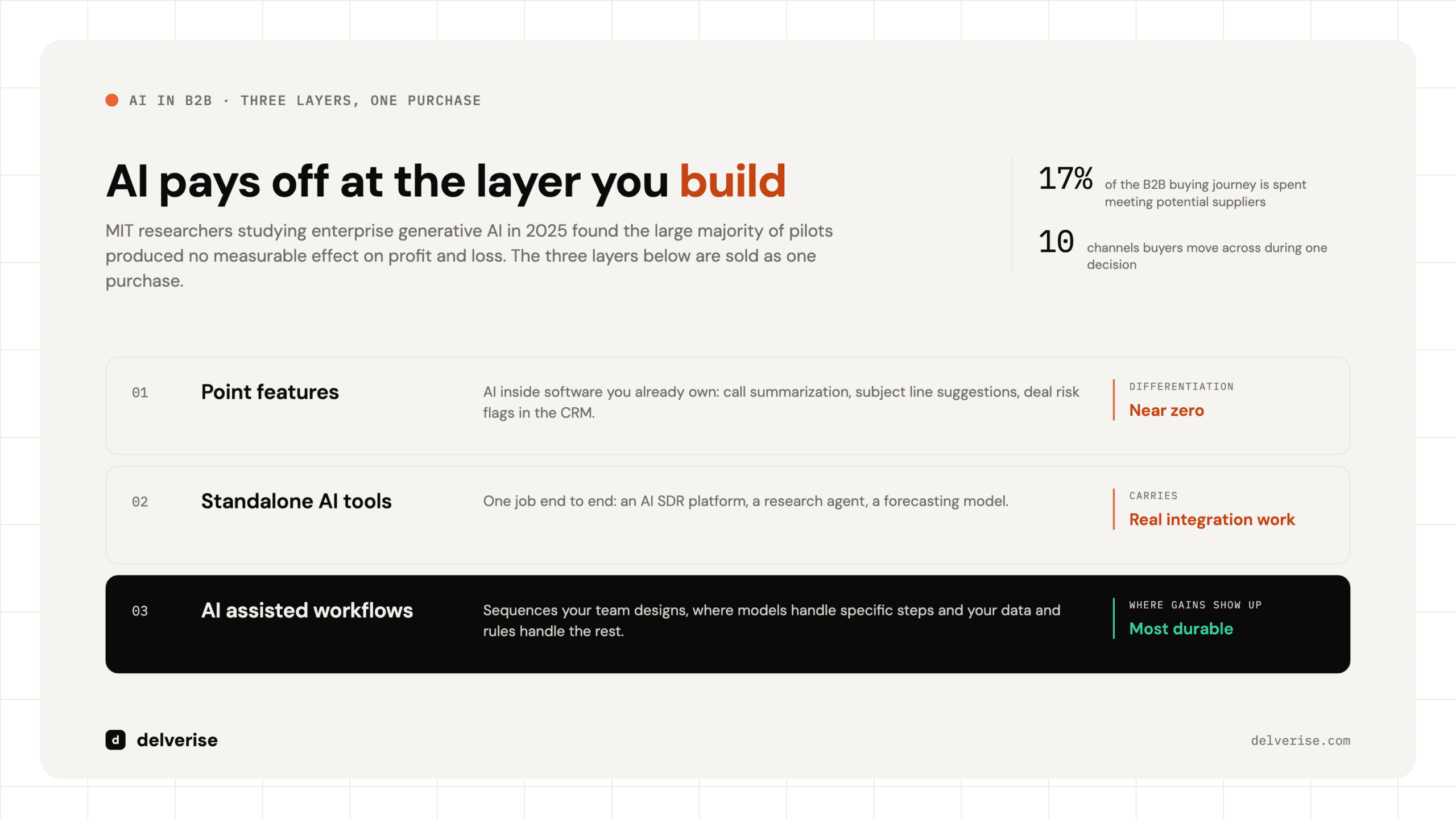
The phrase covers three distinct layers, and buyers get burned when they treat them as one purchase.
Point features are AI capabilities embedded in software you already own: call summarization in your conversation platform, subject-line suggestions in your email tool, deal-risk flags in your CRM. Adoption cost is near zero and so is differentiation, since every competitor has the same button.
Standalone AI tools do one job end to end: an AI SDR platform, a research agent, a forecasting model. These carry real cost and real integration work.
AI-assisted workflows are sequences your team designs, where models handle specific steps and your data and rules handle the rest. An agent in this context means a model given a goal, a set of tools, and permission to take steps on its own. Most durable revenue gains show up at this third layer, because the workflow encodes what your team knows about your market.
Why do most B2B AI projects never show up in pipeline?
MIT researchers studying enterprise generative AI deployments in 2025 found that the large majority of pilots produced no measurable effect on profit and loss, despite significant spend. That result matches what we see inside revenue teams. The failure point is usually one of three things.

The data underneath is stale or incomplete. A model asked to prioritize accounts using job titles that are eighteen months old will confidently prioritize the wrong accounts. Contact and firmographic decay is continuous, which is why serious teams chain multiple providers instead of trusting one. That pattern is worth understanding before you buy anything: see the data enrichment waterfall.
The process was never defined. Automating an undocumented handoff produces an undocumented handoff at higher speed. If your team cannot describe the qualification rule in a sentence, a model cannot apply it consistently.
The output has no owner. AI-generated research that lands in a field nobody reads changes nothing. Ownership questions are the quiet reason automation stalls, which is why GTM operations matters more than tool selection here.
There is also a demand-side reason to be careful. Gartner’s research on B2B buying found that buyers spend roughly 17% of their total purchase journey meeting with potential suppliers, and when several vendors are in play, any single rep gets a small slice of that. McKinsey’s B2B Pulse work found buyers now move across about ten channels during a decision, roughly double the number a decade ago. More AI-generated outreach into that environment does not increase your share of a shrinking conversation. Better targeting and better timing do.
Where does AI actually create revenue in B2B?
| Use case | What AI does well | Where it breaks | What must exist first |
|---|---|---|---|
| Account research and prioritization | Reads hundreds of sites, filings, and job posts; extracts structured signals at scale | Confidently summarizes outdated or irrelevant sources | A defined ICP and a source list you trust |
| Outbound message drafting | Produces a competent first draft grounded in a research variable | Generic personalization that reads as templated at volume | Verified contact data and a real point of view |
| Inbound routing and follow-up | Classifies intent, drafts replies, cuts response time to minutes | Misroutes edge cases; annoys buyers when it pretends to be human | Clean routing rules and clear disclosure |
| Forecasting and pipeline hygiene | Flags stalled deals and missing next steps from activity data | Garbage-in forecasts when reps do not log activity | Consistent stage definitions across the team |
| Post-sale signal detection | Surfaces churn and expansion signals from tickets and usage | Correlations that no one is staffed to act on | An owner and a defined play per signal |
Two patterns run through that table. AI is strong where the work is high-volume and the correct answer is checkable. It is weak where accountability matters. For a deeper breakdown of individual categories, this buyer’s guide to AI sales tools covers the tradeoffs vendor by vendor.

What does a working AI B2B workflow look like end to end?
Here is a concrete example. A Series A SaaS company selling compliance software to mid-market fintechs has 14,000 accounts sitting in its CRM and two AEs. Sending everyone a sequence is wasteful. Manual research on 14,000 accounts is impossible.

The workflow they build has five steps:
- Filter to accounts matching the firmographic ICP: 400 to 5,000 employees, US or UK, in scope for the relevant regulation. That cuts 14,000 to about 1,900 using rules, no AI needed.
- For each remaining account, an enrichment run pulls current headcount, recent compliance-related job postings, and any public funding event in the last twelve months. Orchestration platforms like Clay handle this well because they chain providers and fall back when one returns nothing.
- A model reads each account’s careers page and last two press releases, then answers one narrow question: is this company visibly building or expanding a compliance function? The output is a yes or no plus a one-line citation, so a human can audit it in five seconds.
- Accounts that score yes get contact enrichment for the two or three roles in the buying group. Forrester’s research on B2B buying groups has consistently found more people involved in a purchase than most CRMs record, so mapping past a single champion matters.
- The top 220 accounts flow to sequences where the first line references the specific job posting or funding event. Everything else waits for a new signal.
Notice what AI did here: one classification step and one drafting step. Rules, data providers, and a defined ICP did the rest. That ratio is typical of workflows that hold up. If you want the same structure applied to intent signals rather than hiring signals, this guide to lead intelligence platforms covers how those inputs get scored. Teams that want the build handled end to end can start at our Clay partner page or GTM engineering.
Should you buy an AI product or build the workflow?
Buy when the capability is a commodity and the vendor’s version is better than anything you would build: transcription, email deliverability infrastructure, contact databases, CRM-native scoring. Building these is a distraction.
Build when the logic encodes something specific to your market: your qualification rule, your signal definitions, your routing, your sequencing across channels. Vendors cannot ship your ICP judgment, and packaged products that promise to replace a full role usually underdeliver on exactly this. What AI BDR tools automate and where they break goes through that in detail.
The honest tradeoff on building: workflows need maintenance. Data providers change schemas, models change behavior between versions, and a workflow with no owner degrades within a quarter. Budget for upkeep before you commit.
How do you sequence the first 90 days?
- Write your ICP as filterable rules, not adjectives, and count how many CRM accounts actually match.
- Audit contact data accuracy on a 100-record sample before spending anything on AI outreach.
- Pick one workflow with a measurable output: meetings booked, response time, or forecast accuracy.
- Define the human review step and who performs it, in writing.
- Run the workflow manually for two weeks so you know what “correct” looks like.
- Automate only the steps that were consistent when done manually.
- Set a monthly check on data freshness and model output quality, with a named owner.
How do you measure whether AI is working?
Tie every AI investment to a metric that appears on your board deck. Reasonable candidates: qualified meetings per rep per month, median inbound response time, opportunity-to-close conversion rate, forecast accuracy against actuals, and cost per qualified opportunity. Activity metrics like emails sent or accounts researched go up almost by definition when you add automation, which makes them useless as proof.
Run a holdout. Keep a comparable segment on the existing process for a full sales cycle. If the AI-assisted segment does not beat it on the metric you named upfront, you have learned something valuable and cheaply. Teams that skip the holdout end up defending spend with screenshots of dashboards. For the prospecting-specific version of this test, this guide to AI prospecting tools covers what to benchmark.
Frequently Asked Questions
Is AI replacing B2B sales reps?
No. AI is absorbing research, data entry, drafting, and summarization, which frees rep time for the parts of the job buyers still want a person for: diagnosis, negotiation, and multithreading a buying group. Headcount plans are shifting toward fewer, more senior sellers supported by better systems, rather than toward no sellers.
How much should a Seed to Series B company spend on AI tooling?
Spend on data quality first, because every AI output depends on it. A practical split is roughly 60% of the budget on accurate contact and account data plus the workflow that uses it, and 40% on models and tools. Companies that reverse this ratio typically end up with expensive tools producing output nobody trusts.
Do AI-written emails still work in B2B outbound?
They work when the research behind them is specific and the claim is relevant. They fail when the model is asked to invent personalization from a LinkedIn headline. The differentiator is the input variable, not the writing. Deliverability discipline matters just as much, since volume without infrastructure hygiene lands you in spam.
What is the fastest AI win for a revenue team with no dedicated ops person?
Inbound response time. Automated classification and routing of inbound requests, with a drafted reply a human approves, cuts median response from hours to minutes. It requires no new data sources, the improvement is measurable within two weeks, and speed on inbound has a direct relationship to conversion.
Where does AI fit for teams already running a full stack?
Usually in the connective tissue between systems: enrichment on record creation, signal scoring before routing, and summarization at handoff points. Most stacks have several tools that each hold part of the picture and no layer that reconciles them. That reconciliation layer is where AI pays back fastest for a mature team.
Read next