←Back to blog
Revenue Intelligence & Data ToolingGuideAugust 31, 20268 min read
Lead Generation Bot: What It Actually Does and Where It Fits in a Revenue System
A lead generation bot is software that automates one repeatable step in acquiring leads: capturing inbound interest, qualifying a visitor, researching an account, enriching a record, or triggering follow-up. Most combine deterministic rules with a language model. They compress response time and research effort, and they perform best when a human still owns the offer, the data, and the handoff.
A lead generation bot is software that automates one repeatable step in acquiring leads: capturing inbound interest, qualifying a visitor, researching an account, enriching a record, or triggering follow-up. Most combine deterministic rules with a language model. They compress response time and research effort, and they perform best when a human still owns the offer, the data, and the handoff.
Key takeaways
- A lead generation bot automates a step in your funnel. It does not replace demand, positioning, or a qualified pipeline motion.
- The highest-return deployment for most B2B SaaS teams is speed-to-lead on inbound, because response time has a measurable effect on qualification rates.
- Bots amplify whatever data you feed them. Bad firmographics and stale contact records produce faster bad outcomes.
- Chat bots, enrichment bots, list-building bots, and voice bots solve different problems and fail in different ways. Buy them separately, judged on separate criteria.
- Measure a bot on qualified pipeline created and cost per qualified meeting, not on conversations handled or leads captured.
What is a lead generation bot, and what counts as one?
The term covers a wide range of software. In practice, three categories get called a “lead generation bot”:

- Conversational bots: a widget on your site or in LinkedIn DMs that greets a visitor, asks qualifying questions, and books a meeting or captures contact details.
- Data bots: automated jobs that build target lists, scrape signals, find and verify email addresses, and enrich CRM records. These run headlessly with no buyer-facing interface.
- Agentic bots: LLM-driven workers that chain several steps together, deciding what research to run and what message to send. We cover the distinction in more depth in our breakdown of AI agents for lead generation.
The useful mental model: a bot is a worker that executes a defined job on a trigger. The job needs a clear input, a clear output, and a clear definition of success. When any of those three is fuzzy, the bot produces volume that nobody trusts. Our companion piece on what lead gen bots actually automate goes deeper on the mechanics.
What can a lead generation bot actually automate?
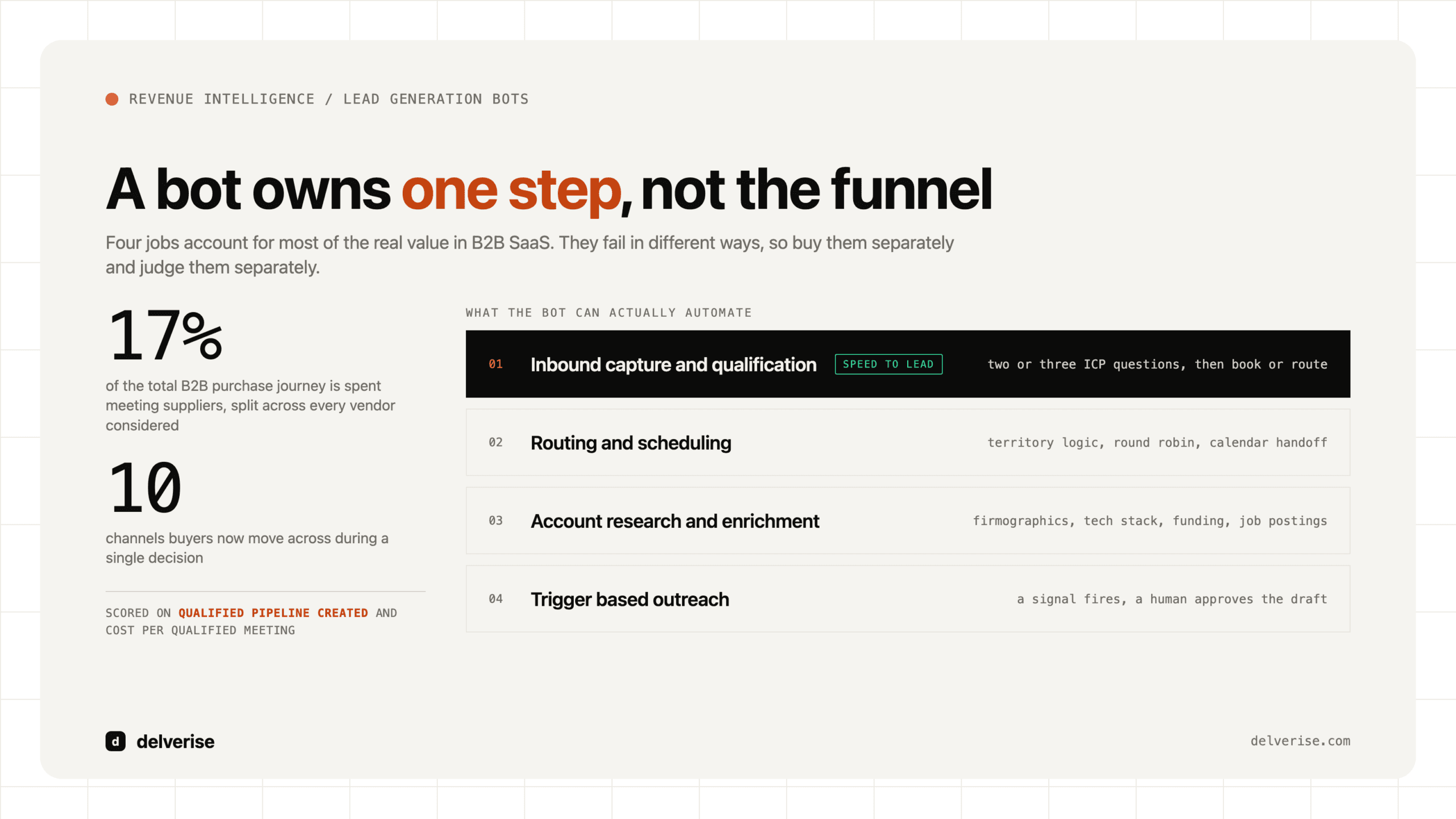
Four jobs account for most of the real value in B2B SaaS:
- Inbound capture and qualification. The bot engages a visitor, asks two or three questions that map to your ICP, and either books time on a rep’s calendar or routes the lead to nurture.
- Routing and scheduling. Territory logic, round robin, account ownership lookups, and calendar handoff. Unglamorous and consistently underrated.
- Account research and enrichment. Pulling firmographics, tech stack signals, headcount changes, funding events, and job postings into a single record so a rep opens a fully briefed account. This depends entirely on the quality of your lead gen data.
- Trigger-based outreach. A signal fires, the bot drafts and queues a relevant message, and a human approves it. The approval step matters more than teams expect.
Gartner’s research on B2B buying found that buyers spend roughly 17% of their total purchase journey meeting with potential suppliers, and that time is split across every vendor they consider. McKinsey’s B2B Pulse work found buyers now move across around ten channels during a decision. Both findings point the same direction: your bot’s job is to be useful in a narrow window of buyer attention, on whatever channel the buyer chose.
Which type of bot fits which revenue problem?
| Bot type | What it automates | Best fit | Where it breaks |
|---|---|---|---|
| Website chat and qualification | Greeting, ICP questions, meeting booking | Sites with 2,000+ monthly visitors and a real inbound trickle | Low-traffic sites; complex products where the first question needs a human |
| Enrichment and research | Firmographics, signals, contact data appended to records | Any team running outbound at volume | Coverage gaps by region and company size; silent data decay |
| List building and scraping | Sourcing accounts and contacts from directories, job boards, social | Defined ICPs with observable signals | Source terms of service, deliverability damage from unverified emails |
| Routing and scheduling | Ownership lookup, territory rules, calendar handoff | Teams with 3+ reps and any territory complexity | CRM hygiene issues surface immediately as misrouted leads |
| Voice and AI SDR | Dials, discovery questions, qualification | High-volume, low-ACV, transactional motions | Enterprise buyers, regulated industries, disclosure requirements |
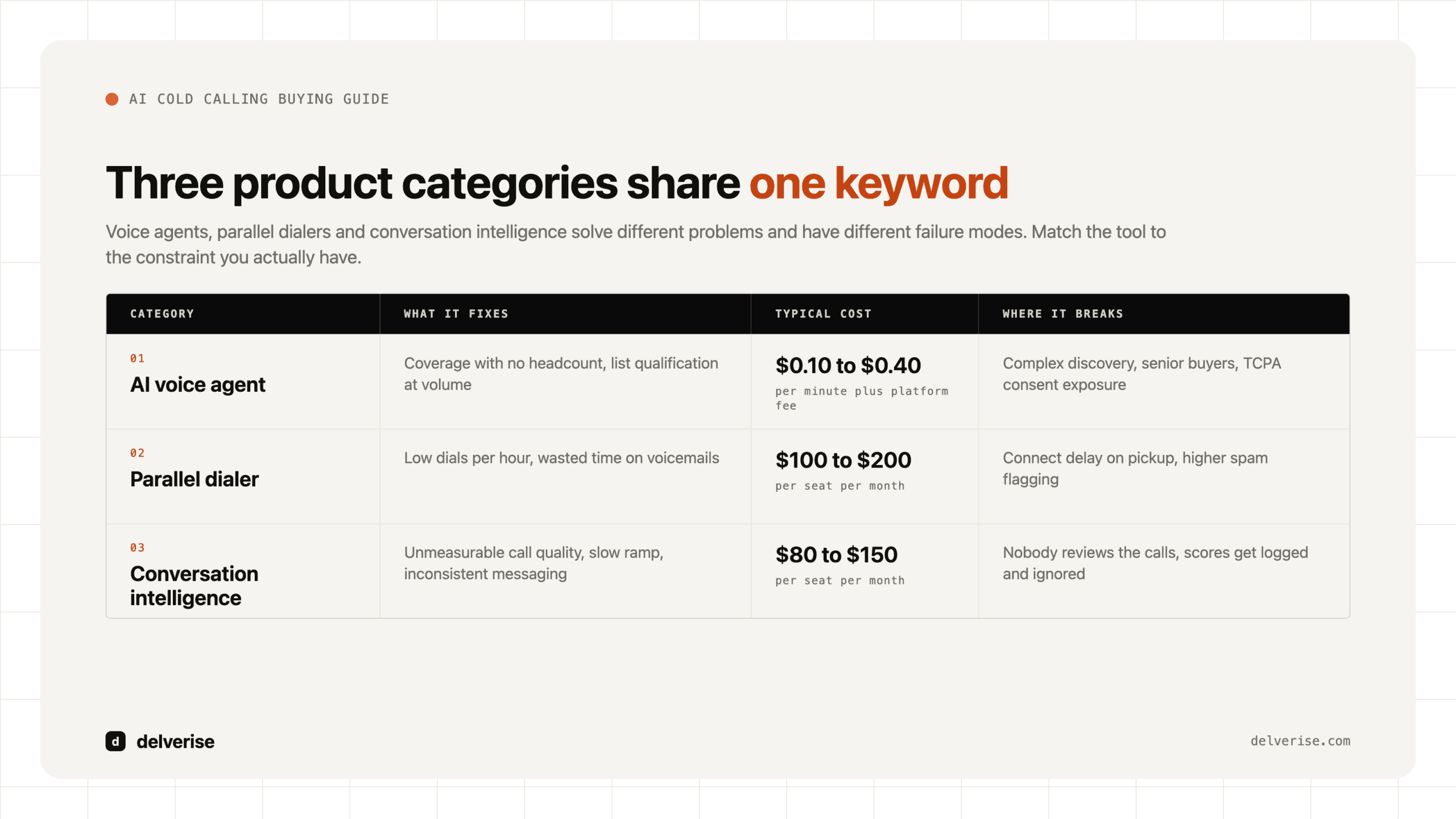
If voice is the category you are weighing, the tradeoffs deserve their own analysis. We covered them in AI cold calling agents.

What does the math look like on a speed-to-lead bot?
The classic Harvard Business Review study on the short life of online sales leads found that firms attempting contact within an hour of an inquiry were roughly seven times more likely to qualify the lead than those that waited an hour longer. That finding is the single strongest argument for an inbound bot.

Run illustrative numbers on a Series A SaaS company. Substitute your own:
- 250 inbound form fills and chat sessions per month
- Median human response time of 5 hours, with nights and weekends going unanswered
- 18% of inbound currently converts to a held meeting, so 45 meetings
A qualification and booking bot that responds in under 60 seconds, every hour of the day, plausibly moves that held-meeting rate into the mid-20s. At 25%, you get about 62 meetings from identical traffic, an incremental 17 meetings per month with no additional demand spend. At a $40,000 ACV and a 20% meeting-to-close rate, that is meaningful new bookings against a tool cost in the low hundreds per month.
The same arithmetic explains why bots fail on thin funnels. Applying a 40% relative lift to 12 monthly inbound leads produces five extra meetings a year, which never justifies the build, the maintenance, or the attention it takes from your team.
Why do most lead generation bots underperform?
Five failure modes cover almost every disappointing deployment we see:
- Data underneath is weak. A bot enriching against a provider with poor coverage in your segment will confidently write wrong titles and dead emails into your CRM. Evaluate providers on your actual ICP sample before you automate against them. Our guide to buying B2B contact data covers how to run that test.
- The offer never changed. Automating a message that was ignored manually produces the same rejection at higher volume, plus domain reputation damage.
- The handoff is undefined. A bot books a meeting and nobody owns the follow-up, the prep, or the no-show sequence.
- Qualification logic is copied from a template. Generic budget and timeline questions annoy buyers. Qualification should mirror the two or three attributes that actually predict a closed deal in your data.
- Nobody measures it against pipeline. Vendors report conversations and captured leads. Forrester’s research on B2B buying consistently shows buyers preferring self-service research over talking to a rep, which means high engagement counts can coexist with flat pipeline.
Should you build one or buy one?
Buy the conversational layer. Chat qualification, routing, and scheduling are commoditized, and the incumbent tools handle edge cases you would spend months rediscovering.
Build the data and research layer. This is where differentiation lives, because your signal definitions, scoring logic, and enrichment waterfalls encode what you know about your market. Clay is the most common home for that logic in modern B2B SaaS stacks: it lets a revenue team chain multiple data providers, run conditional enrichment, and push clean records into the CRM without engineering tickets. The tradeoffs are real. Credit consumption climbs quickly at scale, and a poorly designed table becomes an expensive black box that only one person understands. Teams that want the build handled properly can see how delverise approaches Clay implementation.
The deeper question is how the bot sits inside everything else you run. A bot with no defined place in your GTM tech stack becomes an orphaned tool that nobody maintains after the champion leaves. Sequencing the layers correctly is the core of GTM engineering.
What should you check before approving a bot?
- Inbound volume is high enough that a conversion lift produces double-digit incremental meetings per month
- Qualification criteria are derived from your closed-won data, with named attributes
- The data provider has been tested on a 100-record sample of your real ICP
- A named owner handles every outcome the bot can produce, including declines
- Success is measured as qualified pipeline and cost per qualified meeting
- The bot discloses that it is automated when a buyer asks
- There is a clean path to a human within one interaction
Frequently Asked Questions
Is a lead generation bot the same as an AI SDR?
They overlap. An AI SDR usually describes an agentic system that runs prospecting end to end: research, message drafting, sending, and reply handling. A lead generation bot can be a much narrower job, such as a chat widget that qualifies visitors. Judge both on qualified pipeline produced rather than on category labels.
Will a bot damage our brand with enterprise buyers?
It depends on transparency and escape hatches. Buyers tolerate automation that saves them time, such as instant scheduling and useful answers. They react badly to bots that pretend to be human, refuse to hand off, or ask questions the vendor should already know from the account record.
How long before a lead generation bot pays for itself?
An inbound qualification and scheduling bot on healthy traffic typically shows a signal within 30 to 60 days, because the mechanism is speed and the baseline is easy to measure. Outbound research and enrichment builds take longer, often a full sales cycle, because the effect shows up in reply quality and meeting rates rather than in immediate volume.
What data do we need in place first?
Clean account ownership in the CRM, an ICP definition with named firmographic and signal criteria, and a contact data source you have validated on your own segment. Without those three, the bot will automate an existing data problem at higher speed. Our piece on AI powered lead generation covers the sequencing.
Can a small team run this without engineering support?
Mostly, yes. Conversational and scheduling bots are configuration work. Enrichment and research workflows sit in no-code tools that a technical revenue operator can own. Engineering becomes necessary when you need custom data sources, real-time product signals, or anything writing back into a heavily customized CRM.
Read next