←Back to blog
Revenue Intelligence & Data ToolingGuideAugust 30, 202610 min read
Industrial Lead Generation: How B2B Revenue Teams Build a Pipeline System That Works
Industrial lead generation is the practice of sourcing, qualifying, and routing buyers in manufacturing, engineering, energy, logistics, and industrial services. It differs from standard B2B motions because buying committees are larger, cycles run six to eighteen months, and firmographic data is thinner. Winning teams treat it as a data and routing problem before a messaging problem.
Industrial lead generation is the practice of sourcing, qualifying, and routing buyers in manufacturing, engineering, energy, logistics, and industrial services. It differs from standard B2B motions because buying committees are larger, cycles run six to eighteen months, and firmographic data is thinner. Winning teams treat it as a data and routing problem before a messaging problem.
Key takeaways
- Industrial buyers are hard to find in standard databases because SIC and NAICS codes are coarse, self-reported, and stale. Signal quality, not list volume, decides your outcome.
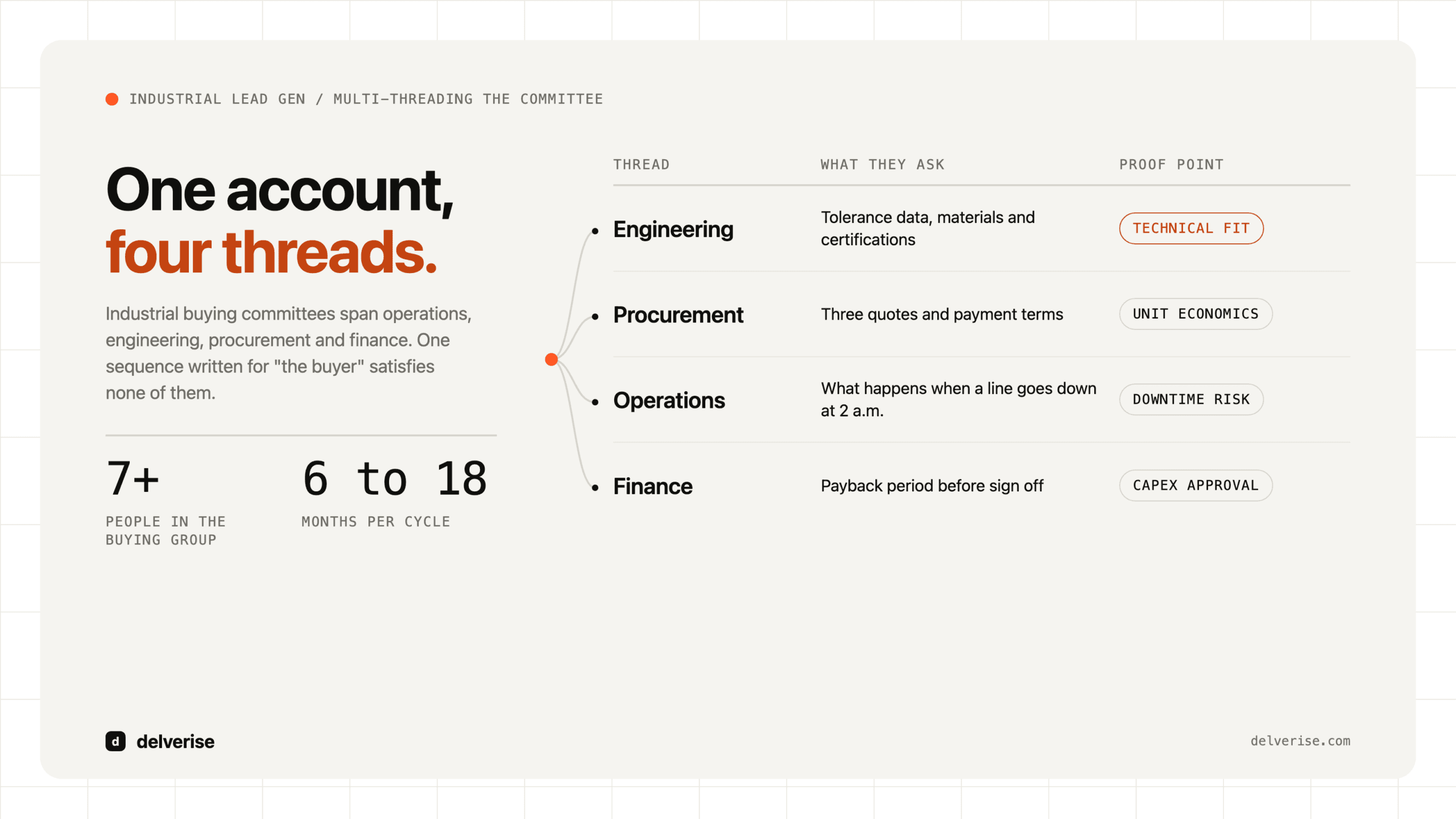
- Buying committees in industrial deals often involve seven or more people spanning operations, engineering, procurement, and finance. Single-threaded outbound stalls.
- Technical fit qualification (materials, tolerances, certifications, plant capacity) belongs upstream in your data layer, not downstream in a discovery call.
- Distributor and channel conflict is a real routing constraint. Your CRM needs to know who owns which account before a rep touches it.
- Attribution has to survive an offline close. If the deal closes over a plant visit and a quote, your model needs to capture that.
Why does standard B2B lead generation break in industrial markets?
Most outbound playbooks assume a searchable buyer. You filter by job title, headcount, funding stage, and tech stack, then send sequences. That works when your buyer is a VP of Marketing at a Series A software company with a LinkedIn profile and a Slack habit.
Industrial buyers break every assumption in that chain. A plant manager at a 300-person contract manufacturer may have no LinkedIn presence, a shared info@ inbox, and a title that appears nowhere in a standard taxonomy. The company’s website may not state what it actually makes. Its NAICS code says “fabricated metal product manufacturing,” which covers thousands of firms with nothing in common.
The result is a targeting problem disguised as a conversion problem. Teams see low reply rates and rewrite the copy. The copy was fine. The list contained the wrong 80 percent of accounts, and no subject line rescues that. Fixing the account layer first, then the contact layer, then the message, is the order that actually compounds. Our breakdown of what B2B revenue teams actually need from lead gen data covers how to sequence those layers.
What makes an industrial buying committee different?
Gartner’s research on B2B buying is the standard reference here: the typical buying group for a complex solution runs to six to ten decision makers, each arriving with their own independently gathered information. In industrial deals that group skews larger and more functionally divided, because you are usually satisfying an engineer on specification, a procurement lead on unit economics, an operations head on downtime risk, and a CFO on capex approval.

Those four people care about entirely different things. The engineer wants tolerance data and certifications. Procurement wants three quotes and payment terms. Operations wants to know what happens when a line goes down at 2 a.m. Finance wants payback period. A single sequence written for “the buyer” satisfies none of them.
Multi-threading in industrial accounts means building parallel entry points from the start: an engineering contact, a procurement contact, and an executive sponsor, each with distinct content and a distinct proof point. That is a data and orchestration requirement before it is a copywriting one. If you are designing sequences to support it, our guide to what actually works in B2B cold email covers the structural side.
How do you find industrial accounts that standard databases miss?
Industrial account discovery works best when you stop treating a contact database as your source of truth and start treating it as one enrichment input among several. The accounts you want often reveal themselves through operational evidence rather than firmographic tags.

Signals that actually predict industrial fit:
- Certification registries. ISO 9001, AS9100, IATF 16949, and ITAR registration lists tell you what a shop is qualified to build. This is a harder qualification signal than any industry code.
- Equipment and capability pages. A manufacturer listing five-axis CNC machines, specific press tonnages, or cleanroom classes is publishing its own fit criteria. Scrape it and parse it.
- Permits and facility filings. Environmental permits, building permits, and expansion filings are public in most jurisdictions and signal capex intent months before an RFQ.
- Hiring patterns. A company posting for maintenance technicians, quality engineers, and shift supervisors at once is expanding capacity.
- Trade show exhibitor lists. IMTS, FABTECH, Hannover Messe, and vertical equivalents publish exhibitor and attendee directories that map an entire subsegment.
Each of these is a scraping and normalization job, then a matching job against your CRM. This is where a data orchestration layer earns its cost. Clay is the common choice because it lets you chain sources (a scraped capability page, then a domain match, then a contact waterfall across several providers) in one table without engineering time. The honest tradeoff: credit costs climb quickly when you run wide enrichment on low-intent lists, and someone on your team has to own table hygiene or it degrades within a quarter. It is a workbench, and workbenches need an operator. If you want the build handled rather than staffed internally, delverise’s Clay implementation work exists for that.
Buy a list or build the data layer? A comparison
| Dimension | Purchased industrial list | Built data layer |
|---|---|---|
| Time to first campaign | Days | Three to six weeks |
| Upfront cost | Low to moderate, per record | Higher: tooling plus build |
| Technical fit accuracy | Weak; based on industry codes | Strong; based on stated capability |
| Contact coverage in industrial roles | Often 30 to 50 percent, frequently stale | Waterfall across sources lifts coverage materially |
| Refresh | Manual repurchase | Scheduled re-runs |
| Compounding value | None; the list decays | Signals accumulate into an account graph |
| Best fit | Testing a new segment cheaply | A segment you have committed to |
The practical answer for most teams is sequential. Buy a small list to validate that a segment responds at all, then build the durable layer only for segments that clear the bar. Our guide to buying B2B contact data covers how to evaluate providers on coverage in specific verticals rather than headline database size.

A worked example: qualifying a precision machining segment
Say you sell quality management software to precision machine shops in the US Midwest, with an ideal customer of 50 to 500 employees holding AS9100 aerospace certification.
The naive approach pulls “machine shops, 50 to 500 employees, Midwest” from a contact database. That returns roughly 4,000 companies, most of which do general job-shop work and have no aerospace exposure, no quality management pain, and no budget line for your product.
The built approach runs in five steps:
- Pull the AS9100 certified supplier registry and filter to your geography. Result: a few hundred verified-qualified accounts.
- Scrape each company site for equipment lists and capability language, then score for complexity indicators (multi-axis machining, tight tolerance claims, prime contractor references).
- Enrich for headcount and growth signals to confirm they are in your size band and expanding.
- Run a contact waterfall for three roles per account: quality manager, operations lead, and owner or GM. Verify emails before send.
- Route into CRM with the qualifying evidence attached, so the rep opens the record already knowing the certification, the equipment, and the trigger.
You end up with 300 accounts instead of 4,000. Every one of them holds the certification that makes your product relevant, and every rep touch starts from specific evidence rather than a generic pitch. Reply rates on that kind of list routinely run several times higher than on a broad pull, because relevance is doing the work the copy usually gets blamed for.
Where does AI actually help in industrial lead generation?
AI is genuinely useful in three narrow places in this motion, and oversold nearly everywhere else.
It works well for unstructured-to-structured extraction: reading a capability page, a PDF spec sheet, or a permit filing and pulling out the fields you care about. That was previously manual research work and is now a reliable API call. It also works for classification at scale, sorting 5,000 scraped company descriptions into segments with reasonable accuracy. And it works for personalization inputs, generating the specific factual observation a rep uses in an opener rather than writing the whole email.
It works poorly for judgment calls on technical fit where being wrong is expensive, and for fully autonomous sending. An AI-drafted email claiming a wrong certification or misreading a tolerance spec costs you credibility with an engineer permanently. Industrial buyers are unusually sensitive to technical imprecision, because catching imprecision is their job. Keep a human review step on anything making a technical claim. We go deeper on where the line sits in what AI actually automates in B2B lead generation.
How should industrial pipeline be measured?
Industrial cycles are long enough that quarterly pipeline metrics tell you almost nothing about whether the system is working. If your average cycle is eleven months, the deals closing this quarter came from work done nearly a year ago.
Measure leading indicators that move inside the quarter:
- Account coverage rate. What percentage of your defined target accounts have at least two verified, enriched contacts in CRM? This is the ceiling on everything downstream.
- Multi-thread depth. Average number of engaged contacts per open opportunity. Below two, your win rate will suffer regardless of activity volume.
- Technical qualification rate. Percentage of first meetings where fit is confirmed. Low numbers point at your data layer, not your reps.
- Signal-to-meeting latency. Days between a trigger firing (permit filed, certification added, expansion hire posted) and first outreach. This is the number automation moves most.
These require your CRM to hold structured fields that most industrial teams never configure. Certification status, equipment class, and channel ownership should be properties, not notes in a text box. Forrester and others have documented for years how poor CRM data quality erodes sales productivity, and industrial teams carry more of that debt than most because their data is harder to source in the first place. If your stack is the constraint, our overview of how to build a GTM tech stack maps the layers.
What breaks when you scale industrial outbound?
Three failure modes show up repeatedly once volume increases.
Channel conflict. If you sell through distributors or reps, outbound into an account that a partner already owns creates real commercial damage. Your CRM needs partner ownership as a hard routing rule enforced before send, not a guideline in a spreadsheet.
Deliverability collapse. Industrial domains often run aggressive filtering and older mail infrastructure. Volume that a SaaS domain absorbs will get you blocked. Keep per-domain sending low, warm properly, and monitor placement by recipient domain rather than in aggregate.
Rep context loss. When a rep opens a record with no evidence attached, they default to a generic pitch and burn the account. Every routed lead should carry the reason it qualified. Our piece on building prospecting that compounds covers the handoff design.
Frequently Asked Questions
How long does an industrial lead generation system take to show results?
Expect first qualified meetings within four to eight weeks of launch and meaningful closed revenue attribution six to twelve months out, depending on your cycle. Judge the first quarter on account coverage, meeting quality, and technical qualification rate. Judging it on closed-won before a full sales cycle has elapsed will lead you to kill a system that is working.
Is cold email or cold calling more effective for industrial buyers?
Both, in sequence, with the phone weighted more heavily than in software sales. Plant and operations roles are often away from a desk and respond better to a direct call, while engineering and procurement contacts respond to email with specific technical substance. The main constraint on calling is coverage: direct dials for industrial roles are harder to source than for software buyers, so budget for phone data explicitly.
Do we need a dedicated data layer, or can our CRM handle it?
Your CRM is a system of record, not a system of discovery. It stores what you already know and is poor at finding, scraping, matching, and scoring what you do not. The workable pattern is a discovery and enrichment layer feeding a clean CRM through defined rules, with the CRM staying the single source of truth for ownership and stage.
How do we handle industrial accounts with no identifiable contacts?
Treat them as a separate track. Use physical mail, trade publication advertising, event presence, and targeted paid to generate inbound from accounts you cannot reach directly. Also check whether the account is genuinely unreachable or just missing from your current provider; running a waterfall across several sources often surfaces contacts a single database misses entirely.
Should we build this in-house or bring in outside help?
It depends on whether you have someone who owns data engineering for GTM as their actual job. If you do, build it. If you are asking a demand gen manager to maintain scrapers and enrichment tables alongside their real role, it will degrade. Our comparison of outside GTM help versus building in-house covers how to make that call on cost and time-to-value.
Read next