←Back to blog
Revenue Intelligence & Data ToolingGuideNovember 16, 20268 min read
How to Automate Prospecting: The System B2B SaaS Teams Actually Need
To automate prospecting is to move the repeatable parts of finding, researching, and reaching buyers into software: trigger detection, list building, enrichment, scoring, and sequencing. The judgment stays with people. Teams that automate the data layer first, then messaging, see higher reply rates and far less rep time lost to manual research.
To automate prospecting is to move the repeatable parts of finding, researching, and reaching buyers into software: trigger detection, list building, enrichment, scoring, and sequencing. The judgment stays with people. Teams that automate the data layer first, then messaging, see higher reply rates and far less rep time lost to manual research.
Key takeaways
- Automation compounds from the bottom of the stack up. Fix ICP definition and data quality before you touch message generation.
- The biggest return is usually hours returned to reps, not volume added. One rep can lose 100+ hours a quarter to account research that software does in minutes.
- Buyers spend very little time with any single vendor, so relevance at first touch matters more than send volume.
- Trigger-based prospecting beats static list pulls, because a signal gives you a reason to reach out that the buyer recognizes.
- Keep discovery, negotiation, and multi-threading human. Automate the work that produces the conversation, then get out of the way.
What does it actually mean to automate prospecting?
Prospecting is the work that happens before a pipeline opportunity exists: deciding who to talk to, learning enough to be worth their time, and starting the conversation. Automating it means each of those steps runs as a defined system with inputs, logic, and outputs, instead of living in a rep’s browser tabs.

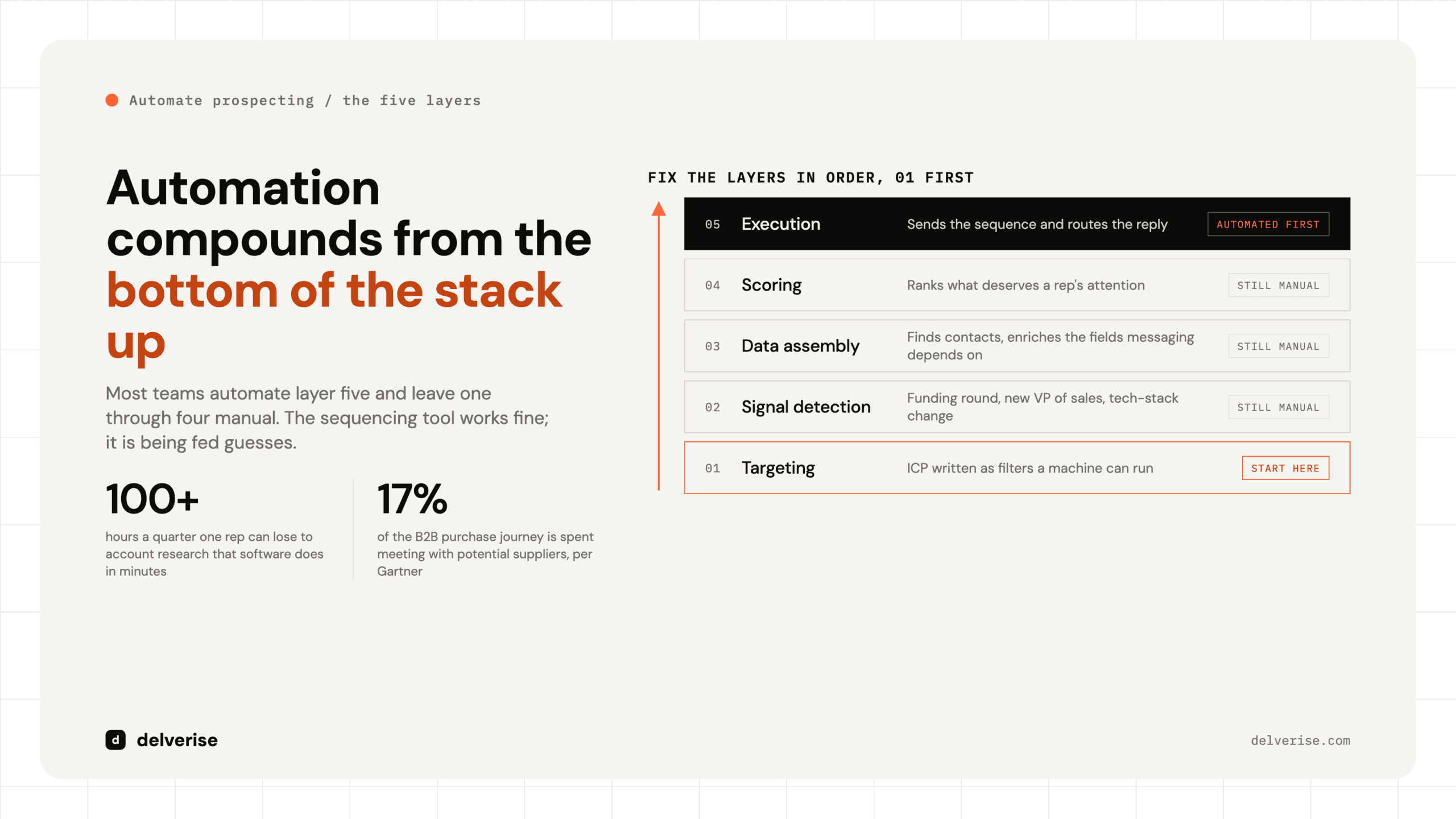
In practice that system has five layers. Targeting defines the accounts and personas that match your ideal customer profile (ICP), the written description of the accounts your product wins and retains. Signal detection watches for events worth acting on: a funding round, a new VP of Sales, a job posting for a role your product supports, a tech-stack change. Data assembly finds contacts and enriches them with the firmographic and behavioral fields your messaging depends on. Scoring ranks what deserves a rep’s attention. Execution sends the sequence and routes the reply.
Most teams automate layer five and leave one through four manual. That is why their output feels like spam. The sequencing tool works fine; it is being fed guesses.
Why do most prospecting automation projects stall?
Three reasons, in order of how often we see them.

The ICP is a slide, not a query. If your ICP cannot be expressed as filters a machine can run (employee count, funding stage, hiring signals, installed tools, geography), it cannot drive automation. Writing that definition is the unglamorous first step, and it is where most of the value sits. Our guide to the six foundation pieces under every revenue stack covers what has to exist before any of this runs.
The data layer is untrusted. Contact data decays constantly as people change roles, and a single bad email address does more damage than a weak subject line, because it costs you domain reputation. Enrichment and verification belong inside the pipeline, running on a schedule, feeding the CRM. That is the work behind CRM enrichment as a system rather than a one-time list cleanup.
Personalization is generated without inputs. An AI model with no research to work from writes fluent, forgettable copy. The same model given three verified facts about the account writes something a buyer will answer. The model is rarely the bottleneck; the retrieval is.
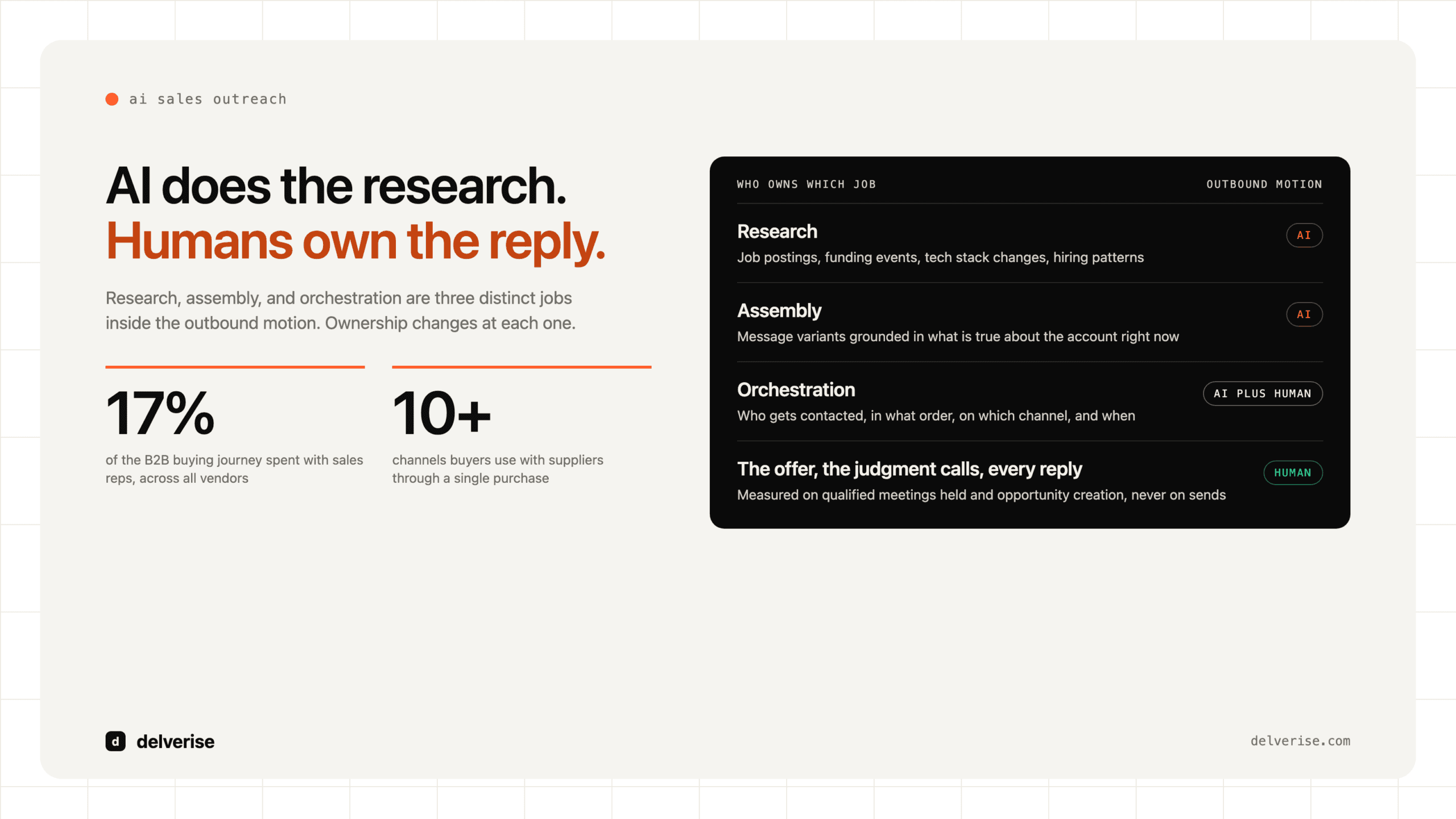
There is real urgency behind getting this right. Gartner’s research on B2B buying found that buyers spend only about 17% of their purchase journey meeting with potential suppliers, and when several vendors are competing, any individual rep may get roughly 5% of that time. McKinsey’s B2B pulse work found buyers now move across about ten channels during a purchase decision, up from around five in 2016. You get a narrow window, through channels you do not control. Relevance is the only lever that reliably widens it.
Which layer should you automate first?
Work bottom-up. Each layer below is only as good as the one under it.

| Layer | Automate it? | What good looks like | Where it breaks |
|---|---|---|---|
| ICP and trigger detection | Fully | Signals monitored continuously; accounts enter a queue the day the trigger fires | Triggers chosen because they are easy to detect, not because they predict buying |
| List building | Fully | Contacts sourced from multiple providers with waterfall fallback, deduped against CRM | Single-vendor sourcing, which caps coverage at that vendor’s database |
| Enrichment and verification | Fully | Every record verified before send; enrichment refreshed on a cadence | Enrichment run once at import, then left to rot |
| Research and personalization inputs | Yes, with spot checks | Three sourced facts per account, stored as fields, cited in copy | Generated claims that no human reviews, which eventually invent something false |
| Message drafting | Partly | Templates with variable blocks; AI fills from verified fields only | Full generation with no guardrails, producing copy nobody would sign their name to |
| Discovery calls and negotiation | No | Rep owns it, with a prepared brief delivered automatically | Bots attempting qualification the buyer did not consent to |
On tooling: the orchestration layer is where teams have the most real choice. Clay has become the common answer for signal-driven list building and waterfall enrichment because it collapses a dozen point tools into one table, and it is honestly priced for teams doing high-intent volume rather than mass blasting. The tradeoff is real: credit costs climb quickly when tables run unbounded, and someone has to own the build. If you want the system designed and handed over rather than assembled in-house, that is what delverise does on its Clay implementation work. Apollo, Outreach, and Salesloft solve adjacent problems, and our breakdown of what Salesloft actually costs is a useful comparison point. The right stack depends on whether your constraint is data coverage, sequencing discipline, or CRM hygiene. Pick for the constraint you have. For a fuller tool evaluation, see how to pick an AI prospecting tool that actually builds pipeline.
What does this look like with real numbers?
Take a Series A SaaS company with three AEs and one SDR, selling to operations leaders at mid-market companies.
Their addressable list is roughly 4,000 accounts. Rather than sequencing all of them, the system watches for two triggers: a new operations hire at director level or above, and a posted job requisition mentioning the workflow their product replaces. In a given quarter, about 250 accounts fire one of those signals.
The pipeline then builds three contacts per account, giving 750 records. Waterfall enrichment and verification pass roughly 80% as safe to send, so 600 contacts enter sequences with three sourced facts attached to each. At a 5% positive reply rate, that produces 30 conversations, and roughly half convert to meetings held: about 15 per quarter from one SDR’s territory.
The efficiency math matters more than the output math. Researching 750 contacts by hand at twelve minutes each is 150 hours, close to a full quarter of an SDR’s usable selling time. The automated version costs about 15 hours of review and exception handling. The rep spends the other 135 hours on conversations. That reclaimed time is the actual product of prospecting automation, and it is what shows up later in your forecast reliability, because pipeline built from signals converts at a more predictable rate than pipeline built from volume.
Speed compounds it. A long-running Harvard Business Review study of online lead response found that firms responding within an hour were close to seven times more likely to have a meaningful conversation with a decision maker than firms that waited just one hour longer. Automated routing is how you hit that window consistently.
What should stay human?
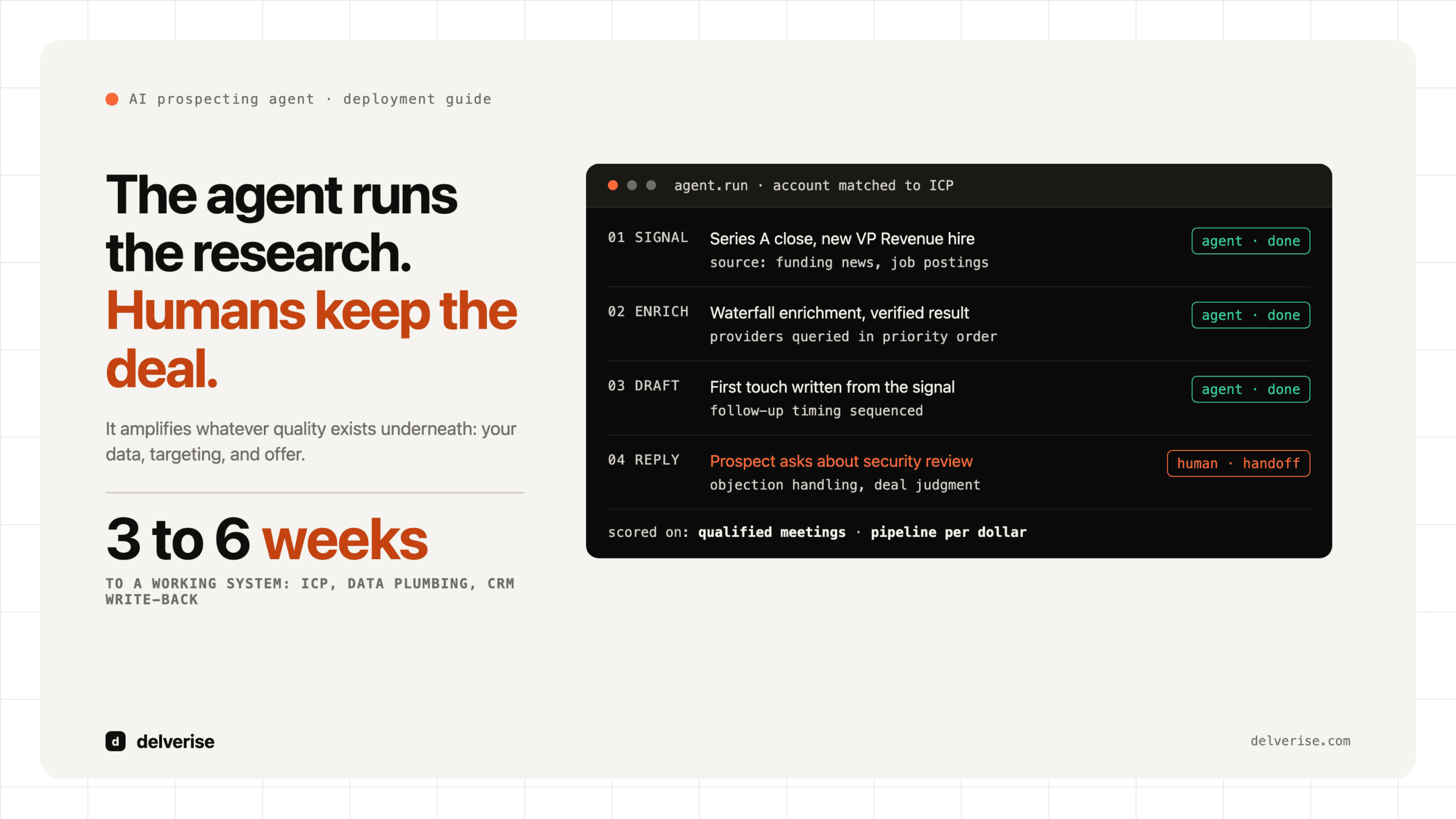
Discovery. Anything involving price. Multi-threading into a buying committee, where the sequencing of who hears what matters. Handling an objection that was not in the playbook. Breakup messages that need real judgment about whether a relationship is worth preserving.
There is also a category worth protecting: the first response to a warm reply. Automated follow-up on a hand-raise reads as indifference, and it undoes whatever goodwill the outbound earned. Route it to a person inside minutes. Our post on what to automate and what to keep human goes deeper on where that line sits, and AI lead qualification covers how to score without letting the score make final decisions.
How do you know the system is working?
Run this check quarterly:
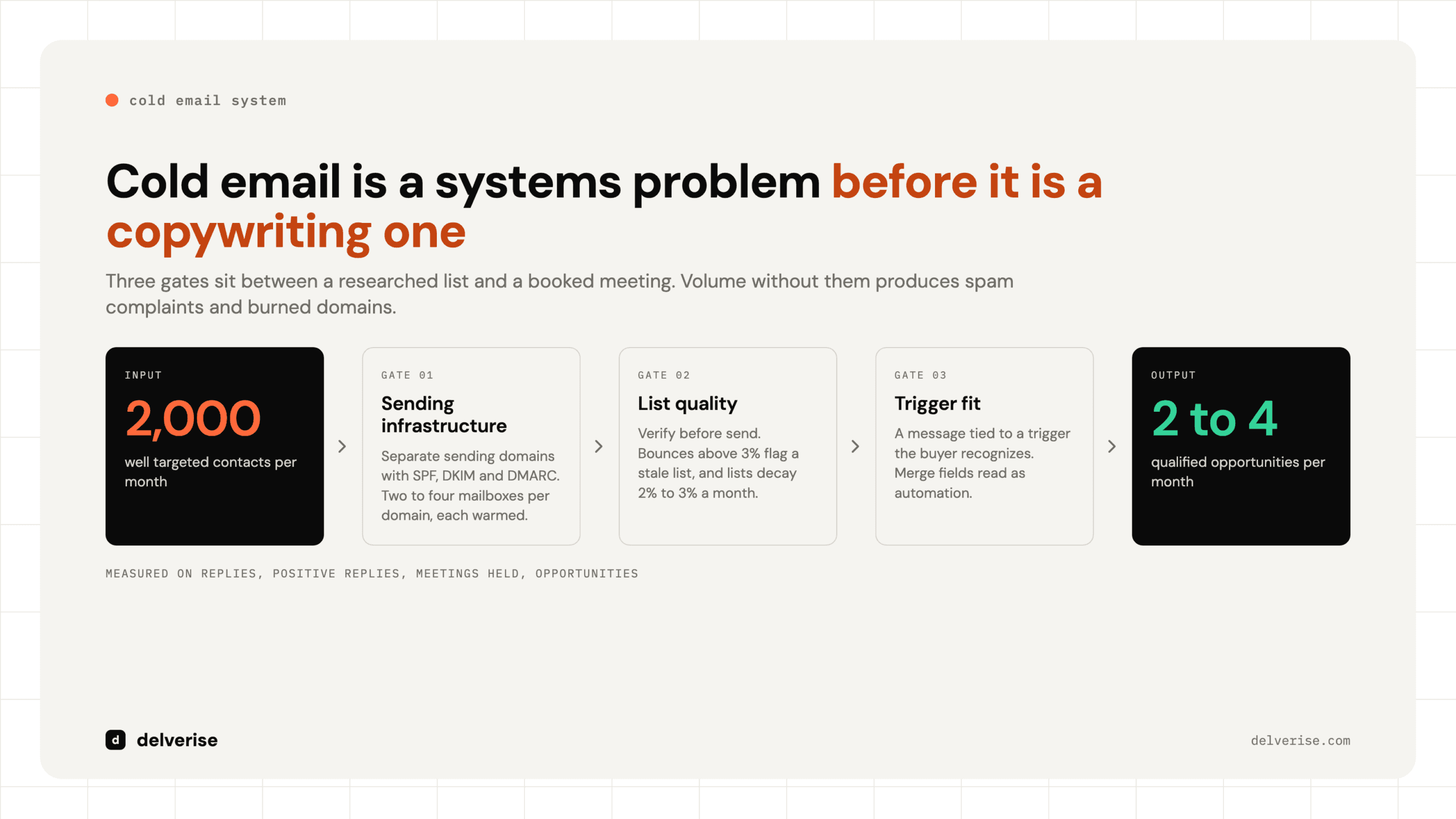
- Bounce rate under 3% across all sending domains
- Every sequenced contact has at least three enriched fields populated and verified within 90 days
- Positive reply rate tracked separately from total reply rate
- Meetings sourced from trigger-based accounts convert at a higher rate than from static lists
- Rep hours spent on research measured and trending down quarter over quarter
- A human has read 20 randomly sampled sent messages this month and would sign their name to all of them
If the last box fails, stop sending and fix the inputs. Volume applied to a broken system just accelerates the damage to your domain and your brand. Building this properly is a GTM engineering problem: defined systems, owned data, measurable output.
Frequently Asked Questions
How much does it cost to automate prospecting?
Tooling for a team of five typically lands between $1,500 and $5,000 per month across orchestration, data providers, verification, and sequencing, with enrichment credits as the variable line. The larger cost is the build: someone has to define the ICP, wire the triggers, and maintain the pipeline. Budget for that ownership explicitly, whether it is internal or external.
Will automated prospecting hurt our domain reputation?
It will if you automate sending before you automate data quality. Verified addresses, warmed sending domains, sensible daily volume caps, and separate domains for outbound all protect your primary domain. Bounce rate is the metric to watch; above 3% and you should pause everything until the data layer is fixed.
Do we still need SDRs if prospecting is automated?
Yes, and their job changes. The research and list-building portion of the role largely disappears, which frees the rep for conversations, account strategy, and multi-threading. Most teams end up with fewer SDRs producing more meetings each. Our breakdown of what one outbound SDR actually produces has the benchmark ranges.
How long before automated prospecting produces pipeline?
Expect four to six weeks to build and validate, then another six to eight weeks of sending before reply-rate data is statistically useful. Anyone promising booked meetings in week two is either running on a list they already had or skipping the data work that makes the system durable.
Should we build this in-house or bring in help?
Build in-house if you have a technical RevOps owner with time to maintain it, because these pipelines need ongoing attention rather than a one-time setup. Bring in help when the opportunity cost of your team learning the tooling exceeds the cost of having the system designed, built, and transferred. delverise builds these as owned systems, documented and handed over, so the capability stays with your team.