←Back to blog
Revenue Intelligence & Data ToolingGuideSeptember 10, 20268 min read
Leadgen AI: What It Actually Automates and Where It Breaks
Leadgen AI is the group of machine learning and large language model tools that find accounts, research them, score fit and timing, then route the best ones to a human. It compresses the research work in front of every conversation. Quality depends entirely on the data feeding it and the buying criteria you define.
Leadgen AI is the group of machine learning and large language model tools that find accounts, research them, score fit and timing, then route the best ones to a human. It compresses the research work in front of every conversation. Quality depends entirely on the data feeding it and the buying criteria you define.
Key takeaways
- Leadgen AI replaces research and triage hours, not the judgment call on whether an account is worth a quarter of your team’s attention.
- The gains come from the data layer. Bad firmographics and stale contact records produce confidently wrong output faster than a human could produce it slowly.
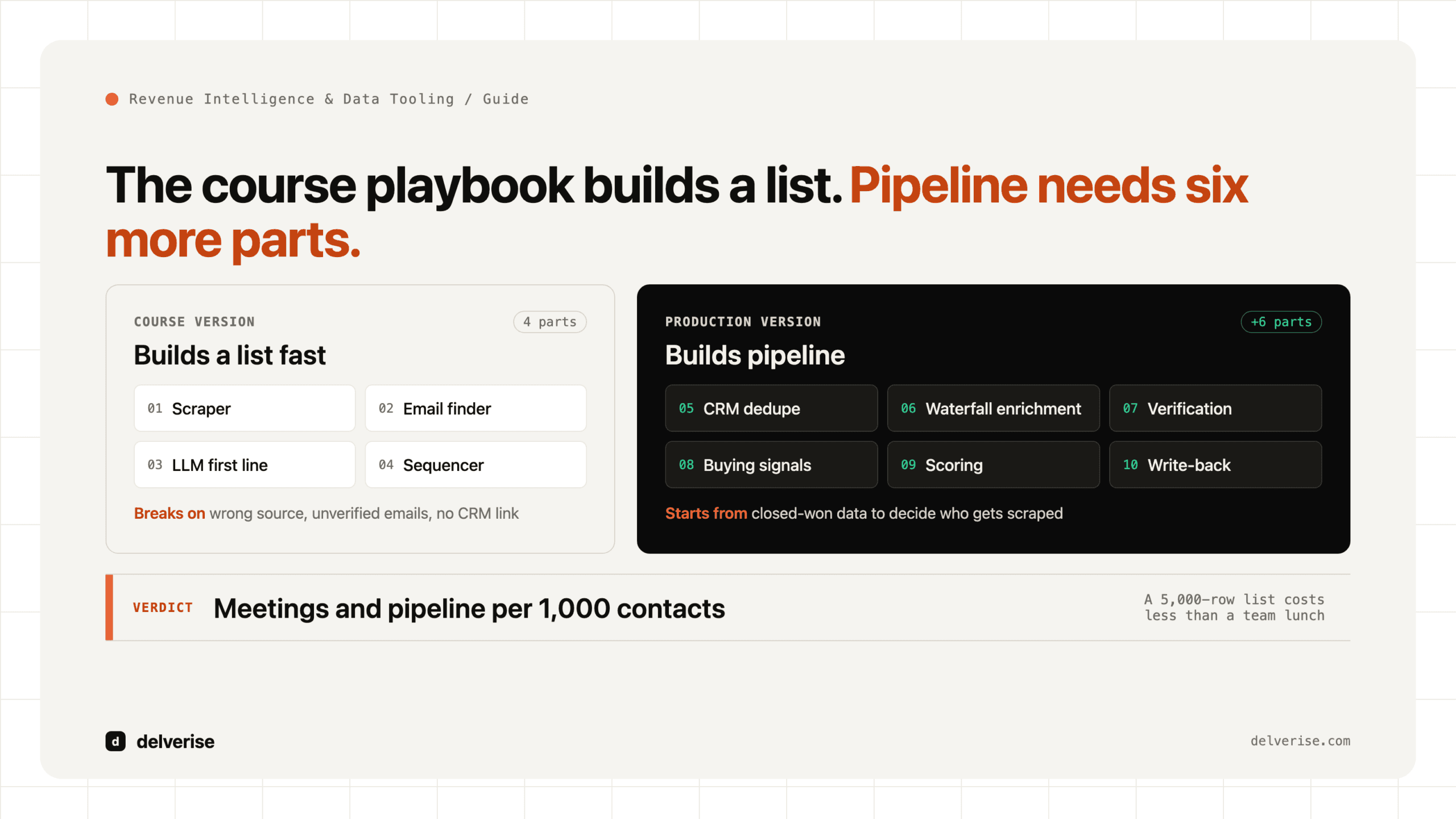
- Most teams buy five overlapping tools when they need one clean pipeline: signal in, enrichment, scoring, routing, human touch.
- Measure it on qualified meetings per 100 contacts touched and on stage-2 conversion, since volume metrics will always look good.
- Expect a 60 to 90 day build before the scoring model reflects how your buyers actually behave.
What is leadgen AI, exactly?
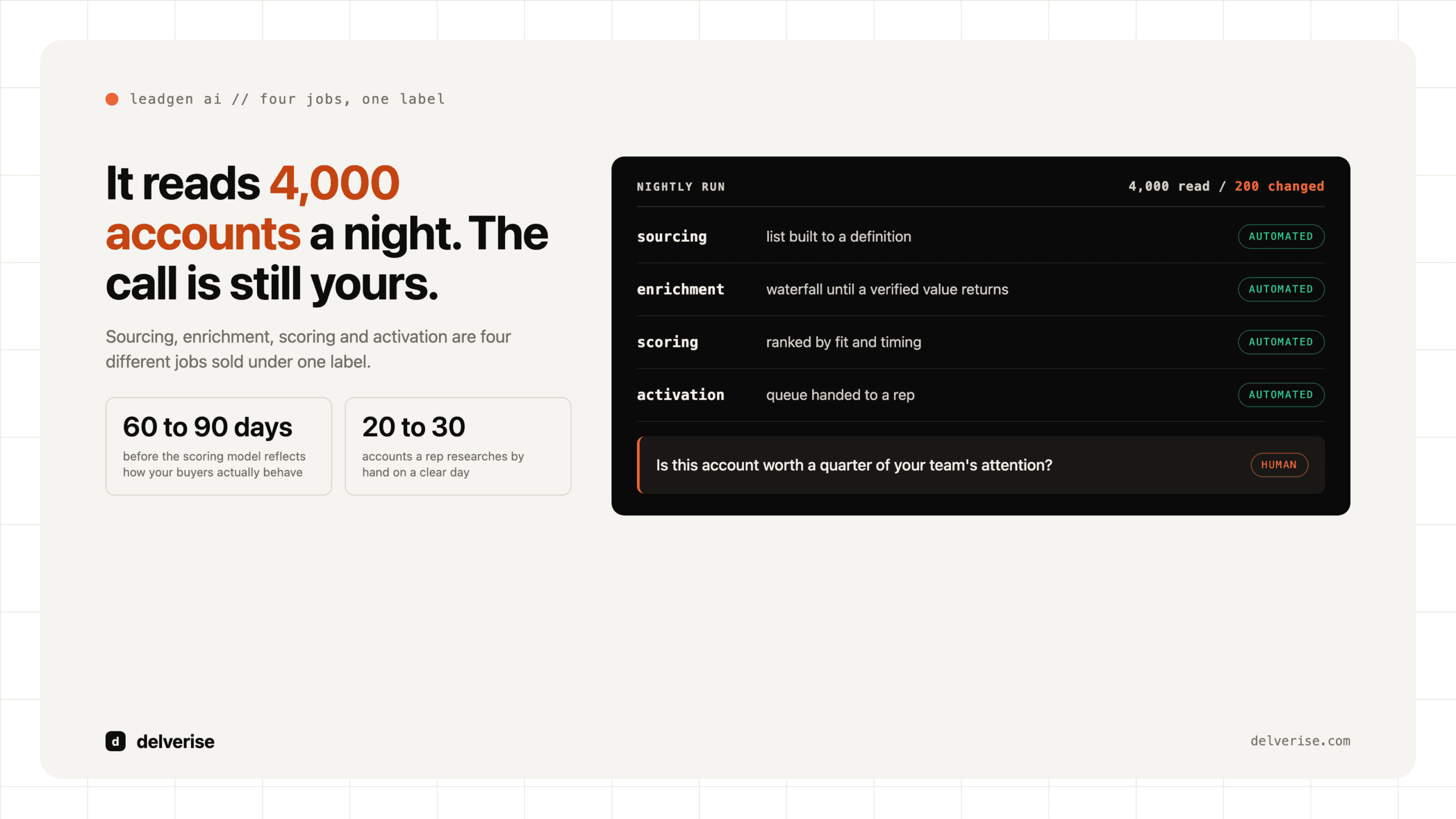
The term covers four different jobs that vendors sell under one label. Sourcing means building a list of accounts and contacts that match a definition. Enrichment means attaching attributes to those records: headcount, tech stack, funding, verified email, hiring activity. Scoring means ranking those records by fit and timing. Activation means writing and sending the first touch, or handing a ranked queue to a rep.

Any given product does one or two of these well and gestures at the rest. A revenue leader evaluating this category should ask which of the four jobs the tool genuinely owns, because that determines what you still have to build around it. We covered the buying criteria in depth in our guide to AI tools for lead generation.
One definition worth fixing early: a signal is an observable event that correlates with buying readiness. A job posting for a role your product supports, a new funding round, a security page update, a competitor’s logo appearing on their site. Signals are the raw material of every credible leadgen AI system.
What does leadgen AI actually automate?
The honest answer is research throughput and consistency. A rep researching accounts by hand covers 20 to 30 in a day if their calendar is otherwise clear, and applies slightly different standards on Friday afternoon than on Monday morning. A pipeline that reads 4,000 accounts nightly applies the same standard every time and surfaces the 200 that changed.

Concretely, the work that moves off human hands:
- Watching account-level signals continuously instead of at campaign-planning time.
- Waterfall enrichment, where a record is passed through several data providers in sequence until a verified value comes back. This is a mechanical job that no rep should own. Our breakdown of AI email finders covers where the accuracy actually comes from.
- Reading a company’s site, job posts, and filings to extract the two or three facts that make an opener specific.
- Scoring and ranking, so the queue is ordered by something other than alphabetical account name. See what AI lead qualification actually scores.
- Routing and follow-up logic that used to live in a rep’s head.
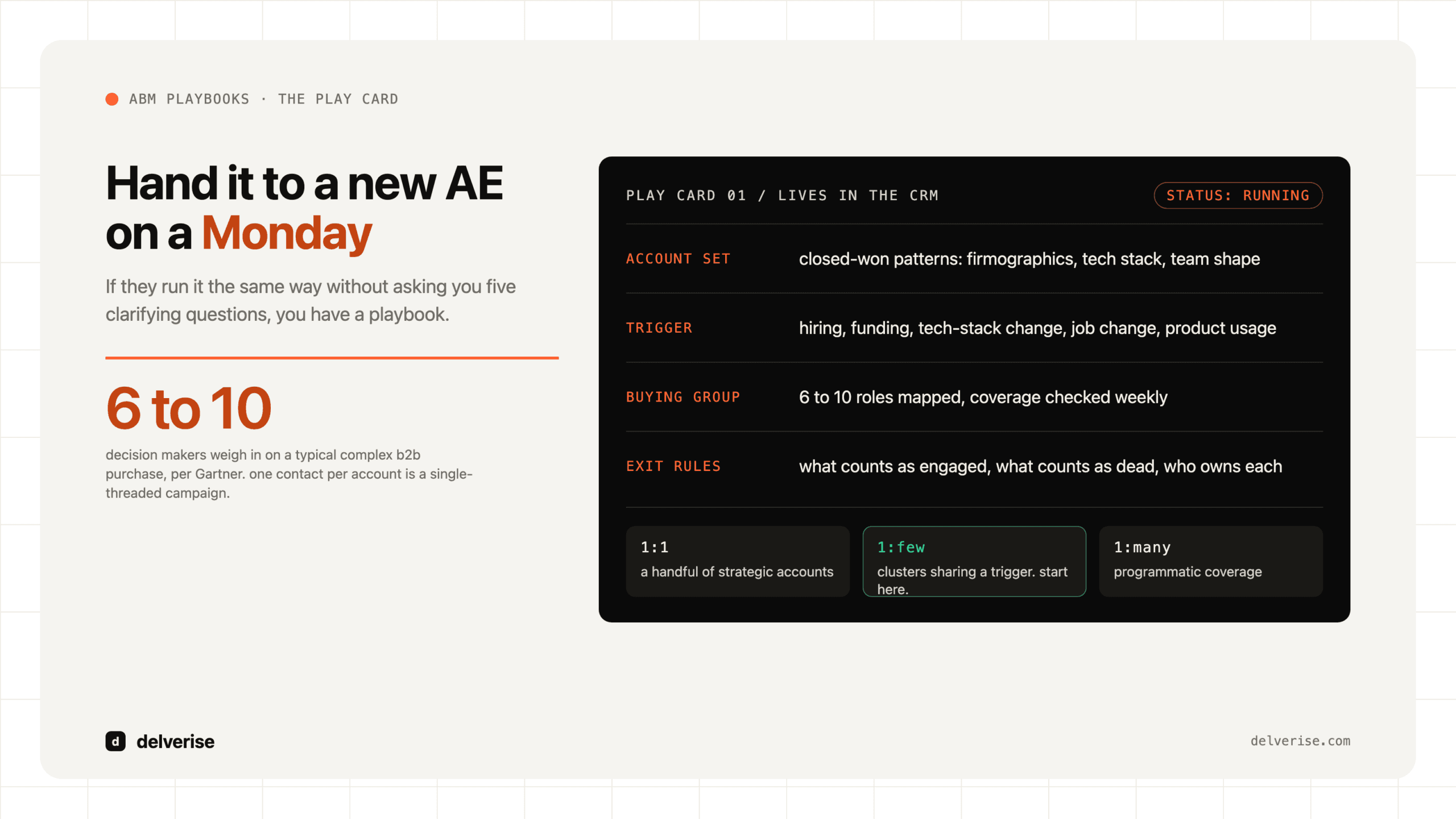
Gartner’s research on B2B buying is the reason this matters. Buyers spend roughly 17% of their total purchase journey meeting with potential suppliers, and that time is split across every vendor under consideration. Any single rep gets a sliver. The preparation behind that sliver is where leadgen AI earns its cost.
Where does leadgen AI break?
Four failure modes show up repeatedly.

Garbage inputs, confident outputs. An LLM handed a stale CRM record will write a personalized email about a product line the company sold off two years ago. The model has no way to know. This is why data hygiene work precedes tool selection every time, and why we treat CRM structure as a foundation piece rather than a later cleanup project.
Scoring that models the wrong outcome. Most out-of-the-box models are trained on lead-to-meeting conversion because that data is plentiful. Meetings are cheap. If your model optimizes for meetings booked, it will learn to favor the accounts most willing to take a call, which skews small and skews curious. Train on closed-won or on stage-2 progression instead, even if the sample is thinner.
Volume without a constraint. The cost of sending drops to near zero, so teams send more. Deliverability, brand, and reply quality all degrade together. The constraint that used to be rep hours has to be replaced with a deliberate one: a cap on sends per domain, a minimum signal threshold, a human review step.
Personalization that reads as generated. Buyers have recalibrated. A first line that references a job posting now signals automation to a sophisticated buyer rather than effort. The differentiator has moved to whether the message names a problem the buyer recognizes, which is a positioning question that no tool solves for you.
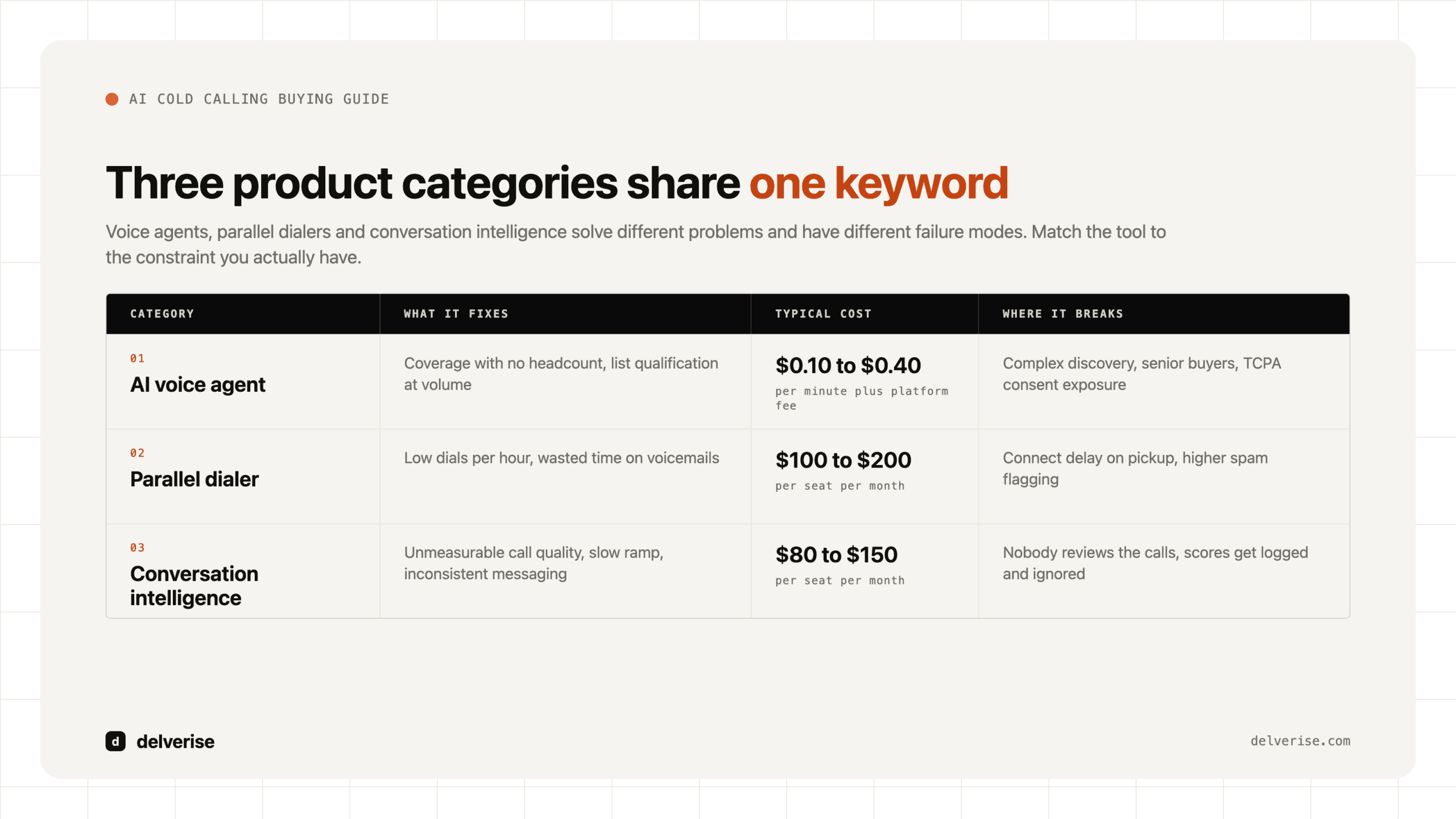
How do the categories compare?
| Category | What it automates | What it will not do | Fits when |
|---|---|---|---|
| Intent and signal platforms | Detects account-level research activity and third-party intent spikes | Tell you which person inside the account cares | You have 3,000+ addressable accounts and cannot cover them evenly |
| Enrichment and orchestration | Waterfall data lookups, list building, AI research per record | Fix an undefined ICP or a broken CRM schema | You want one programmable layer feeding everything downstream |
| Scoring and predictive models | Ranks fit and timing across your full database | Produce reliable output before roughly 100 closed-won records exist | Rep capacity is your binding constraint |
| Sequencing and AI SDR agents | Drafting, sending, follow-up cadence, reply classification | Handle a non-obvious objection or a multithreaded deal | Messaging is already validated by humans |
| Inbound conversational tools | Qualifying and routing site visitors in real time | Create demand that was not already there | You have meaningful traffic already. See our take on lead generation bots |
Orchestration is where most teams get the highest return per dollar, because it makes the other layers composable. Clay is the common choice here for teams that want to run waterfall enrichment and AI research inside one table before anything reaches the CRM. The honest tradeoff: it rewards teams with someone who enjoys building systems, and it sits idle for teams that expected a finished product out of the box.
What does the math look like on a real pipeline?
Take a Series A company with two SDRs and an ICP of about 4,000 accounts.
Manual approach: each rep researches and works 25 accounts a day, so the team touches roughly 1,000 accounts a quarter with uneven quality and no way to prioritize which 1,000.
Systematized approach: the full 4,000 are checked nightly against five signals. In a given month, 260 accounts cross the threshold. Enrichment pulls three contacts per account for 780 records, verification drops about 15% as unreachable, leaving 660 sendable contacts with a stated reason each one surfaced. Two reps can work 660 contacts across a month with real review time per message.
At a 3% meeting rate, that produces about 20 meetings a month from outbound. The pre-system baseline for a team like this usually sits between 8 and 12. The data cost runs a few cents per verified contact, so the enrichment line item is measured in low hundreds of dollars monthly. The real cost is the 60 to 90 days of build and iteration, plus someone who owns the signal definitions. That distribution of cost is the part most buyers underestimate.
What should a revenue leader measure?
Volume metrics will always improve after you deploy this. Ignore them. Four numbers tell the truth:
- Qualified meetings per 100 contacts touched. The single best efficiency measure, and the one that exposes spray behavior.
- Stage-2 conversion of AI-sourced opportunities versus rep-sourced. If sourced pipeline converts at half the rate, your scoring model is wrong.
- Sampled data accuracy. Pull 50 enriched records a month and check them by hand. Accuracy decays quietly.
- Time from signal to first touch. A funding-round signal acted on 19 days later is a generic email with extra steps.
McKinsey’s research on B2B buying behavior found that buyers now move across roughly ten channels during a purchase decision, up from about five a decade ago. Attribution gets harder as that number climbs, which argues for measuring the system on aggregate pipeline created rather than on channel-level credit.
What do you build first?
Sequence matters more than tool choice. Work down this list in order:
- Write the ICP as a queryable filter, with specific firmographic and technographic thresholds, rather than a persona slide.
- Audit CRM field hygiene on the objects your scoring will read from.
- Define three to five signals you believe correlate with buying, and write down why you believe it.
- Build the enrichment layer and measure verified-contact accuracy before automating any sending.
- Validate messaging with humans on 100 accounts before an agent writes at scale.
- Set your send constraint deliberately: caps per domain, minimum signal score, human review threshold.
- Instrument the four metrics above from day one, since retrofitting attribution is painful.
Teams that follow this order tend to buy fewer tools and get more from them. Teams that start with a vendor demo tend to accumulate overlapping subscriptions and a rep queue nobody trusts. If it helps to see how these pieces connect end to end, our overview of AI sales lead generation and the GTM engineering page walk through the full architecture. delverise builds these systems for B2B SaaS teams from Seed to Series B, including Clay implementation when orchestration is the missing layer.
Frequently Asked Questions
Is leadgen AI the same as an AI SDR?
An AI SDR is one category within leadgen AI, covering drafting, sending, and reply handling. Leadgen AI as a whole includes sourcing, enrichment, and scoring, which sit upstream and determine whether the AI SDR has anything worth sending. Buying the agent without the upstream layers is the most common expensive mistake in this category.
How much data do we need before predictive scoring works?
Roughly 100 closed-won records gives a model enough signal to beat a well-designed rules-based score. Below that, write explicit rules based on what your best deals had in common and revisit in two quarters. Rules you can read and argue with beat a model you cannot interrogate.
Will leadgen AI reduce our SDR headcount?
It changes what the role produces before it changes how many you need. Reps shift from list building and research toward multithreading, call quality, and handling the accounts the system flagged. Most teams hold headcount flat and raise output per rep. Our breakdown of what one outbound SDR actually produces gives the benchmark numbers.
What does a realistic budget look like?
For a Seed to Series B team, the tooling itself typically lands between $1,000 and $4,000 a month across data, orchestration, and sequencing. The build effort is the larger line item, whether that is internal time or outside help. Anchoring on subscription cost alone consistently underestimates the total by a wide margin.
How do we stay compliant while enriching contact data?
Confirm your provider’s lawful basis for processing, honor suppression and deletion requests across every system rather than only the CRM, and keep EU-based contacts on a separate consent path. Compliance obligations follow the data into every tool it touches, so a clean audit trail from source to send is worth building early.
Read next