←Back to blog
Revenue Intelligence & Data ToolingGuideAugust 29, 20268 min read
Lead Generation for IT Companies: How to Build a System That Actually Produces Pipeline
Lead generation for IT companies means running a repeatable system that spots accounts undergoing technical or commercial change, reaches the three to six people who own the decision, and earns credibility before the first sales call. Signal quality drives the outcome: hiring patterns, stack changes, funding events, and contract timing outperform raw list volume at any budget.
Lead generation for IT companies means running a repeatable system that spots accounts undergoing technical or commercial change, reaches the three to six people who own the decision, and earns credibility before the first sales call. Signal quality drives the outcome: hiring patterns, stack changes, funding events, and contract timing outperform raw list volume at any budget.
Key takeaways
- IT buyers move in groups. The average B2B buying group runs close to seven people, so single-contact outreach misses most of the decision.
- Timing beats targeting. An average-fit account with a live trigger converts better than a perfect-fit account with no reason to move.
- Your data layer is the constraint. Coverage, freshness, and verification determine what any sequence, ad, or SDR can do downstream.
- Measure at the account and buying-group level. Counting individual MQLs hides whether you are reaching the people who sign.
- Build the system once, then feed it. Most IT companies rebuild campaigns quarterly when they should be maintaining one pipeline of signals, enrichment, routing, and messaging.
Why is lead generation harder for IT companies than for other B2B sellers?
“IT companies” covers a wide span: managed service providers (MSPs), IT consultancies, systems integrators, VARs, cybersecurity vendors, and software companies selling into technical buyers. What they share is a buying process with unusual friction.

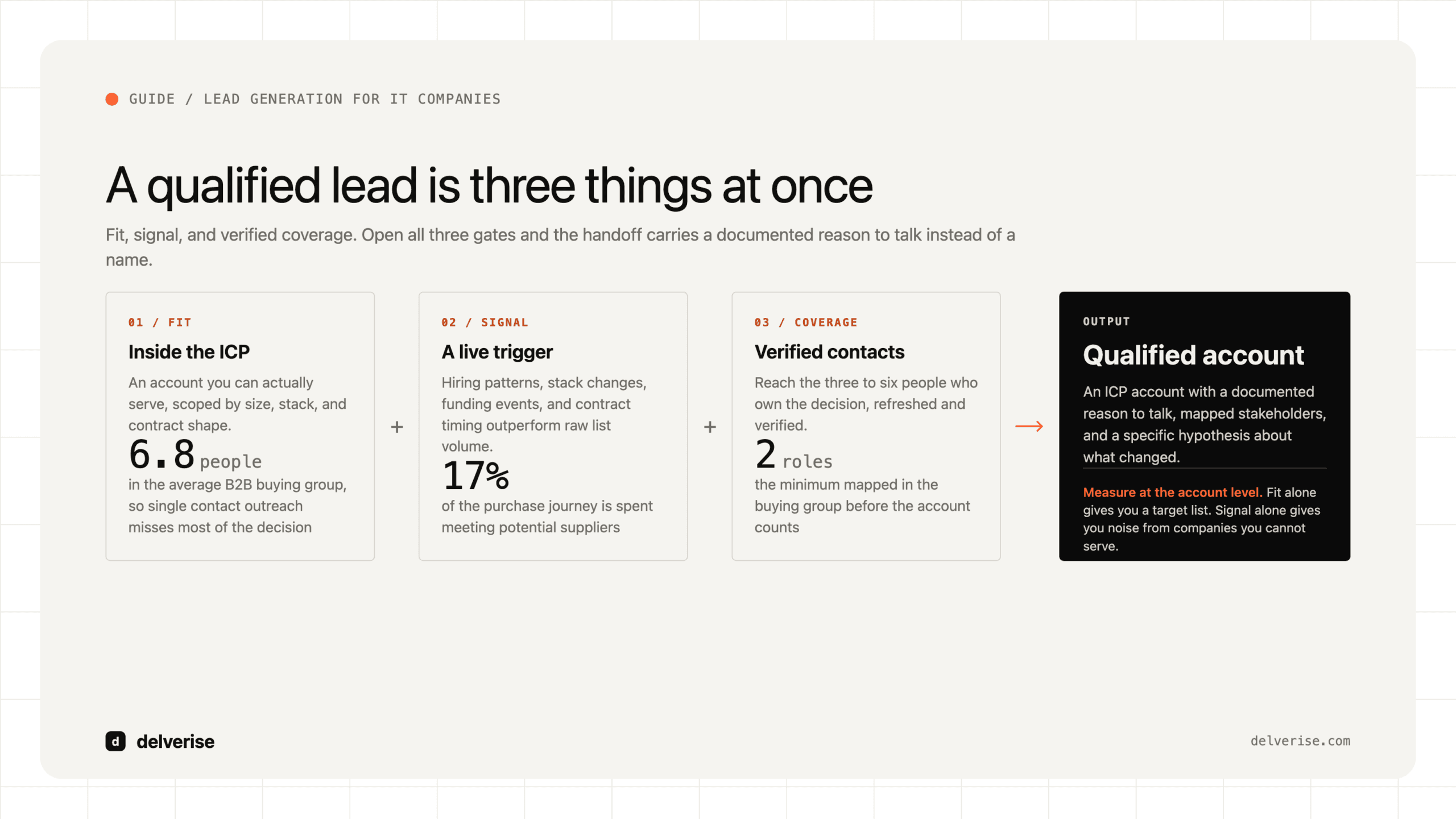
First, the buying group. A buying group is the set of people who influence or approve a purchase: a technical evaluator, a security reviewer, a finance approver, an executive sponsor, and often an end-user champion. The research behind The Challenger Customer, published by CEB and covered widely in Harvard Business Review, put the average B2B buying group at roughly 6.8 people. Every one of them can stall a deal.
Second, access. Gartner’s research on B2B buying found that customers spend only about 17% of their total purchase journey meeting with potential suppliers, and when several vendors compete, any individual rep might get about 5% of the buyer’s time. Most of the decision happens without you in the room.
Third, incumbency. IT purchases carry switching costs: migration risk, contract terms, retraining, security review. Prospects who are broadly satisfied stay put until something changes. That “something” is the signal your system needs to detect.
What counts as a qualified lead when you sell IT services or software?
A useful definition: a qualified lead is an account inside your ideal customer profile (ICP) that shows a change worth acting on, where you have verified contact coverage across at least two roles in the buying group.

Three components, all required. Fit alone gives you a target list. Signal alone gives you noise from companies you cannot serve. Contact coverage alone gives you email addresses with nothing to say. Forrester’s work on buying groups argues for measuring at the group level, since one contact rarely represents an account’s true readiness.
This reframes the SDR handoff. Instead of passing a name, you pass an account with a documented reason to talk, mapped stakeholders, and a specific hypothesis about what changed. Our breakdown of how revenue teams build prospecting that compounds goes deeper on the mechanics.
Which signals actually predict that an IT buyer is in market?
Intent data, meaning behavioral evidence that an account is researching a problem you solve, comes in several forms with very different reliability. Here is how the common sources compare.

| Signal | What it tells you | Typical source | Useful window |
|---|---|---|---|
| Job postings naming a technology or role | Budget approved, project starting or expanding | Job boards, career page scrapes | 30 to 90 days |
| New CIO, CTO, VP Engineering, or Head of Security | Vendor review is likely within two quarters | LinkedIn changes, press releases | 60 to 180 days |
| Tech stack additions or removals | Active migration, integration gap, or displacement opening | BuiltWith, HG Insights, DNS and job-post inference | 30 to 120 days |
| Funding round or acquisition | New spend capacity, consolidation work, compliance pressure | Crunchbase-class databases, news | 90 to 180 days |
| Compliance triggers (SOC 2, ISO 27001, HIPAA, DORA) | Forced project with a deadline | Trust pages, job posts, regulatory filings | 60 to 180 days |
| Third-party topic surges | Someone at the account is researching. You rarely learn who | Bombora, G2 category activity | 14 to 45 days |
| First-party website and product behavior | Strongest signal available, smallest volume | Your analytics, CRM, product telemetry | 7 to 21 days |
Rank them honestly. First-party behavior converts best and covers the fewest accounts. Third-party topic data covers many accounts and converts worst, because it is aggregated and anonymized at the company level. Most IT companies get the best economics from the middle rows: hiring, stack, leadership, and compliance triggers, which are public, specific, and easy to reference credibly in a first message. Our piece on why batch outreach cannot see buying timing covers the failure mode this fixes, and what buying intent data actually changes looks harder at the third-party category.
How do you build the data layer underneath it?
Every campaign inherits the quality of the data feeding it. Three properties matter: coverage (what percentage of target accounts you can resolve to real people), freshness (how recently the record was verified), and accuracy (whether the email and phone number work).
Practical sequence:
- Define the ICP in machine-readable terms: employee band, geography, stack markers, and disqualifiers. Vague ICPs produce vague lists.
- Build the account universe once and maintain it, rather than rebuying lists per campaign. Our guide to how revenue leaders should buy contact data covers vendor tradeoffs.
- Enrich in waterfall order. Waterfall enrichment means querying providers in sequence and stopping at the first hit, which raises coverage and lowers cost compared with paying one vendor for everything. Tools like Clay make this practical without engineering time, and Apollo, Prospeo, and similar providers slot in as waterfall steps.
- Verify before sending. Unverified sends damage domain reputation, which quietly caps every future campaign.
- Write signals back to the CRM as structured fields, so routing, scoring, and reporting can use them.
Vendor-neutral caveat: enrichment platforms are excellent at assembly and terrible at strategy. They will happily enrich a badly defined ICP at scale. If you want the workflow architected around your motion rather than a template, that is what our Clay implementation work and broader GTM engineering practice exists to do.
What does the whole system look like end to end?
Illustrative arithmetic for a 40-person IT services firm selling cloud modernization at a $70,000 average contract value. Run your own numbers; these are structural, not benchmarks.
| Stage | Volume | Assumption |
|---|---|---|
| ICP accounts maintained | 1,800 | Mid-market, three verticals, two regions |
| Accounts with a live signal this quarter | 126 | 7% trigger rate across signal types |
| Contacts reached across buying groups | 378 | 3 verified roles per account |
| Meetings booked | 23 | 6% contact-to-meeting on signal-based outreach |
| Qualified opportunities | 9 | 40% of meetings pass qualification |
| Closed won | 2 to 3 | 25% to 30% win rate |
Two things fall out of this model. Raising the trigger rate from 7% to 10%, by adding two more signal sources, adds roughly 50% more pipeline without touching messaging or headcount. And doubling contacts per account from three to six lifts meetings materially, because you stop depending on one person forwarding your email. Both improvements come from the data layer.
Channel choice sits on top. Email works when the signal is specific, as our guide to turning email prospecting into a system lays out. Calling works when the trigger is urgent. Paid retargeting against the signal-matched account list keeps you visible during the 83% of the journey Gartner says happens without you. McKinsey’s B2B Pulse research has consistently found buyers now move across around ten channels in a single decision journey, which argues for coordination across channels instead of picking one winner.
What should you build in house versus buy?
Buy the components with commodity economics: contact data, email infrastructure, sequencing (Outreach, Salesloft, or the native tooling in HubSpot and Salesforce), and enrichment credits. Build the parts that encode your specific judgment: ICP logic, signal definitions, scoring, routing rules, and the message templates tied to each trigger.
The common failure is buying an all-in-one platform and expecting it to supply the judgment. The second failure is building everything in n8n or Python and discovering that maintenance consumes the RevOps hire you made to improve conversion. A reasonable split for a Seed to Series B team: buy the plumbing, orchestrate it in a tool your operators can edit, and document the logic so it survives turnover. Our GTM tech stack guide maps the layers and where they break.
How should a revenue leader measure this?
Retire raw MQL counts as a headline metric. Track these instead:
- Signal coverage: percentage of ICP accounts with at least one detected trigger per quarter.
- Buying-group coverage: average verified contacts per engaged account, by role.
- Pipeline by signal type, so you can defund the signals that never convert.
- Data decay: percentage of contact records failing verification each quarter.
- Cost per qualified opportunity, including tooling and data spend, not just labor.
First 90 days, in order:
- Rewrite the ICP as filterable fields with explicit disqualifiers
- Pick three signal sources and define what “qualifies” for each
- Build the maintained account universe and set a refresh cadence
- Add waterfall enrichment plus verification before any sending
- Map three buying-group roles per account and write one message per signal type
- Instrument CRM fields for signal type, detection date, and buying-group coverage
- Review pipeline by signal type at day 90 and cut the weakest source
Lead generation for IT companies rewards patience with the system and impatience with the tactics. Keep the data layer, signal definitions, and measurement stable. Change the channels and copy freely on top of it. For more on the inputs, see our guide to what B2B revenue teams actually need from lead gen data.
Frequently Asked Questions
How long before a signal-based lead generation system produces pipeline?
Expect four to six weeks to build the data layer and first signal feeds, then a full sales cycle before closed revenue. Meetings typically appear in weeks three to eight. IT sales cycles of 90 to 180 days mean the honest first read on ROI comes at roughly two quarters.
Does cold outreach still work for MSPs and IT services firms?
Yes, when it is triggered by a real event and sent to a mapped buying group. Undifferentiated volume sends have collapsed in performance as filtering has tightened. The teams still booking meetings send fewer emails to better-selected accounts with a specific reason for the timing.
Should we hire SDRs or build the system first?
Build the system first. An SDR with no signal feed and thin contact data spends most of their week on research and produces inconsistent output. With the data layer running, the same hire spends their time on conversations. Sequencing this correctly usually saves a full headcount.
Is third-party intent data worth paying for?
It depends on your volume. If your ICP is 5,000-plus accounts and you have the outbound capacity to work a weekly surge list, it can pay back. Below roughly 1,000 target accounts, public signals like hiring, funding, and stack changes deliver more usable specificity per dollar.
How do we handle a long buying group without overwhelming our team?
Automate detection and enrichment, keep human effort on the champion and the executive sponsor, and use content plus paid retargeting to cover the security and finance reviewers. Our guide to GTM team structure covers who owns which part of that motion.
Read next